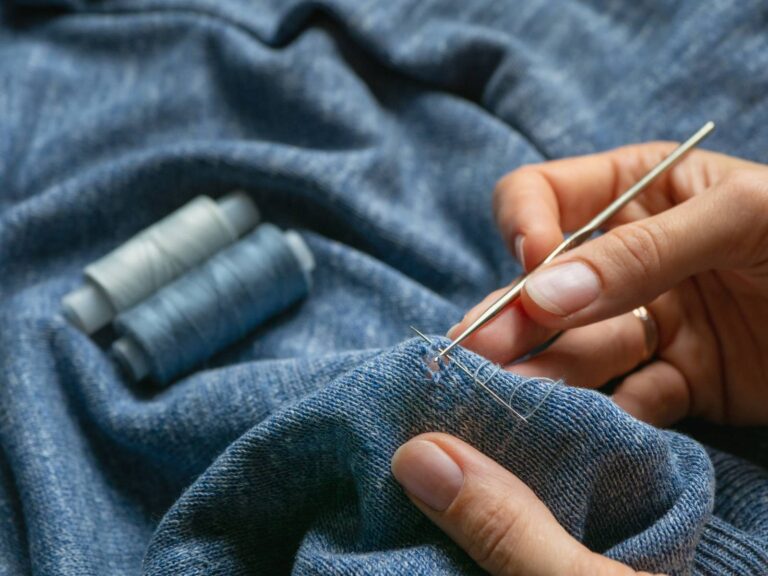
Repairing your clothing is one of the most time-honored traditions. Whether you’re beginning your journey of sustainable living, looking to stretch your budget, or just wanting to preserve that special article of clothing, learning to mend will serve you well as a versatile life skill. There are few things more satisfying than restoring a piece of clothing and knowing that your skill kept it from going into the landfill.
- Get started with sewing by becoming acquainted with the tools of the trade.
- Extend the life of your jeans and jackets by learning how to replace broken zippers.
- Patches add durability and charm to clothing in need of repairs.
- Worn-down jeans can be cut apart and sewn into a new bag.
- Quilts are an excellent way to repurpose old fabric and scraps into something comfortable and cozy.
When I was growing up, one of the most mysterious tools in my home was the sewing machine. Older than me and bought second-hand from a thrift store, the 1970s Kenmore sewing machine was heavy and difficult to move. I’d often heard stories of how my mother, a thrifty immigrant from Germany, made her own wedding dress, and I’d always wanted to learn how to work this enigmatic machine. Whenever I needed something altered or repairs (which was often), I’d watch my mother take the clothing to the sewing machine, and as if by magic, return with something that fit or was fixed. The clattering of the interior, the sewing thread wound throughout the machine, the metal pedal, the flash of the sharp needle–all of these were connected somehow.
Eventually, when I was old enough to be aware of the dangers of operating the sewing machine, I learned how to run it. My first project was a pillow case: all straight seams with a simple hem and a quick finish. From there, I moved to hemming curtains, sewing basic skirts and dresses, and making my own clothing repairs. Of these, I’ve found those simple repairs to be the most helpful in my day-to-day life. A few thoughtful moments at the sewing machine can rescue a favorite skirt or blouse.
However, you don’t necessarily need a sewing machine to keep your clothing in good order. I’ve had great success with darning the soles of favorite socks or stockings. Learning basic sewing skills is easier than you might think. Some of the simplest yet effective mending can be done with hand-sewing. All you need to get started are sewing needles, matching thread, a thimble, a measuring tape or ruler, and tailor’s chalk or a vanishing-ink pen. Discover more about these invaluable tools of the trade and what to look for.
A beginner-friendly mending project is replacing a broken or stuck separating zipper (such as one you might see on a jacket). To begin, obtain a similar zipper of the same length and type at a fabric or big-box store. Carefully remove the old zipper by unpicking the stitching that holds it to the fabric. Then, pin and install the new zipper either by hand or with a sewing machine.

Whether you’re looking to create an invisible mend or express your creativity when repairing tears and fraying fabric, patches are a time-honored way to keep your clothing in good shape. The type of patch you’ll need will depend on a few variables: whether you want a mend that blends in with the rest of the fabric, the extent of the tear in the original fabric, and whether you have any identical fabric in your stash. To add a patch, you’ll just need to know how to fold over fabric and how to sew a straight stitch.
If you’re wondering what to make with that old pair or two of jeans, consider repurposing the denim into a bag. To make it, remove the bottom hem of both legs, and then, unpick or cut away the top-stitching along the outer thigh seam. Cut the fabric into strips, keeping in mind that some areas of the jeans may be cut on the bias. For the full instructions, see “Try This: How to Make a Handbag from Recycled Jeans” by Maya Donenfeld.
For a homey project to use up any fabric scraps or leftovers, try your hand at a quilt. It’s the perfect accessory for braving the winter and an excellent way to give old fabric a new life. Even better, you don’t necessarily have to visit a fabric store to craft a beautiful quilt to pass down. Learn how to salvage old and thrifted clothing, how to repurpose stained scraps around your home and garden, and how to determine the grain of the fabric.