

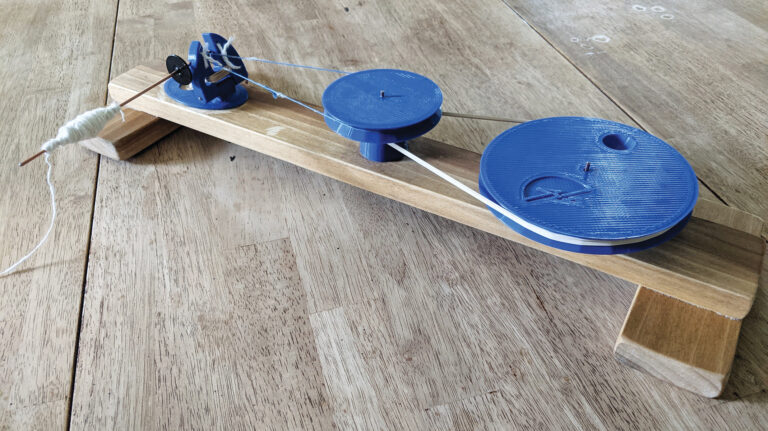
Build your own collapsible spinning wheel for spinning your own cotton thread. Print your own parts with the Thingverse plans below and learn how to make a charkha spinning wheel.
After buying my first 3D printer in 2018 and printing the usual assortment of desk toys, I decided to print my own folding-book charkha, a collapsible version of an Indian spinning wheel. I’d dabbled in spinning before, once making a drop spindle from a judge’s gavel, but the uniquely rich history of the charkha spinning wheel and its delightful ability to fold up and hide on a bookshelf piqued my interest anew.
History of the Portable Charkha Spinning Wheel
It’s no exaggeration that Gandhi was a big supporter of the charkha, even going so far as to bring his own spinning wheel to public meetings, spin while giving speeches, and even spin while jailed for civil disobedience.
For Gandhi, the charkha was the center of a web of cottage industries that radiated from this humble craft, and he believed a revival of hand-spinning would turn the tide of empires by reinvigorating local cottage industry and severing economic incentives that tied India to Great Britain. As he said, “The spinning wheel represents to me the hope of the masses. The masses lost their freedom, such as it was, with the loss of the charkha. … It was the friend and solace of the widow. It kept the villagers from idleness. For the charkha included all the anterior and posterior industries – ginning, carding, warping, sizing, dyeing, and weaving. These, in their turn, kept the village carpenter and the blacksmith busy.”
The revival of home-spinning and the Indian boycott of factory-made clothing not only helped starve out the business interests that kept Britain in India, it also revived the spiritual heart of the Indian people as they regained material and political self-reliance through locally sustained industry. Spinning allowed the common people of India to support and clothe themselves and their communities through their own labor. This deep connection between home-spinning and national independence was memorialized on early versions of the Indian national flag with the image of a spinning wheel, and to this day, the Indian flag is legally required to be made of homespun and home-woven cloth.
Independence and Cottage Industry
As I learned more about the charkha, my desire to learn to spin on one grew stronger by the hour. The charkhas I found online were more expensive than I was willing to pay at the time, ranging into the hundreds of dollars. However, I had a 3D printer, and I couldn’t help but feel there was a certain poetry in the idea of making my own charkha with this tool.

The ideas of independence and cottage industry associated with charkhas sing to me, and they’re essentially the same reasons that got me interested in 3D printing in the first place. With a desktop 3D printer, it’s possible to make things at home that used to require expensive injection molds and massive factories to produce. For our own home, I’ve made guitar mounts and organizers, board games and toys for my children, a sign for our bathroom, tools for the kitchen, jigs for the shop, a drum carder, wool combs, a cheese press, an exact replica of the skull of Phineas Gage, musical instruments, parts for my rifle, a sock-knitting machine (I’m still working on this one), and the blower for a forge. Since spending the time needed to learn a little 3D design software, I’ve been asked by several friends and family members to make custom parts for a clothes washer, a small part for my brother’s school project, and a modification for an iPad stand to make it more usable from a wheelchair.

One of the most common plastics used in 3D printing, PLA, is biodegradable and made from fermented starch. And some members of the 3D-printing community have made strides in using common plastic waste to make their own printing filament. Like the charkha, my cheap 3D printer opens a world of cottage industry and allows me to offer productive services to my local community, and this connection led me to design my own 3D-printable charkha as my first-ever design project in the spring of 2021.
How to Make a Charkha Spinning Wheel
The traditional form of the charkha consists of a wheel approximately the size of a bicycle wheel, which is turned by means of a hand crank; this wheel then drives a simple quill spindle that’s used for a long-draw spinning technique with the other hand. During the time Gandhi enthusiastically promoted hand-spinning for the Indian independence movement, a variant of this traditional wheel was developed that used a small pair of compound pulleys to replace the large wheel, making the whole spinning wheel so compact and portable that an entire spinning wheel could be made to fold up inside a cigar box. For my own version, I designed my wheel around the 3/32-inch welding rod I opted to use for the spindles, using the same rod for both the hinge pin in the spindle holder and for the axles for the pulleys.

On my Creality Ender-3 printer, I can print all the parts needed for this style of charkha spinning wheel in about six hours. Once printed, I simply add the short sections of welding rod that serve as axles to the printed bases, and glue those and the spindle-holder base to either a wooden board or the inside of a suitable folding box. (Most chess boxes fit the bill perfectly.) The large pulley and the compound pulley both slide onto their axles, and the top of the spindle holder attaches to its base with the aid of a hinge pin made from the same welding rod. The spindle holder is tensioned with a common rubber band looped through the larger holes in the top piece of the holder and wrapped around a spur in the base; this spring loads the holder and helps hold the spindle in place while spinning. I tie loops of cotton yarn through holes to make bearings for the spindle to rest against. (Doing so makes the charkha spin more smoothly and quietly.) For the spindles themselves, I attach the 3D-printed pulley and disk to the welding-rod shaft by sliding them into place and then applying heat to the shaft with a lighter or a candle until the plastic in contact with the metal melts slightly. Finally, two loops of yarn form the drive belts between the larger drive pulley and the accelerator pulley, and between the accelerator pulley and the spindle.

One of my charkhas fits on a shelf in a self-contained box I found at a thrift store in true book-charkha fashion, but I more frequently spin with a charkha assembled on a board of thin oak found at the hardware store.
To spin with the charkha, I place a finger of my right hand in the divot in the larger pulley to turn it, and I spin purchased cotton balls with a long-draw technique with my left hand, which feels completely natural on this machine.
Print Your Own Charkha Spinning Wheel and More
I think there’s tremendous untapped potential in 3D printing for traditional crafts and for creating a revival in cottage industry. After designing this simple charkha, I spent a few months designing a full-sized Irish-tension castle wheel using 3D-printed parts and construction lumber. After I shared my design for my 3D-printable charkha online, I opened a shop on Etsy and began selling them as kits. I quickly added designs for cheaper wool combs and a hackle. Within three months, I was selling a kit for a full-sized flax wheel, and as of writing this, my home business, which I call Good and Basic Manufacturing, has become my full-time income.

If you’re interested in printing either of these spinning wheels, the designs for these products are available online at Thingverse under a Creative Commons non-commercial license, and you’re welcome to print them for yourself or even for a friend, so long as you don’t intend to sell them. You can also purchase a pre-printed kit to make your own Charkha spinning wheel. There’s also a thriving community of people who share their 3D designs online, and a little searching can reveal many treasures that will be useful to those with an interest in homesteading, self-reliance, and traditional crafts.
Joseph Bjork designs, prototypes, and prints the products available through Good and Basic Manufacturing. He also helps run a YouTube channel Good and Basic, where he and his business partner explore ideas and projects like fiber arts, primitive technology, and philosophy.






