
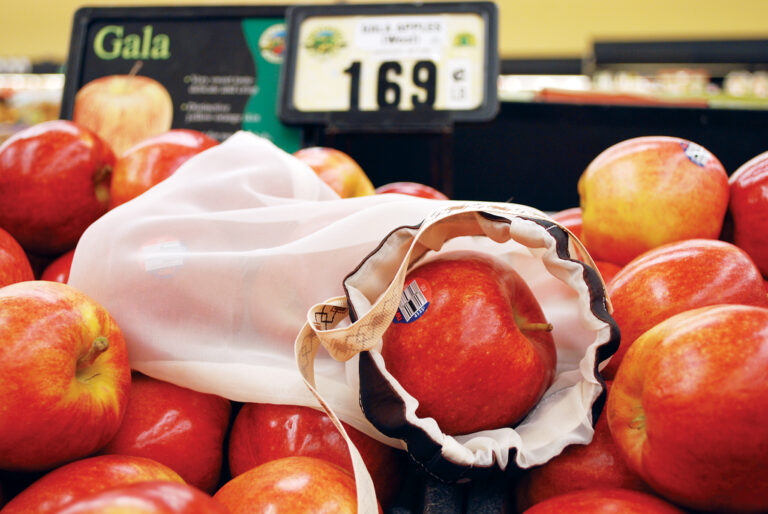
How to Make Reusable Produce Bags

Make your own grocery/produce bags to eliminate the need for plastic produce bags.

Produce bag
Making your own reusable grocery/produce bag will eliminate the need to use plastic bags.
HEIDI WARREN
Article Tools
Bookmark and Share

Over two years ago, I purchased reusable and washable canvas bags for packing all my purchases at the grocery store. This eliminated my consumption of plastic grocery bags. Unfortunately, I still had to bag fresh fruits and vegetables in the plastic bags provided in the produce section.

RELATED CONTENT

To eliminate the need to use those bags, I made cloth fruit and vegetable bags. The bags need to be transparent so the cashier can read the produce label, lightweight because produce is usually weighed, and washable and sturdy enough for multiple uses. I used sheer curtain fabric for its transparent and lightweight properties. Alternative materials could be tulle, hosiery or nylon netting.

These bags are suited for storing most fruits and vegetables, but the mesh bag is unable to retain the moisture needed to keep lettuce from wilting.

I’ve found the cloth bags to be excellent alternatives to plastic, and hopefully shoppers will reduce more of their waste stream with similar reusable packaging.


Construction instructions:

The cloth produce bag is made from sheer curtain fabric for transparent fruit and vegetable viewing and light weight properties. Alternative materials could be tulle, nylon netting, and hosiery material. A rectangular section of fabric is cut and then folded in the middle (diagram 1 and 2 — for all diagram images, please see the Image Gallery).  Start with a rectangular piece 12" wide by 24" long before folding.

The fold forms the bottom of the bag. The sides are sewn together with a French seam (diagram 3). For a French seam, sew the wrong sides of the fabric together with a 1/4" seam allowance. Turn the bag inside out, with the right sides together, and sew another seam, this time with a 1/2" seam allowance. This traps the raw edges of the sheer fabric and completes the seam nicely. The top of the bag is finished off with a traditional hem (diagram 5). To close the bag, a light weight ribbon is attached with reinforcement to the bag (diagram 6).

Comments

  • Tiffany 7/11/2009 9:20:10 PM

    I love this idea! I'm always looking for something to do with my extra fabric and to be a little more environmentally friendly! This is a great way to reuse that fabric now! Thanks so much!

  • BeckyD 6/19/2009 12:45:59 PM

    I have sewed up lunch bags for my teenage son using scraps from other sewing projects. They have become very popular and I have sewen many for his friends too.

    I used some lightweight muslin to use when I purchase vegs and fruit at the grocery store and at the local farmers market.

  • elizahleigh 6/17/2009 7:09:43 PM

    I love that we've all finally figured out that with a little ingenuity, we can make pretty much anything that we need without having to buy it in a store! The majority of the time, our sweat equity results in a far nicer final product that is better quality and longer lasting. Plus, with this home made produce bag tutorial, you really don't have to have wickedly fantastic sewing skills to pull it off.

    On a similar vein, if you like the idea of making your own reusable sandwich wrappers and snack bags (so that you never have to buy another plastic version again), I saw a helpful article all about it on www.greenwala -- the online green social network. Here's the link if anyone wants to take a look: http://www.greenwala.com/community/blogs/all/1094-Sandwiches-and-Snacks-Time-To-Bag-The-Ziplocks-Forever-More?f=true

  • cher gomez 6/16/2009 5:33:46 PM

    The diagram for making the bags is WAY TOO SMALL. I can not even enlarge them on my computer big enough for me to read.

  • Michele 6/7/2009 4:28:33 AM

    This is an excellent idea, which has been going around the web for some time, but I have to disagree with your material suggestions. Nylon is NOT good for the environment, and such bags can easily be made from natural materials and/or old fabric found at home/in a secondhand shop. Produce like lettuce can simply be placed in an airtight container when you return home, and I'm sure the shop assistants won't mind taking a peep inside the bag to see what it contains.

    I made my own produce bags using an old burlap bag, but any lightweight material you find in your home could also be used. For photos and instructions: http://www.ahousecallednut.com/a_house_called_nut/2009/05/reusable-vegetable-bags.html)

Add Your Comment

Please note that there is currently a problem with the comments function and your comment may or may not post successfully. We are working to correct the problem and thank you for your patience. 

You can use this comment form to enter your personal experiences or additional information and resources that you'd like to share with Mother Earth News readers. Your helpful advice will be posted on this page.  E-mail addresses are never displayed on comments, but they are required to confirm your comments.

Line breaks and paragraphs are automatically converted — no need to use <p> or <br> tags.

New to Mother Earth News?
Sign up to share comments.
Asterisks(*) indicate required fields.
Name*
Your name appears next to your comment.

E-mail Address*
This will be your login ID.

City State Zip Code

Password*


Confirm Password*

Comments
1500 character limit (Offensive materials and/or spam will be removed, no HTML allowed)
Please Note: Your sign-up must be verified via e-mail before your comment is published.


Subscribe Today - Pay Now & Save 66% Off the Cover Price

First Name: *
Last Name: *
Address: *
City: *
State/Province: *
Zip/Postal Code:*
Country:
Email:*
(* indicates a required item)
Canadian subs: 1 year, (includes postage & GST). Foreign subs: 1 year, . U.S. funds.
Canadian Subscribers - Click Here
Non US and Canadian Subscribers - Click Here

Lighten the Strain on the Earth and Your Budget

Mother Earth News is the guide to living — as one reader stated — “with little money and abundant happiness.” Every issue is an invaluable guide to leading a more sustainable life, covering ideas from fighting rising energy costs and protecting the environment to avoiding unnecessary spending on processed food. You’ll find tips for slashing heating bills; growing fresh, natural produce at home; and more. Mother Earth News helps you cut costs without sacrificing modern luxuries.

At Mother Earth News, we are dedicated to conserving our planet’s natural resources while helping you conserve your financial resources. That’s why we want you to save money and trees by subscribing through our Earth-Friendly automatic renewal savings plan. By paying with a credit card, you save an additional $4.95 and get 6 issues of Mother Earth News for only $10.00 (USA only).

You may also use the Bill Me option and pay $14.95 for 6 issues.


