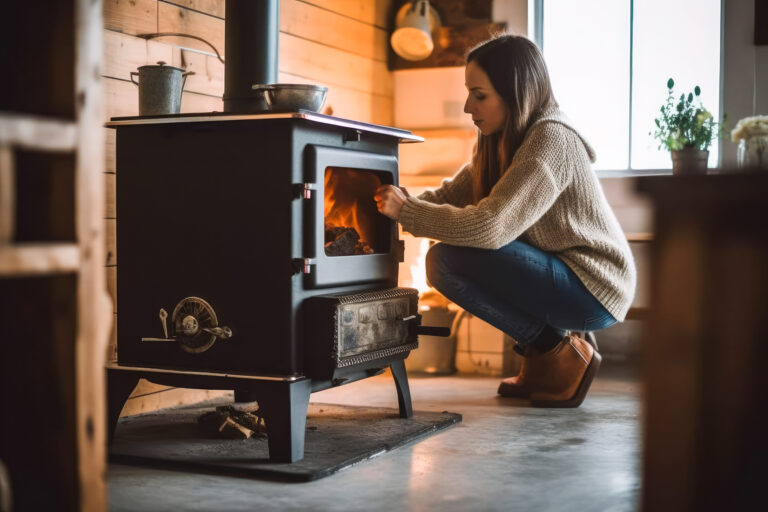
When choosing to heat with wood versus oil or another fuel source, you have wood-burning stove advantages and disadvantages to consider.
The significance of wood heat as an energy resource can be seen during a drive through small towns or down country lanes: The long lines of piled firewood in the yards prove that heating with wood remains a viable option.
Every winter, people who choose to heat with wood devote time to cutting up logs, and every spring they split the logs and stack them in rows to dry under the summer sun. In fall they move firewood to the house and stack it again, and in winter they burn it to warm their homes as they begin cutting again for the next year’s supply.
Why do so many households in forested areas choose to heat with wood — a bulky, messy and labor-intensive fuel source? Firewood is a homegrown energy resource that helps families stretch their household budgets, strengthen their local economies and continue a generations-long tradition.

Wood Heat: Understand the Pros and Cons
During tough economic times, more people turn to heating with wood. The U.S. Energy Information Administration data released in October 2012 projects that more than 2.6 million households will heat their homes with wood this year, which is a 3% increase over last year.
Yet the topic of fuelwood is all but missing from energy policy debates — few politicians discuss its merits or plan for its strategic use. (Industrial wood energy, however, is getting some attention. A recent report from Duke University points out that advanced wood-combustion technologies can be used to cleanly burn wood to generate electricity. The report shows that this renewable power source could be quickly developed to provide more power in the United States than we currently get from hydroelectric sources. To learn more about this report, read Cleaner Energy From Firewood.)
Wood heating mostly attracts attention when people discuss pollution. Wood smoke has caused real problems in small towns and large cities throughout North America, and an increasing number of activists clamor to have wood burning banned from their communities because of its associated air pollution. Some environmentalists warn that an increase in firewood use would damage forests. As a result, wood burning has become more often identified as a problem to be solved rather than an opportunity to be harvested. Fuelwood can be a renewable energy resource that most governments — and even some renewable energy advocates — don’t seem comfortable with.
It is not my intention to trivialize the environmental impacts of wood heating or to deflect concerns by emphasizing the pollution from other energy sources. Wood-burning technology has greatly improved over the past 25 years, however, and I believe wood heating should remain a part of our energy discussions. For example, upgrading to an advanced woodstove can reduce a household’s smoke output from wood by as much as 90%!

Woodstove Efficiency
Emissions from older, conventional woodstoves average at least 25 grams of smoke particulates (almost an ounce) per hour of operation, and the emissions from older, wood-fired outdoor boilers range from 50 to more than 100 grams per hour. By contrast, the Environmental Protection Agency (EPA) limits emissions of certified woodstoves to no more than 7.5 grams per hour. Since the regulation was established in 1988, the average emissions of certified stoves have declined steadily because of advances in technology and competition among manufacturers. Today, most new woodstove models emit only 2 to 4 grams per hour.
Just as noticeable as new stoves’ reduction in visible smoke is the increased efficiency that results from newer models burning — not wasting — the energy-rich smoke. Efficiency is expressed as the percent of potential energy in the fuel that’s delivered as useful heat to the house. Older woodstoves range in efficiency from about 35% for a cast-iron box stove or furnace to 55% for some 1980s-era airtight stoves. Most old outdoor boilers are less than 50% efficient. By contrast, EPA-certified woodstoves average about 70% efficiency, and none is less than 60% efficient. The newer generations of EPA-certified outdoor boilers are also much more efficient. (For more details on the advantages of EPA-certified stoves, see our Woodstove Buyer’s Guide.)
Wood as a Renewable Energy Resource
These days, there is plenty of debate over what to do about climate-changing carbon dioxide emissions from fossil fuels. But firewood literally grows on trees, and the ability of a woodlot to regenerate is the secret to its status as a renewable energy resource. Wood is about half carbon by weight, but its use as a fuel is almost carbon dioxide-neutral, because trees absorb CO2 as they grow. When trees fall in the forest, the same amount of CO2 is emitted when they decompose as is released when they are burned for heat.
Despite fuelwood’s considerable advantages, not all households can solve the problems of rising home heating costs and global warming by heating with wood. Firewood is not a great home-heating fuel in densely populated urban areas, because its emissions tend to be higher than other options, and the air in urban areas is already burdened with pollution from factories and vehicles.
But large parts of North America are relatively thinly populated and have highly productive forests — these are the regions where wood heating makes sense. Forests need to be managed sustainably, but the methods to do so are now well-known: selective harvesting, thinning of dense stands, removal of poorer-quality trees, leaving seed trees of all present species and ages, and allowing some standing dead trees to provide wildlife habitat.

Wood-Burning Stove Advantages and Disadvantages
Economists focus on the monetary cost of energy, but the net energy cost can provide better insight into environmental costs and the underlying reasons for the monetary cost.
“Net energy” is the usable amount of energy left after extracting, processing and transporting an energy commodity to market. Natural firewood has a very high net energy ratio compared with almost all other options because it needs little processing, much of which can be done with human labor. This bodes well for fuelwood’s price stability in the future. Price stability is not likely for fossil fuels, because the net energy goes way down and the retail price goes way up as easily accessible deposits are depleted. Declining net energy is the biggest reason oil prices are now so high. (Read How Much Energy Does It Take to Get Our Energy? for more information on net energy costs.)
Advantages
Considering the rising cost of conventional fuels, households located outside major urban centers that have access to forests can save some money by heating with wood. A household that heats with wood trades its own labor for big savings in home operating expenses. Depending on climate zone and other available fuel options, a household that produces its own fuelwood supply can save $2,000 or more each year. Plus, consider the intangible, non-monetary benefits:
- The beauty and ambience created by a fire burning behind clear glass doors
- The special warmth given off by a woodstove located in a main living area
- The satisfaction one feels in mastering self-sufficient home heating, largely through personal labor and ingenuity
- The sense of security, both in terms of energy price stability and in the ability to remain fed and comfortable during electrical power interruptions
Disadvantages (Or Considerations, At Least)
But those savings and benefits do come with some costs:
- The investment in a new woodstove and, if necessary, a new chimney
- The space needed to store a winter’s supply of firewood outside the house, and space indoors for a few days’ supply
- The physical strength and stamina required to split, move and stack firewood, or the effort of finding and purchasing wood from other sources
- The time spent gathering the fuel supply, tending the fire and dealing with regular maintenance, such as cleanup of wood chips, bark and wood ash

Buy Local Fuel
A woodlot owner who produces and sells firewood provides employment and income to the area. If the producer uses sustainable forestry methods, the quality and value of the woodlot increases as it is worked. If a household buys its winter fuel supply from a neighbor, the transaction has a multiplying effect by keeping the money circulating within the community, increasing local incomes and creating jobs.
Most people recognize that wood is humanity’s original heating fuel. Rarely acknowledged, however, is that its dominance was displaced relatively recently. Wood was the only practical heating fuel option in much of rural North America until the mid-20th century, when coal became more widely available.
Heating with wood today is dramatically better than it was in the past. The efficiency of the average woodstove has roughly doubled to about 70%, and these advanced stoves don’t produce dense plumes of blue-grey smoke. Chimney technology and safety have also improved — there are now clear (if complicated) safety rules and trained professionals to help homeowners comply with regulations.
In a world of touch-screen convenience, pocket-sized computers and climate-controlled environments, wood heating is, in every way, rough, basic and steadfastly hands-on. Responsible producers and consumers of fuelwood are engaged in an activity that reduces greenhouse gas emissions and uses a renewable energy resource, thereby taking pressure off of dwindling supplies of ever-pricier fossil fuels. Wood heating is also a gentle way to produce energy compared with mountaintop-removal coal mining or nuclear reactors.
You can see that wood-burning stove advantages and disadvantages are about much more than home heating. Fuelwood is the ultimate populist energy resource — and the most easily accessed and affordable of all renewable energies. People who purchase firewood create jobs close to home and strengthen their local community. Sometimes, the woodlot owner’s household earns part of its income by supplying fuel to neighbors. Those who heat with wood know more about the cause-and-effect relationships of energy production and consumption than those who simply pay utility bills. And families that use fuelwood responsibly will find that the act of heating with wood is its own reward.

John Gulland is a wood heat consultant and educator who has been working with woodstoves since 1974. Visit Wood Heat, John’s online organization, to learn more.