

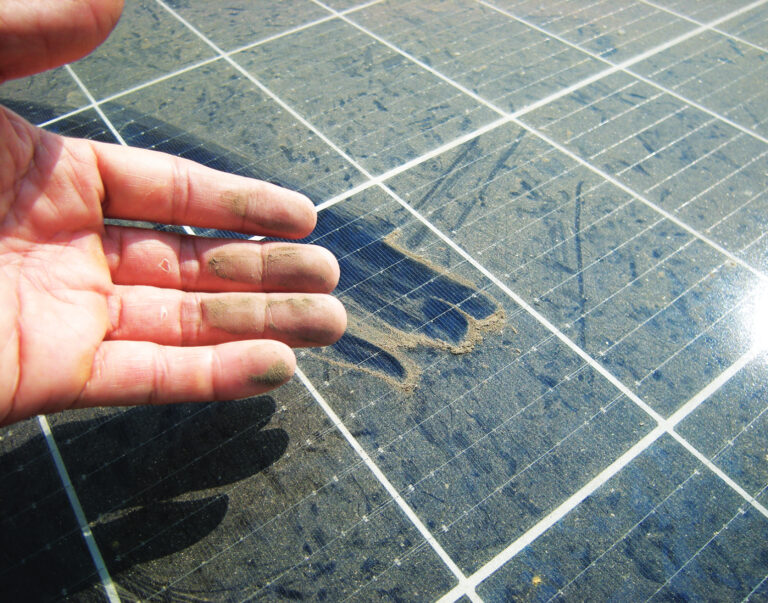
Follow the maintenance required for solar panels to keep them working in tip-top shape for 30 or even 40 years of life.
Welcome to our series answering reader questions and concerns about how to cut the utility-company cord.
I often see solar panels rated to last 25 years, yet some homeowners claim they’ll get 30 or even 40 years of life from their panels. What can I do to extend the life of my solar panels to get their maximum number of years?
Archie, Minnesota
You point out a widespread misconception that solar panels last no longer than 25 years, when you can, in fact, find panels efficiently operating beyond 35 years of service. Because most solar photovoltaic (PV) manufacturers provide warranties for 25 years – assuring the panels will maintain a relatively reliable power output during that time, typically 80 percent or greater – the notion has proliferated that 25 years is how long panels can last. Warranties are good indicators, of course: A PV panel rated at 400 watts should still produce 320 watts or better after 25 years of service. But afterward, the panel will continue to operate, just at a declining efficiency.
Before we go further, let’s address a major fault with solar warranties. When I first got into the solar business, I could count on one hand the number of companies making PV panels in the U.S. When the industry took off in the 2000s, I noticed new brands popping up constantly, all offering warranties. You have to ask yourself how a startup PV company can stand by a 20-year guarantee when none of its panels have been around that long. It turns out, many of those companies, like most startups, barely made it through their first five years; their warranties weren’t worth the paper they were printed on! Despite this turn of events, the panels these American manufacturers made were, by and large, of high quality – and many of those panels are still working today.
How can you know whether your panels were built to last? Solar panels are like any other equipment: You can buy cheaply made ones that expire long before their warranty is up or ones that will last years past their warranty period. If you’re trying to achieve a PV lifespan of three decades or more, the secret is to buy a good solar panel to begin with and take good care of it throughout its life. I’ll tell you how to do both.
To get a good panel, start with how it’s made. The most common type of PV is called “monocrystalline” and is made of a layer of silicon-based solar cells sandwiched between tempered glass and a protective backing. The perimeter of the assembly is sealed up (a weatherproofing process called “lamination”), and these sealed units get mounted inside aluminum or poly frames. The assembly is fairly standard from one manufacturer to the next, so quality comes down to details. Some sealants are made to last 50 years; others, 15. Tempered glass comes in various levels of clarity and thickness (and, therefore, ability to withstand the elements). These days, robots complete much of the assembly, and some companies are lax with their quality control. If you suspect you have low-quality panels, continue paying for insurance in case of failure, and you can consider replacing any damaged panels with superior ones as you go.
Second, have your panels regularly inspected and maintained, which includes cleaning them, by qualified technicians. I do this quarterly. Technicians should look for indications of overheated components, such as scorch marks and melted wires. They’ll test all fuses and place a label inside each fuse enclosure with the date they performed the test. They should test string voltages using a DC tester at each fuse holder, DC disconnect, and inverter (or battery). Also, they’ll test all voltages and amperages that lead from inverter AC terminals to the main service disconnect. Finally, they’ll look for damaged or loose components, cracks in the glass, and signs of moisture.
Maintenance starts with clearing away any vegetation, such as vines and tall grass, that has grown up around electrical equipment. Remove other obstructions that shade the array. Make cosmetic repairs, such as minor paint touch-ups. Clean the surface of each solar panel and inverter with a noncorrosive cleaner. Remove inverter vent covers, and blow out dirt and debris. If you or a technician finds any evidence of animal activity, look for chewed cables. Finally, the tech should tighten mounting clamps and bolts per the manufacturer’s torque specifications.
As a bonus, I’ve made my PV inspection and maintenance checklist available. Perform the steps often enough, and you’ll catch issues early, so you can use your warranty while the panels’ manufacturer is still around to honor it!
Send Us Your Power-Full Questions
We’ll do our best to answer your questions on energy in upcoming issues. Email them to Letters@MotherEarthNews.com with “Energy Q&A” in the subject line. May all your days be filled with sunshine – even when it rains!

Hoss Boyd is founder, president, and CEO of TeraVolt Energy and a recognized solar and energy-storage expert. Learn more about TeraVolt Energy at http://TVNRG.com.
Originally published in the October/November 2026 issue of MOTHER EARTH NEWS and regularly vetted for accuracy.





