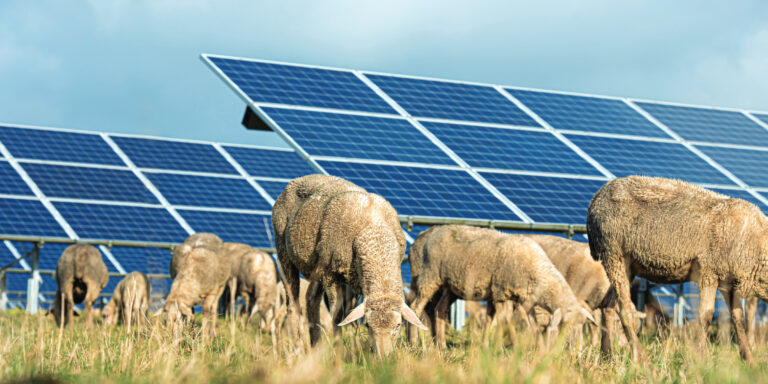
Sheep grazing solar farms offer economic diversity without a trade-off between food and electricity.
Even before the COVID-19 pandemic, Jonathan and Jen Northrop’s dairy farm in upstate New York was struggling. To keep up with the trend toward consolidation across the state’s dairy industry, they’d grown their 50-head herd to 230 cows and still barely managed to compete with the large corporate operations. When the pandemic dried up the milk market seemingly overnight in 2020, forcing the Northrops to dump $45,000 worth of milk in one month, they knew their farming model needed to change or they’d risk losing it all. They already raised some sheep, and, noticing large solar arrays popping up across the region, they hatched a plan: sell off most of the cows, scale up their sheep herd, and put them to work grazing solar fields. That would allow their own land to be redirected to growing hay to sell to the larger dairy farms.
The plan worked. By 2025, the Northrops had contracts to graze seven solar sites with their 450 sheep. Today, “solar grazing,” as the practice is called, supplies one-third of Northrop Farms’ income, and diversification has given Jonathan and Jen a sense of security for the future. After all, solar land leases often span 25 to 40 years, which has allowed the Northrops to secure long terms for their agreements with developers and, in turn, leverage those contracts when they need bank loans to improve other parts of their farm business.
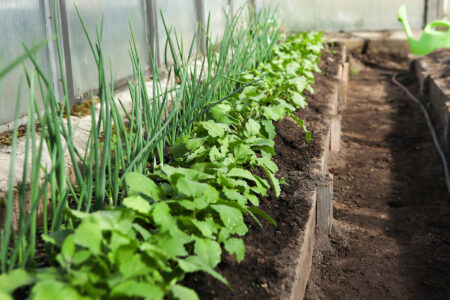
Solar grazing is a specific subset of a broader group of activities known as “agrivoltaics,” which combines solar-photovoltaic power generation with agriculture. If you’re familiar with agrivoltaics but have pictured tidy rows of cabbages or vining squashes sheltered beneath ground-mounted solar arrays, you’re not altogether wrong – but you might adjust your vision to look more like the Northrops’ operation. While crop-based systems do exist, only a fraction of the existing agrivoltaic acres incorporate fruits and vegetables; 99 percent involve grazing animals.

Yet, both types of agrivoltaic systems, livestock- and crop-based, are growing steadily around the U.S. – doubling over the past six years – offering farmers a chance to diversify their revenue. If you’ve considered how to diversify your own farm’s revenue, now may be the time to tap into an agrivoltaic market projected to double again, reaching $789 million over the next six years.
Sheep Grazing Solar Farms
Kevin Richardson told me the Northrops’ story. Richardson, who’s the senior director at the American Solar Grazing Association (ASGA), the farmer-led, nonprofit authority on the subject, was pleased that Jen and Jonathan were able to save their land from being gobbled up by a corporate dairy. He also liked that the couple added a new revenue stream by selling lamb to a growing market for Middle Eastern and Latin American cuisine. “Katahdin sheep are especially popular with eaters,” he said, noting that the U.S. currently imports 70 percent of the approximately 300 million pounds of lamb consumed in the country each year.
ASGA has tracked massive solar grazing growth over the past two years. Proof points: The association now has 1,400 members and estimates that 130,000 acres of solar fields are grazed on more than 500 sites. Texas is the leader in solar grazing, hosting half the sheep munching solar acres in the U.S. But solar grazing has also surged in Virginia, Georgia, Arkansas, California, Louisiana, and the Midwest, to the extent that about a tenth of all ground-mounted solar projects are “mowed” with sheep.
Part of the demand for grazed systems came with updated practices for how large-scale solar systems get built. Rarely do solar developers grade a site and lay gravel, which is expensive and creates conditions for overheating. Vegetation underneath keeps the panels cooler and, therefore, operating more efficiently. But vegetation needs to be mowed. It didn’t take long for solar operators to realize that large herbivores can maneuver through the intricate understory of a solar installation better than mechanical mowers can – and at less cost. Tampa Electric in Florida, for example, saved 75 percent on mowing costs when it switched to grazing its solar fields.
“You rarely see two very different industries work so well together,” Richardson says, explaining how sheep are the perfect size to browse beneath the standard height of utility-scale solar arrays and that their efforts have been shown to reduce the risk of fires. But as we talked, it became clear that while Richardson recognizes the clear economic benefit to solar developers, he’s a farmer’s advocate foremost. Thankfully, the business sense works both ways. “It’s an incredible opportunity for sheep farmers, because you now have a steady income,” he says, describing the vegetation-management fee that developers will pay to ranchers – between $250 and $750 per acre for a growing season – which makes it possible for the ranchers to “lease their land, put their sheep on a solar company’s fields, and then sell the meat or wool.”
Austin Kinzer, agrivoltaics senior technical specialist with the nonprofit American Farmland Trust, agrees. “Historically, ranchers would’ve needed to pay to lease land,” he says. “Now, they get paid to bring their sheep there. It has really flipped the economics for grazers.”

Still, Kinzer hears opposition from communities, not least because of a perceived takeover by Big Energy and its disregard for the land. “You used to hear of projects where topsoil wasn’t properly stabilized and a heavy rain caused it to run off,” Kinzer says, adding that things have improved. But even if the industry has evolved over the past decade to better avoid ruined viewscapes and degraded soils, those early missteps aren’t easily forgotten. Today, data centers are the new specters haunting ag lands – and power-hungry, rather than power-producing, ones at that. A movement is underway, led by communities hoping to require data centers to “bring your own clean energy” (affectionately, “BYONCE”), but these ordinances can feel to some like fighting development with more development.
The American Farmland Trust launched its Smart Solar program in an attempt to mediate any Wild West tendency coming out of the agrivoltaics boom. Smart Solar promotes four principles that can safeguard productive cropland while supporting energy build-out:
- Prioritize rooftop solar on barns or other buildings first before exploring ground-mounted solar (and then site arrays only on the least-productive land).
- Protect soil health to ensure land can remain productive into the future.
- Plan agrivoltaic projects so that food or fiber production thrives side by side with electricity generation.
- Give farmers decision-making authority on their community’s energy future.
“There remains a lot of division in the ag community around solar,” says Kinzer. “We’re hoping to change perceptions.”
The Deal With Yields
Crop-based systems occupy a tiny proportion of all agrivoltaic acres, which makes sense when you consider the mechanics of row cropping: Common ag equipment may not be able to squeeze between the relatively narrow rows of solar arrays, so some cropped systems must be harvested by hand. Hay is the exception, given that hay-baling equipment has long been built in a wide range of sizes, including those small enough to traverse narrow rows, making hay a common agrivoltaic crop.
However, not all agrivoltaics systems need to be enormous to be desirable. Solar-cropping systems tend to be between 2 and 7 acres, or about the area needed to produce up to 1 megawatt of electricity generation. This size can be a perfect fit for small farms needing to power refrigeration, irrigation systems, and barn lighting, and where people-powered planting also makes sense.
In terms of yields, a February 2026 study published by Noriko Maruyama and colleagues in npj Sustainable Agriculture found no reduction in leafy greens grown in agrivoltaic systems. Kale, lettuce, cabbage, broccoli, and Swiss chard can even benefit from the shading provided by panels. Shading also reduces water loss through evaporation, which especially benefits fruit trees during drought years. Kinzer cited Talbott Farms, a Colorado orchard known for its peach trees and other fruits. Noticing his trees flowering earlier but still getting hit by late-spring frosts, owner Charlie Talbott installed solar panels to guard against frost. The panels moderate temperatures, which ends up keeping the peach buds safe from freezing in late spring, but then keeps the trees cool in summer. Cereals, corn, soybeans, and potatoes appear to experience reduced yields, but the scientific consensus is that more research is needed to know for certain. For instance, perennials may do better, and D.C.-based solar developer Sol Systems has launched a pilot in Illinois to plant agrivoltaic Kernza, the perennial wheat.
One of the more promising forays into solar-crop systems involves growing wine grapes in hot, arid regions. As state viticulturist, Horst Caspari is charged with the not-so-small task of supporting the success of Colorado’s 800 acres of grapes and, by extension, its 150 or so wineries. It took him a few years to raise the funds needed to trial an agrivoltaic system on the school’s 0.7 acre of Chardonnay grapes, but by 2025, Caspari had covered about one-third of the vineyard in solar panels.
“These were old vines!” Caspari says of the grapes, which had been planted in 1991. Not only did he prove that established vineyards could be accommodated to agrivoltaics, but that grapes in this part of the world benefit from solar shading. “Living in an area where water comes at a premium, agrivoltaics can significantly reduce the amount of water used by crops. [The panels] also protect the grapes from hail and heavy rain.”
As a scientist, Horst wanted to try variations, testing two types of panels: semi-transparent panels (53 percent transparency) that produce 260 watts of power and black rooftop panels (0 percent transparency) that produce 530 watts. He installed trackers so each row of panels could follow the sun’s movement. This turned out to be a significant innovation. Most crop-yield studies haven’t tested using solar trackers, so they may unnecessarily report lower yields. “In dynamic tracking systems, the panels adjust throughout the day, letting morning light come in when photosynthesis is highest, and then by 12 p.m., [the panels] go back to standard, providing shade to the grapes – which actually benefits the plants,” Horst explains. “And keep in mind the grapes only grow six months of the year, so I only track during the middle of the season.” Ultimately, Horst hopes to show what combination of opaque and transparent panels optimizes for yield.

Saying ‘Yes In My Back 40’
If you’re wondering whether agrivoltaics – particularly solar grazing – may be a good way to diversify your farm’s revenue, orient your questions around the decisions that will affect long-term financial viability. Consider whether you’ll add solar to land you own (in which case, state incentives matter) or instead rent out your herd to a solar developer (in which case, contract savvy matters). Choose the type of livestock you’ll graze (including breeds), and consult the experts on the technical aspects of site assessment, system design, and construction. It’s possible to retrofit an existing, standing array for agrivoltaics, particularly for grazing, but it’s easier to plan these systems from the beginning so you can appropriately space the panels and mount them at a height suitable for the animals you’ll graze or crops you’ll grow.
Incentives for agrivoltaics vary by state, and the National Caucus of Environmental Legislators is a good resource for tracking them. Massachusetts offers a feed-in tariff, offering agrivoltaic projects 9 cents per kilowatt-hour on top of base compensation, while Maryland exempts agrivoltaic acreage supplying community solar from paying property taxes. Federally, agrivoltaic projects can leverage the U.S. Department of Agriculture’s Powering Affordable Clean Energy (PACE) program, which forgives up to 40 percent of loans for eligible alternative energy and storage projects.
For farmers who lease their panels from solar developers (a common path), business arrangements vary widely. “It requires a mind shift,” ASGA’s Richardson says of farmers who haven’t negotiated these types of contracts in the past. “The time you have the most leverage is when signing the lease.” ASGA’s resources help farmers and ranchers navigate contracting to achieve the best outcome for their situation.
When choosing sheep breeds, Richardson says everyone has their “hot take” for whether hair sheep or wool sheep are better; both can work well. For now, Katahdin sheep (a hair sheep that sheds its wool, so it doesn’t need shearing) tend to be preferred by many solar grazers. The hair breed White Dorper is particularly common in Texas, while wool breeds, including the Rambouillet, are more popular in the Midwest. Richardson stresses that solar grazing allows flexibility and the chance to play around. “You have the cool opportunity to experiment bringing back heritage or rare breeds,” he says.
If you raise cattle, the main issue to plan for is their large size. Solar panels need to be raised higher off the ground – 8 feet or more – and their structures built stronger to guard against cows bending the piles or knocking them over when they rub on them. Because these adjustments require a lot more steel, expect added costs to run into the tens of thousands to accommodate cattle over sheep – which can make a project unviable. “These solar companies need to sell electricity at a certain rate, and if livestock make it too expensive, it won’t get built,” says Richardson.
Whether energy projects are built on or near ag lands, one thing seems clear: Many more projects will get built. Electricity consumption in the U.S. is projected to grow upward of 55 percent over the next two decades, driven by the AI boom, manufacturing, and the electrification of nearly everything. And despite an uptick in fossil gas and coal projects over the past year, solar remains the fastest-growing energy source in the world. AFT’s Austin Kinzer sees agrivoltaics as a key to unlocking win-wins, offering the chance for large solar generation to integrate with existing farm operations in ways that uplift agricultural communities. “When it allows farmers to keep land in the family and keep their operations afloat,” he says, “solar can be about farm viability.”
U.S. Agrivoltaic Projects
By Number, Generating Capacity, Acres, Main Type of Agriculture. Source: U.S. DOE, 2025.

Resources
American Farmland Trust’s Solar Soil Health Guide: www.FarmlandInfo.org/publications/solar-soil-health-guide
American Solar Grazing Association’s (ASGA) film series: www.SolarGrazing.org/film-series
ASGA’s “Solar Grazing Checklist”: www.SolarGrazing.org/solar-grazing-checklist
U.S. Department of Energy’s InSPIRE project: https://OpenEI.org/wiki/inspire
Kale Roberts is a senior editor at Mother Earth News and helps city governments build long-term sustainability. He gardens and raises chickens in New York’s Hudson Valley.
Originally published in the October/November 2026 issue of MOTHER EARTH NEWS and regularly vetted for accuracy.