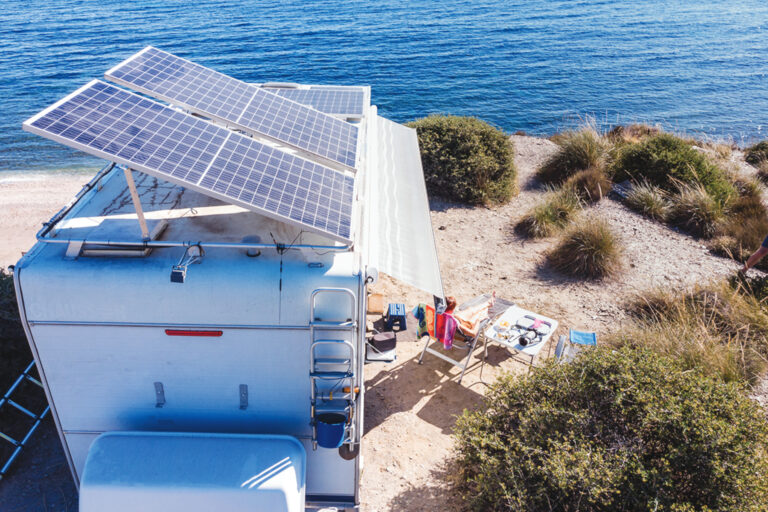
Looking for power on the go? Learn how to install a solar panel for RV battery charging, plan and install your system, or find the right professionals.
Welcome to our series answering reader questions and concerns about how to cut the utility-company cord.
What are my options for going off-grid in an RV? After I sell my solar-powered house, can I make use of any the systems’ components on the road?
Kenneth, Missouri
Setting up an off-grid RV is a fun adventure; however, I’d start fresh with components already made for recreational vehicles. Here’s why.
First, you’ll want to preserve your home’s highest value. I’ll assume you have a roof-mounted solar array and a conventional grid-tied inverter. If you were to take some of the existing solar panels off your roof, you’d reduce the value of your home. Your PV system lowers your monthly electricity costs, and that savings often translates to a higher selling price. Also, I’ve never seen a solar dismantle effort look great without some additional work. Taking panels off can leave holes in the roof that, after repair, won’t match the rest of the roof. And the roofing that was underneath the panels is usually darker than the sun-exposed portion. I say leave the system alone.
Second, your solar panels aren’t optimized for an RV or off-grid use. All inverters have a minimum starting voltage and a maximum operating voltage. You get the correct voltage for your inverter by stringing solar panels in a series: plus-to-minus-to-plus-to-minus. The series adds to the voltage. You won’t have space on an RV rooftop to string enough panels together to drive a conventional inverter, nor will the grid-tied inverter work when you go off the grid with batteries.
If I’ve convinced you to start fresh with your RV solar build, here’s how to go off-grid on the road.
Solar Panel for RV Battery Charging
When doing the work yourself – or even if you’ll hire a professional – be careful drilling holes into your vehicle’s roof. I once owned a Winnebago Minnie Winnie that I asked an RV shop to mount a cargo pod onto. After I got several hundred miles away from the installer, the water pump quit working. Turns out, they’d drilled through the pump’s wiring. Shortly after, the roof started leaking. The lesson: Before you mount solar panels on an RV, locate all electrical lines, because mounting PV panels also involves brackets that bolt onto the roof. Newer RVs have a waterproof membrane over decking. When an installer drills holes, they may or may not drill through the structural members underneath the membrane. Placing the brackets over structural members may be a stronger way to mount the panels – or it can damage your RV. Consult your RV’s manufacturer to get their recommendations before you drill, not least because if you do it yourself, you may void the warranty on your roof.
The purpose of solar on recreational vehicles is to keep batteries charged. Accomplishing this can be as simple as wiring in an inexpensive charge controller that connects the batteries to the solar panels. You’ll also need to bring the solar cables from the top of the RV through the roof to your electrical equipment inside. You can buy a weatherproof box made for this purpose, but make sure you have a weathertight seal between the electrical box and the roof.
Take your setup to the next level by installing an inverter-charger, which will not only allow you to charge batteries but also to interconnect with a generator or your RV’s electrical system in order to power any AC-voltage circuits. Quite a few manufacturers make complete solar kits for RVs. One I like is Renogy, which offers every component you’d need, including solar panels and lithium-ion batteries, as well as information on how to plan and install your system. A real challenge you’ll have is hiding all those wires while locating the equipment where it’s easy to get to. Cabinets are a good place to hide wiring, but be sure to securely fasten the wires in a flexible outer covering or conduit to protect them. You can run wiring under the RV between the coach and the frame if you use even heavier-duty protection.
If you’re uneasy about doing this project yourself, leave it to the professionals – but educate yourself enough to ensure they know what they’re doing. An RV system doesn’t need to be expensive. Happy trails to you.
Send Us Your Power-Full Questions
We’ll do our best to answer your questions on energy in upcoming issues. Email them to Letters@MotherEarthNews.com with “Energy Q&A” in the subject line. May all your days be filled with sunshine – even when it rains!
Hoss Boyd is founder, president, and CEO of TeraVolt Energy and a recognized solar and energy-storage expert. Learn more about TeraVolt Energy at http://TVNRG.com.
Originally published in the August/September 2026 issue of MOTHER EARTH NEWS and regularly vetted for accuracy.