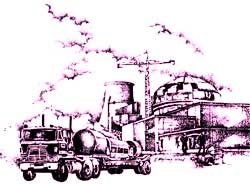
For the last 30 years, the disposal of radioactive waste has been “a political but not a technological problem”–or so say engineers and scientists involved in the nuclear industry. But despite their confidence (and large injections of federal funds), no “radwaste” has actually been disposed of yet, and the most optimistic estimates being made today are that these materials will have to remain in temporary facilities for a minimum of another 20 years. As of 1982, this “political hang-up” involved 3 million cubic yards of low-level radioactive waste, 175 million tons of uranium mill tailings, 77.6 million gallons of high-level liquid wastes, 430,000 cubic yards of transuranic (heavier than uranium) waste, and 7,400 tons of spent nuclear reactor fuel rods. And each year approximately 2,200 tons of used-up fuel rods alone are being added to the tally.
Where are these materials today, and what methods are being proposed to deal with the rapidly accumulating piles? These questions could be vital to our well-being and the economic health of the nuclear industry. As you might suspect, the answers aren’t simple, but at least the nuclear industry and the government are finally beginning to address the issues.
Nuclear Numbers
There are many different types and origins of radwaste, but these materials can be divided into two general categories, high-level and low-level, according to their degrees of radioactivity. Low-level wastes are those that contain less than ten nanocuries of transuranic elements per gram (28.4 grams = 1 ounce).
And just what does that gibberish mean? Well, a nanocurie is one billionth of a curie, so we’re talking about ten billionths of a curie per gram of material. (It looks like this: .0000000010.) That doesn’t seem like much until you realize that a curie is a unit of radioactivity equal to 37 billion disintegrations per second–quite a large number of radioactive emissions.
Now, the health hazard of a particular curie (or fraction thereof) depends on the types and energies of radiation involved … still, ten nanocuries is a fair amount of radiation. Accordingly–to provide one example–tentative federal standards allow 1.5 picocuries (that’s 1. 5 trillionths of a curie) of radon gas per liter of air.
What, then, is high-level waste? Anything that has more than ten nanocuries of transuranic elements per gram, of course. And how high might high-level radiation levels go? Well, one ounce of pure plutonium-239 (if such a thing were to be found) would contain about 450 curies; typical nuclear fuel waste has a little over 13 curies per ounce. That’s right, there are no decimal points in those two figures: In moving from typical low-level wastes to high-level wastes, we’ve jumped from fractions in billionths … to multiples of ten or a hundred! Obviously enough, radwastes with such different levels of radiation require radically different precautions. And, indeed, the two classes of nuclear waste are dealt with in entirely different ways. Consequently, we’re going to discuss their characteristics and handling separately.
Radioactive Waste: Too Hot to Handle
The three main categories of high-level wastes are spent nuclear fuel … by-products of the reprocessing of nuclear fuel that contain leftover uranium and transuranics … and the somewhat more dilute slurries that are by-products of nuclear weapons development. Basically, they’re all the result of either the nuclear fuel cycle in reactors or subsequent processing of waste materials from them. Reprocessing for commercial purposes is no longer done in the U.S. One plant did operate at West Valley, New York, from 1966 to 1972, but environmental problems and economics drove it out of business. Since the West Valley facility closed, all reprocessing in the U.S. has been done by the military to extract uranium and plutonium for nuclear weapons.
To date, no one has attempted to dispose of high-level wastes. One reason is that there’s a law against it. In 1972, the Atomic Energy Commission decided that all high-level waste had to be recoverable for at least 20 years. The commission wasn’t entirely motivated by the fact that there wasn’t (and isn’t) existing technology to accomplish permanent disposal; they were at least as concerned about the valuable products left in the spent fuel. Many fissionable elements remain after the rods are no longer useful for producing heat (the heat is used to make electricity). After reprocessing, some of this “waste” could be reused in reactors, while the potentially recoverable plutonium could keep us in bombs forever. In the spirit of recycling, then, most nuclear fuel from commercial reactors has been kept in containment facilities at the site where it was used.
The problem today is that these on-site storage facilities are filling up rapidly. Some utilities will run out of space in 1985, even though the Nuclear Regulatory Commission (NRC) has given many of them permission to pack the heat-producing fuel rods more tightly in their water filled enclosures. If all the existing space is filled (by shipping rods from loaded facilities to the ones that have space), the on-site storage pools will still be filled by 1990. Of course, more on-site storage space can be built, but utilities are unenthusiastic about undertaking this major capital expenditure. And in any event, a disposal solution will have to be developed eventually.
The basic guidelines suggested for such disposal are that the materials in each repository should present a hazard of no more than 0.01 deaths per year to the U.S. population for the next 10,000 years. Therefore, a disposal site must be practically impenetrable by any natural phenomenon (earthquake, storm, etc.) or by accidental human intrusion (fences, signs, etc., can’t be expected to last for the necessary length of time). The technological problems of accomplishing these goals are numerous, but the major hurdle is that of dealing with the intense heat output of spent fuel rods over a period of about 50 to 100 years after they’re removed from a reactor.
Six methods have been proposed for dealing with high-level wastes: shooting them into space … burning them in breeder reactors … burying them in the Antarctic ice sheet … drilling them 20,000 or so feet into the earth … burying them in sub-seabed deposits … or placing them in underground cavities. Rocketing waste into space is a handy solution–assuming the launch is successful and excluding costs. Need more be said? The breeder reactor concept died, at least for the time being, with Clinch River. Besides, breeders would still produce waste, though the volume would be reduced. The ice-sheet burial concept has fallen into disfavor because the deposits might not be stable over the time periods required. After all (long after), plutonium-239 has a half-life of 24,360 years. To continue through the list, deep drilling the necessary large-diameter hole is currently beyond our technological capabilities. In fact, only the last two possibilities bear further examination for a solution in the immediate future.
Sub-Seabed Disposal: In both the Atlantic and Pacific oceans, areas located between the mid-ocean ridges (where heavy seismic activity is common) and the continental margins have deep, stable layers of sediments. Scientists of the Sub-Seabed Disposal Program have, since 1973, been studying the possibility of burying containerized high-level wastes under about 15,000 feet of water and approximately 100 feet into these sediments. From a geological standpoint, proper sub-seabed locations are probably the most seismically stable sites on the earth’s crust. Though they move laterally at rates of an inch or more per year because of plate spreading, there seems to be little vertical movement, and rates of deposition of new sediments are fairly constant.
Scientists now estimate that containers for high-level waste are likely to hold back radioactive elements for about 1,000 years, though the controversy over just what material to use is still a heated one. After that time, the clay sediments on the ocean floor would have to prevent the radwaste from migrating into the ocean. How impervious these clays actually would be has not yet been determined. Questions remain about subtle movements of water through them, and heat given off by the radwastes may alter the clays’ basic makeup. Were radwaste to make its way through the 100-foot cover, the last line of defense would be its remote location and dilution by the ocean water–at which point the situation would be little different from the ocean dumping of aged radwaste, which has been banned by an international organization called the London Dumping Convention.
It will take about 35 years to resolve the scientific questions and to work out the engineering details of actually implanting the containers in the ocean floor, so sub-seabed disposal couldn’t start until about 2020. By that time, the wastes that have been generated up until now would have cooled considerably in their interim on-site storage facilities, but the burden of dealing with a large volume of new, intensely active waste would be tremendous (even if the nuclear industry fails to expand).
Continental Geological Disposal: The construction of the first mined dump for high-level waste is already under way near Carlsbad, New Mexico. The $1 billion Waste Isolation Pilot Plant (WIPP) will be a disposal site for military waste and could, over the strident objections of New Mexico governor Toney Anaya, be used for experimentation with more-radioactive spent fuel. At this point, a 12′-diameter shaft has been sunk 2,150 feet into a bedded salt deposit that was formed more than 200 million years ago when the area was covered by a shallow, salty sea. The underground labyrinth will be about 120 acres in extent by 1990 and could begin receiving wastes before 2000.
Though it was long assumed that salt deposits were impervious to groundwater movement, research to determine the actual hydrological activity in these complex formations is proving to be a stumbling block to their use for radwaste disposal. The concern is that radioactive material might escape its container and eventually be carried into the environment by underground water movement. Not surprisingly, rock formations thousands of feet below the earth’s surface don’t reveal their secrets easily. Too, it’s been found that brines present in salt formations tend to migrate toward a heat source (a high-level waste container, for example). The brine is extremely corrosive, which has presented additional problems for engineers designing containers.
Despite the difficulties that are being recognized as inherent in their development as disposal sites, salt beds are still the Department of Energy’s preferred dump locations (perhaps because the agency already has so much invested in the concept). Consequently, in addition to WIPP, exploration is in progress concerning domed and bedded salt formations in Louisiana, Mississippi, Texas, and Utah though the last one, located in the Paradox Basin, has been put on hold through actions by the Utah state government.
Currently, the federal government is experimenting with two geological alternatives to salt formations: volcanic basalt formations at the DOE’s Hanford facility in Washington, and tuff–a different kind of volcanic rock–at the Nevada Test Site near Las Vegas, the location of many bomb tests. Both of these proposed disposal sites are meeting stiff opposition from state officials and residents, however, and the veto power given to states in a radwaste bill passed by Congress in 1982 may be their undoing.
In any event, no commercial high-level radwaste facility is expected to be operational before the year 2000, which means that, for the next couple of decades, the burgeoning piles will continue to be housed at reactor sites. Many experts don’t consider this more than a logistical problem involving the construction of expensive new containment buildings. And there seems to be widening agreement that it may be wise to allow spent fuel to cool for as long as 50 years before shipment and disposal are attempted. Nevertheless, even if we could shut down every power reactor in the country tomorrow and allow the contents to cool, we would still have a major disposal problem to face.
Low-Level Wastes
Over the next 20 years, low-level radwaste will be more difficult to handle and will be a greater threat to human health than the intensely radioactive high-level materials we’ve just discussed. Because the problem of safe storage of low-level wastes has often been ignored in the past, because there are huge volumes of these contaminated materials on hand at dozens of sites in populated areas around the U.S., and because there are only three facilities accepting the approximately 5 million cubic feet of waste being generated each year, immediate action is mandatory.
Low-level wastes consist of solids, such as old reactor parts and medical instruments … sands, such as those from tailings at uranium mills and old radium factories … organic matter, including research animal carcasses and clothing … and liquids, of which reactor cleaning solvents are just one example. Three Mile Island alone has had to deal with 700,000 gallons of coolant water containing about a half million curies of radioactivity. More than 600 buildings in Grand junction, Colorado, were built with uranium mill tailings and have had to be excavated and/or reconstructed. In densely populated Montclair, New Jersey, a 12-square-mile area has been accepted for Superfund cleanup status because of radium wastes from an old factory that produced luminescent watch dials.
Half of the low-level waste disposal sites in the U.S. have closed in the last ten years. West Valley, New York, and Maxey Flats, Kentucky, both shut down after radioactive water leaked from disposal trenches, and a site at Sheffield, Illinois, reached capacity in 1978. The burden was passed primarily to Hanford, Washington, and Barnwell, South Carolina– a site at Beatty, Nevada, accepts less than 5% of the nation’s commercially generated low-level waste–but public pressure soon caused problems. When Hanford and Beatty closed temporarily in 1979 because of safety problems, South Carolina decided to put a lid on the amount of wastes it would accept. And in 1980 the citizens of Washington state voted three to one not to accept any out-of-state waste. (The referendum was later ruled unconstitutional.)
Consequently, Congress passed legislation in 1980 that ordered the formation of regional state compacts that would be responsible for the development of their own disposal sites by 1986. Each six- or seven-member compact would have one disposal site, and the decision on the location for it would be reached by consensus. To date, there have been six compacts formed, but there’s little chance that any new waste facilities can be completed by the deadline. So in theory, in about a year and a half some states may be excluded from depositing reactor, medical, and research waste at existing sites.
Assuming that there are places to put low-level radwaste, how is it to be handled? Today a technique called shallow land burial is used almost exclusively. It involves forming a shallow trench that may be lined with bentonite clay or a rubber membrane (EPDM is the usual material) or left unlined if the underlying rock is considered impervious. The trenches are filled with solid waste, and a layer of uncontaminated soil and rock about a yard thick is placed over the top. This, in turn, is capped with more bentonite clay or another rubber membrane. Liquid wastes are either stored in concrete tanks or are evaporated to leave disposable solids.
Decommissioning
In the next ten years, the nuclear industry will have to begin to face the problem of decommissioning reactors that have reached the end of their useful service lives. When the first large commercial reactor went on line 26 years ago at Shippingport, Pennsylvania, the plan was to entomb old reactors in concrete for a time sufficient to allow the important short-lived radioactive elements–such as cobalt-60, with its half-life of 5.3 years–to deteriorate. In the late 1970’s, however, unexpected concentrations of very long-lived radionuclides were discovered in reactor shells. Nickel-59 has a half-life of 80,000 years, and niobium-94 only drops to half its original radioactivity after 20,300 years.
Because of the presence of persistent radioactive material, it’s now assumed that reactors will have to be dismantled and moved piece by piece to low-level waste facilities. According to Battelle Laboratories, dismantling a 1,200-megawatt reactor will generate about 23,000 cubic yards of low-level wastes–about a quarter of today’s annual production rate. The four most immediate candidates for decommissioning, after Shippingport, will be Humboldt Bay, California; Dresden, Michigan; Indian Point I, New York; and Three Mile Island, Pennsylvania. Estimates are that each decommissioning will cost at least $100 million.
Abandoned Sites
At least by comparison, wastes that have reached a licensed facility are in good hands. (One can hope that some lessons have been learned from West Valley and Maxey Flats.) There are, unfortunately, more than 100 abandoned low-level dumps that need clean up. Many of these are old uranium ore processing sites for the Manhattan Project–the government operation responsible for the development of the first atomic bomb. One, at Middlesex, New Jersey, has recently been decontaminated and placed in interim storage status on location, under the DOE’s Formerly Utilized Sites Remedial Action Program. (The name and acronym, FUSRAP, seem to fulfill the current administration’s requirements for anti-inflammatory language.) Another clean-up–at Canonsburg, Pennsylvania, under the Uranium Mill Tailings Remedial Action Program (UMTRAP)–is under way and will also store the wastes at the site. Up at Niagara Falls, New York, a “surplus facility” that’s part of the former Lake Ontario Ordinance Works and owned by the DOE is (under FUSRAP) undergoing decontamination of about 190 acres.
Scarcity of information, added to the complex nature of the problem, can lead to making simplistic assumptions about the distribution and health effects of radioactivity from the abandoned dumps around the country; it would be impossible to make an accurate estimate of the threat that abandoned dumps present to the general public. In a number of instances, levels of radioactivity above federal standards have been found beyond the boundaries of these sites, and in some instances–Montclair and Grand Junction, for example–the waste has been distributed around the countryside intentionally.
Ordinarily, the operators don’t foot the bill for cleanup. At TMI, for instance, this job has been declared a DOE research and development project. The wastes go to Hanford, and the taxpayers get the bill. All told, the DOE budget for low-level radwaste cleanup will be about $1 billion in 1985. And that bill will increase. In 1975 it cost a utility $1 per cubic foot to send low-level waste to Barnwell. Today that bill runs $15 per cubic foot, and the annual rate of increase is 45%.
The costs of radioactive waste storage and disposal are clear; the hazards of improper disposal are harder to define but definitely significant. Can we afford not to properly dispose of the nuclear waste we’ve already generated? Can we afford to generate more? Whether these questions are technical, economic, or political … can we afford to ignore them?