Today–as energy shortages and
escalating prices force us to accept the indisputable fact
that man has nearly depleted the planet’s store of
fossilized solar power–it’s apparent that we must
rapidly change our methods of energy production and our
habits of consumption. Windmills, biomass conversion
centers, hydroelectric plants, and solar collectors are
already being used to help us redirect our energy needs
toward renewable sources. And, late last year, another
benign method of harnessing the sun’s power became a
reality off the coast of Hawaii.
OTEC–or Ocean Thermal Energy Conversion–is a
hundred-year-old idea that was brushed aside during the
years of fossil fuel abundance. However–under the
pressure of our recent energy shortages–the concept
has undergone a renaissance which could eventually make ocean power a significant source of both economical and
environmentally sound power. By taking advantage of the
natural difference in temperature between sun-warmed
surface water and the chilly depths, OTEC is tapping our
planet’s largest solar collectors … the seas.
Electricity is generated in an ocean thermal plant through
a Rankine cycle (condensation/vaporization cycle) … the
same basic technique that air conditioners employ. However,
OTEC combines warm and cold water to produce electricity
instead of using electricity to separate warm and cold air.
The theory is rock solid, but until recently OTEC was
nothing more than a good idea.
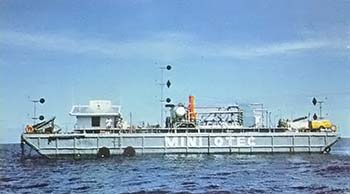
Then, in early August of 1979, a converted U.S. Navy dump
scow–moored in 3,000 feet of water off Keahole Point,
Hawaii–became the world’s first ocean thermal plant
to produce more electricity than it consumed. So far, the
barge isn’t putting out much juice by power plant
standards: Its total capacity is only 50 KW, and 10 KW of
that wattage goes to plant operation … but it is a
beginning! The floating power producer–designed and
built by the State of Hawaii, Lockheed Missiles and Space
Company, and the Dillingham Corporation–has
demonstrated that OTEC is more than theory.
Admittedly, like Edison’s first light bulb, Mini-OTEC’s
operation is feeble and sometimes cantankerous, but the
real economical application of the concept is almost
entirely a matter of upping the prototype’s scale. From the
titanium plate-type heat exchangers (donated by Alfa-Laval
of Sweden) to the Rotoflow turbine/generator system, all of
Mini-OTEC’s hardware is off-the-shelf, state-of-the-art
equipment. Similarly, her moorings consist of common
materials such as polyethylene pipe … and her anchor is
made of concrete.
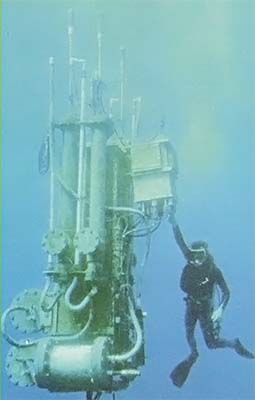
Mini-OTEC pumps up about 2,700 gallons of 40°F water
per minute from 2,500 feet, and employs an equal amount of
80°F surface water. The warm liquid evaporates ammonia
… which is circulated through pipes arranged in
heat exchanger fashion. Pressure–developed by the
vaporization of the fluid–then spins a turbine and
power generator. Upon exiting from the turbine, the ammonia
flows into another heat exchanger (located in the cold
water inlet) which condenses the gas and readies it for
reuse.
One of OTEC’s great advantages is that it doesn’t pollute.
The temperature of the liquid involved in the process is
changed by only 2° to 3°F … so the warm water that’s
returned to the sea tends to remain near the surface, and
the cold–in turn–descends to find a layer of
approximately its own density. Thus OTEC merely exploits
the natural ocean patterns of sun-warmed surface water and
deep, cold, arctic currents.
Of course, as you’d anticipate from any prototype, there
are problems to be worked out. Extensive research has been
going on for the past several years to develop methods to
prevent efficiency-robbing marine organisms–such as
barnacles–from attaching themselves to the heat exchangers.
And there’s also the question of how to transmit the energy
generated at an OTEC plant to the mainland. One promising
solution involves the “grazing” concept, which suggests
that the barges be directed by satellites to the warmest
pools of water. The plants would then use their electricity
to produce hydrogen … which could be shipped in a liquid
state.
Whatever form the energy potential of the oceans takes,
OTEC will play a role in our shift from nonrenewable to
renewable fuels. With 70% of the earth’s surface area
covered by water, the capacity of our seas to hold valuable
solar heat is a resource we cannot afford to ignore.