

Mark Mein and Ellen Davis have been living with
solar-generated electricity for 10 years. They have no
utility power at their house. Instead, they have 15 solar
photovoltaic (PV) panels that provide electricity for them
and their seven-year-old son. However, the PVs alone did not
provide enough electricity during the dark midwinter period
and they found themselves grudgingly relying on their
gasoline generator from November through January. In October
of 1992 they decided to move away from this dependence on
fossil fuels and set up a home wind power system, taking advantage of the other renewable
energy source they had overhead.
As Mark said, “I wanted to vote with my dollars for the
kind of energy picture I want to see in the U.S. and the
world.” So Mark and Ellen bought a 1-kW wind turbine to
help out their solar system on cloudy days. While before
they might have used about 50 gallons of gasoline a year to
provide backup power, with their wind generator they use
only 20.
Their wind/PV system provides enough electricity to run
their “typical, low-energy” house. This includes lights,
TV, VCR, stereo, washing machine, refrigerator, freezer,
convection oven, water pump, hand-held power tools, and a
variety of other small appliances. Mark thinks that if they
did not have a renewable energy system at their house, they
would be burning $500-600 worth of gas each year.
Like Mark and Ellen, thousands of people across the country
are using wind power to generate electricity. Some of them
do it to save on utility bills, others to decrease
dependence on fossil fuels, and still others because they
have no other energy option. Together they have forged a
radical change in how wind power is perceived.
Planes and Radios
Wind power has been an important source of energy in the
United States for centuries. Over eight million mechanical
windmills have been installed in America since the 1860s,
and thousands are still in operation across the West. Their
main function was to pump water, not to provide the kind of
fossil fuel-replacing help that we need the most.
It wasn’t until the 1920s that wind-generated electricity
took off — literally. Mick Sagrillo, president of
Lake Michigan Wind & Sun, explains that it all began
with the airplane. The propeller was discovered to be not
only an efficient way of producing thrust, but it also
drove an electrical generator far better than a mechanical
water wheel, which is very similar to what the earliest
wind generators used. As the propeller developed, so did
generating stations on the ground.
The radio was wind power’s second ally in the first half of
this century. Farmers and ranchers were as dependent upon
radios for critical weather information in the 1930s as
they are today. Without grid electricity, people listened
to battery-powered radios that weren’t particularly
dependable and needed frequent recharging. Each charge
meant a long trek to town and a few days with no radio.
However, a small 6-V wind generator provided enough
electricity to keep the battery continuously charged, with
power to spare. By the 1930s, wind-charged radios were hot
items across the Great Plains.
In time, the 6-V radio chargers were replaced by 32-V
generating turbines, and thousands of homes gained access
to power they had never before imagined possible. Wind
generator companies sprung up all over America. However,
with the passage of the Rural Electrification Act of 1936,
the wind industry was driven out of business. By the 1950s,
government policies favoring utility lines and fossil-fuel
plants left the wind industry crippled. With the coming of
the energy crisis in the 1970s, that trend began to
reverse. Between 1976 and 1990, over 5,000 small wind
systems were installed at individual homes in America.
All of the People, Some of the
Time
Wind power is a form of solar energy produced by the uneven
heating of the earth’s surface. It is a highly variable
source of energy, as anyone who has failed to keep a kite
aloft or battened down for a hurricane will attest.
Although it’s an energy source that is almost impossible to
regulate, wind power is democratic. Everyone gets some and
it is free to all. Nobody owns it. It is also a clean
technology, emitting no pollutants as it transforms wind
into electrical power. And it is the cheapest energy
technology we have today. In some ideal wind locations, the
cost of wind-generated electricity is just 5 cents per
kilowatt-hour. Anyone who has paid a utility bill knows
that it doesn’t get much cheaper.
There are many places across the United States that are
ideal wind sites. Wyoming, Montana, South Dakota, North
Dakota, Kansas, Nebraska, and Minnesota offer some of the
most promising locations for wind power. South Dakota, the
“Saudi Arabia of wind energy,” actually has enough wind
resources to provide half of the electricity for all of
America. There are also pockets of ideal wind sites
scattered throughout the country. You can find a place
where wind power is economical in Arizona, Florida, New
York, Vermont, and, in fact, in almost all 50 states.
Few people choose to power their entire household with the
wind. In many instances, wind blows stronger during the
winter months, leaving homesteaders to devise an
alternative generating device for the summer. Hybrid
systems, like Mark and Ellen’s PV/wind system, are an ideal
solution and there are thousands like them across America.
Another hybrid power system is a utility-tied configuration. In
this system there are no batteries. The utility acts as
storage. Most of your appliances are run off grid power.
However, when the wind blows, you sell energy back to the
utility. Wouldn’t it be nice to receive a check from the
local utility company rather than a bill?
From Breeze to Batteries
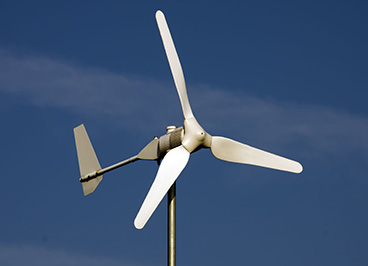
A turbine converts the wind into electrical power. It
consists of propeller-like blades (the rotor) and a
generator. The rotor is what captures the energy of the
wind and converts it into motion to drive the generator. A
properly designed rotor turns the generator fast enough to
produce maximum power but not so fast that it presents a
danger to the system.
A turbine must have a clear shot at the wind, so a
well-designed tower is crucial for an effective system.
Building too short a tower is the most common mistake home
owners make. The higher one goes above ground, the stronger
and “smoother” the wind is. Smoother air means air that is
free from the turbulence that occurs from obstructions such
as trees and buildings. It is always a better
investment to get more tower instead of a larger wind
turbine. Mark feels that if he had gone only 20 or 30 feet
higher in his 70-foot tower, he could almost double the
output of the generator. As a rule of thumb, the tower
should be at least 30 feet above any obstacles within 500
feet.
Before you run out and install a tower on your roof,
cleverly thinking that you can cut 30 feet off your tower
height, remember that towers vibrate a lot. The vibrations could seriously damage both
your house and your nerves. Wind towers should always be
installed on the ground.
Since the wind does not always blow when you want to listen
to your stereo, catching the wind with an “off-grid” system typically entails storing power in batteries so that electricity is available
at any time throughout the day, plus a regulator to protect
the batteries from overcharging. A battery system will
usually also have an inverter to change the DC electricity
from the turbine and batteries into AC electricity that
most of our appliances consume.
Windy Enough for You?
How much power is available from the wind? The main factor
is speed. In 1927 Alfred Betz of Germany computed a formula
for how much power the wind can generate. He concluded that
the power in the wind is proportional to the cube of the
wind speed. For example, if the wind speed doubles, the
available power increases eightfold. That is, a 20-mph wind
will yield eight times the power of a 10-mph one.
Another important factor in the amount of power possible is
the area of the rotor. A larger rotor will intercept a
larger area of wind, thus providing more power. Although we
do have control over what size rotor we use, we don’t have
control over the wind speed. So it is essential to know how
much wind is necessary for a wind system to be practical.
Since wind speeds change constantly (changes of up to 30
mph are possible in 5 seconds or less), it is important to
talk of average wind speeds. Areas with average monthly
wind speeds of 12 to 16 mph or above are excellent wind
sites. For a utility-tied system, speeds of 9 mph or above
are economical. Finally, for places where there is no
utility and wind is your only option, areas with very low
wind speeds might still be more economical than relying on
a diesel generator.
How do you know what your average wind speed is? Although
wind speed data are easily accessible for many locations
throughout the United States, it might not be accurate for
home wind applications. Most of the wind data are collected
at airports, which are generally built in places with the
least amount of wind. According to Mick, “unless you live
in a hole or the middle of the woods, you can expect at
least a 1- to 4-mph increase above airport data.” If you
have any doubts, do a little studying on your own.
Anemometers can measure wind speed at any location (and
some simple hand-held models can be purchased for as little
as $15). They should be positioned as high as the wind
system tower will be. To get an estimate of your average
wind speed, you can measure your site twice a day for 2
weeks. Then call the local weather bureau and find a ratio
between your readings and their daily measurements. You can
then extrapolate to estimate your wind site year-round.
Once the average wind speed is known, it is a simple matter
to determine how much energy is available to you.
But that is only half of the equation. You also need to
know how much energy you use. And for a wind system (or any
renewable energy system, for that matter) to be practical,
it is necessary to use energy efficiently. That means no
electric stove, electric water heater, or electric clothes
dryer. Solar thermal energy or propane makes more sense for
those applications. You can run the majority of your
current appliances, but energy-efficient models will be of
tremendous assistance in the long run. Reducing your need
for electricity will do more than anything else in making
your system affordable.
Paying for Power
Once the wind system is up and running, your utility bills
will be substantially lower, or even nonexistent. However,
energy doesn’t come free. Like any other renewable energy
device, the cost of the equipment, or the first cost, is
what will dig into your wallet. Mark and Ellen’s 1-kW
system costs about $4,500. A third of the cost was the
turbine, a third was the tower and installation, and the
last third was miscellaneous hardware. They were lucky in
that they had the batteries and inverter already in their
PV system.
However, a typical 500 – 600-W system can run about
$6,000, an amount nearly equivalent to that of a similar
solar stand-alone system. The wind turbine will be between
$800 and $1,000; the tower, up to $3,000; the batteries,
$800 to $1,600; and the inverter, controller, and wiring,
$1,000 to $2,000. A utility-tied system will be even
cheaper because it doesn’t require batteries.
Six grand worth of up-front costs is a considerable sum,
but it is crucial to take into consideration that in six or seven
years the amount of money saved from not paying utility
bills will pay for the entire system. After that, the
investment will yield nothing but savings. Better yet,
maintenance costs for modern generators are very low, and
the “fuel” is free. Depending upon the type chosen,
batteries will need to be replaced approximately every 10
years.
In remote locations where there is no utility, the payback
will come even sooner. Faced with the overwhelming cost of
extending grid power to a remote home, it is usually cheaper to
install an independent or hybrid wind system at a relatively
good wind site than to extend the transmission lines or
rely on a diesel generator. And, of course, the
satisfaction of generating your own electricity from a
nonpolluting energy source has no price value.
Remember that wind power does have some practical
considerations. In the past, turbines were noisy.
Fortunately, the newer turbines are quieter. Today, noise
is rarely a problem in house-sized systems. And wind
turbines are definitely quieter than listening to a
generator all day.
It is also hard to ignore the visual impact. Many people do
not want to look out their windows and see their neighbor’s
wind tower. But how many of us have become accustomed to
the plethora of utility lines outside of our windows and
above our heads every day? To many, a wind tower is a
beautiful symbol of energy independence, a sculpture in
motion.
Wind machines are not for everyone, however. Not only is it
a mechanical device that occasionally needs maintenance,
but it is a mechanical device that is very high up in the
air. If the idea of climbing a 100-foot tower once or twice
a year sends you groping for the Dramamine, you might want
to reconsider your energy options. But if you have a
maintenance contract with a local wind dealer, you can
enjoy your system from the safety of the ground. A tilt-up
tower is another option. You can lower your tower to do any
work or inspection and tilt it back up without lifting a
foot.
What About the Law?
Before you put up your wind tower, you should research
zoning ordinances, building codes, and any legal
requirements that might affect your installation.
Some ordinances have height restrictions and setback
requirements (the minimum distance a structure can be from
the property line). These stumbling blocks can generally be
overcome. You might have to apply for a variance or
convince people that a wind system should be classified
under the same category as communication towers for TVs,
CBs, and ham radios. Either way, do your homework and find
out the hurdles that must be overcome before buying your
tower.
Putting Up the System
Now that you have measured your site, picked out the right
system, and obtained any necessary permits, you are ready
to get your system up and running. The easiest thing to do
is call your local Mick Sagrillo and have a trained crew do
the work for you. Installing the tower, raising the wind
generator on top of it, wiring the system, and installing
the batteries is not a simple weekend project.
Mick, however, has no qualms about people installing their
own system. In fact, he encourages it: “If you get your
hands dirty, you have more vested interest in making sure
it works properly.” However, he discourages people from
building their own tower. The tower is a critical component
and a poorly built one can actually be deadly.
There are various ways to put the actual wind generator in
place. You can use a crane or a gin pole, which is a small
crane that attaches to the top of the tower. The generator
is usually raised first and the rotor and tail vane follow.
Once the generator is in place, it must be checked to see
if it is level and the rotor blades are tracking properly.
If the unit is out of balance it will vibrate, increasing
noise and losing power. However you put up your system, it
is strongly recommended that you work with an expert. A
poorly installed or wired system can mean major damage in
the first big wind.
Once your system is operating, maintenance is minimal. Mark
climbs his 70-foot tower twice a year to lubricate and
inspect the generator (“not the most pleasant task”). You
can do this yourself or hire a local dealer. In an off-grid
system, the batteries will need some attention. They must
be checked periodically and you may need to add distilled
water to them a couple times a year.
But to the thousands of people living with wind systems,
this is a small price to pay. And once your system is
spinning that wind into electricity, you might think
differently the next time you feel a cool breeze or even a
strong gale. That gust of air means that the days of
needless and spiraling utility expenses are over.
For More Information
Workshops:
Organizations
American Wind Energy Association
Books
Wind Power forHome & Business
(Chelsea Green Publishing Co., 1993) by
Paul Gipe.
Wind Power forthe Homeowner (Rodale
Press, 1981) by Donald Marier.
Wind Manufacturers






