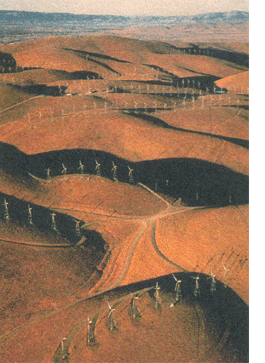
You’re probably aware of the huge wind farms that provide
supplemental power to Los Angeles and power entire cities
in other countries. I’m excited about the potential for
large-scale wind power plants for cities, and in my
community I have already begun to see the potential of wind
power for the small system do-it-yourselfer.
After apprenticing as an electrician and studying at the
Carbondale, Colorado-based Solar Energy International-a
nonprofit organization that provides renewable energies
education and technical assistance-I started Amazon Power
in 1993 and began installing solar in the area. As my
clients took an interest in wind, I began installing wind
generators to supplement many solar systems.
These
generators are often the most sensible way to boost the
capacity of an existing photovoltaic (PV) system. A strong
wind resource can allow you to have a smaller battery bank
for storage. If you’re interested in exploring the
possibility of adding a small wind turbine to your system,
read on for some tips I’ve gained from working with small
units manufactured to provide power to independent homes,
small schools and clinics, as well as for pumping water.
Evaluating Wind Potential
First, assess your location for its wind power potential.
You can purchase metering devices and obtain average wind
speed data from the airport closest to your home. This
information is normally collected at 30 feet above ground
level, which is about the minimum height to set a wind
generator, as wind speeds are somewhat slower and are
subject to more obstructions closer to the ground.
Inversely, the higher above the ground, the more
significant the wind speed.
For a small supplemental
generator that can cost as little as $1,000, including the
tower and installation, a visual assessment of available
wind power can he sufficient. Raise a light flag, and make
it a habit to observe trees and shrubbery around your site.
If they are perpetually bent, it’s a good indication of a
persistent wind. At 4 to 7 mph, you can feel the wind on
your face and leaves will rustle. At 8 to 12 mph, leaves
will be in constant motion and the flag will raise in the
wind. Wind speeds of 13 to 18 mph raise dust and move small
branches, and at 19 to 24 mph, trees in leaf begin to sway.
At 25 mph, large branches begin to move, and you’ve got
great wind-generating potential!
Small generators can be
mounted on a pole with guy wires. (I don’t recommend
mounting a wind generator on your roof, regardless of what
some manufacturers might suggest. Even with a small
generator, noise from vibration is a problem.) Put the
generator on a tilt up pole tower to make it easier to
install and maintain This allows you to mount the generator
and connect the wires on die ground before raising the
tower-no climbing needed! Keep voltage lass down to 2% by
using large enough wire. Manufacturers will provide charts
to help determine the proper wire size for your
installation.
Evaluating Wind
Generators
About a year
ago, I installed an Air 303, made by Southwest Windpower,
for supplemental charging in a 24-volt home/ recording
studio system. The system consisted of 12 Solec 50-watt
solar modules. 18 Exide 6-volt golf cart batteries, a Trace
4024 sinewave inverter and a Trace C-30 charge controller,
with fuses and disconnects for safety. The loads in thus
system are a Vestfrost refrigerator/freezer a small water
pump, efficient lighting and a recording studio. The PV
system could have provided ample power for these loads. but
the users were unaccustomed to living with a renewable
energy system and neglected to turn off loads when they
weren’t using them. After a couple of years of operating
under a perpetually low- state of charge, the hatter. bank
was suffering
Several home owners in the arc.: had already
added an Air 303 to their PV systems. This hit the market
in ’95 am quickly became popular. It was inexpensive, sell
regulating and maintenance free. My client decided this the
best solution to supplemental charging of her batteries.
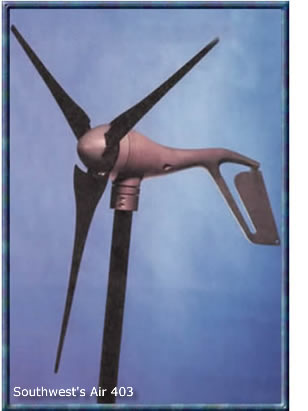
Since this installation, the Air 303 has been supplanted by
an upgraded model, the Air 403, because there were some
problems with regulation. This new, improved model boasts
the same benefits as the 303, but in a more reliable and
sturdier machine. It gives the batteries a trickle charge
at as little as 15 mph of wind. It maxes out at about 35
mph, putting 600 watts of charge into the battery bank With
an average wind speed of 25 mph. which is common at this
location, it would require the addition of 15 to 20 more
Solec nodules to equal the energy output of this machine.
With a price tag of about $300 per solar module. and about
$600 on the Air 403 Coot in pole and installation), it’s
easy to see why the addition of a small wind generator can
he a very attractive option for someone living with a good
wind resource.
I mounted doe Air 303 on a freestanding pole
buried in cement. If I had to do it over again today, I
would put guy wires on it, but there have been no problems
and the client is satisfied (it is only on a 20foot pole).
I installed a switch at rite bottom of the pole to stop
rotation in the event maintenance is required, and then ran
the wires into a disconnect switch. With the
self-regulation, the charge went right into the batteries
from there. The battery bank was topped off within a couple
of days and there has been a state of undercharge since.
There’s a lot about the Air 303, and its successor, the Air
403, that make them attractive for the homeowner who has
modest power requirements and a site with some wind
resource available. I like the lightweight, easy
installation and self regulating features, not to mention
the fact that they are virtually maintenance free. Keep in
mind that the smaller the unit is, the faster it has to
turn to put out the same amount of power as a larger one.
This can lead to overheating and premature wear, as was a
problem with the Air 303. It appears that Southwest
Windpower has made several changes in the Air 403 that
should make it a more reliable machine-only time will tell.
The folks I know who have added this machine to their
systems have been pleased with the results. There are
several models by different manufacturers that are slightly
larger and not much more expensive. Many of them have a
stronger track record after years of operation and are
worth investigating.
Final Thoughts
Keep in mind that anything that is up in the air and moving
at high speeds can be dangerous. Even the machines that are
supposedly maintenance free deserve a visual inspection at
least once a year to make sure nothing is rattling loose.
Some concerns my clients have had about adding a wind
system include noise and aesthetics. As for noise, I’ve
worked with several owners of generators from the small Air
303 to a Jacob, 3,000-watt generator on a 60-foot tower.
The only time noise has been an issue is when the generator
was mounted on a building.
Admittedly, some people don’t
like the looks of renewable energy systems. I think they’re
attractive and show something about the character of the
person who will take power into his or her own hands. I’m
amazed at how often I’m asked to hide a system. Be proud!
By accepting the idea that a battery is like a bucket, and
renewable energy systems the sources that can fill it, you
will become exponentially more aware of your potential to
minimize your impact on the planet.