

Farmers and landowners want to lower fuel and feed costs, explore feed and fertilizer co-products, be more self-sufficient, and rely less of fossil fuels. Biomass grass crops can be established on marginal lands and processed as a fuel replacement for heating oil or propane, or as an addition to wood chips or pellets.
There are four main models for implementing grass energy on a farm. The models differ from each other in where the grass is grown and processed. Two are closed-loop models, in which the grass is grown and processed on-site, and the others are variations of processing the grass in a central facility and distributing production of the feedstock among regional farms.
Grass fuel can occur as bales that get chopped just prior to combustion or densified fuels like pellets, cubes, or briquettes. The densified fuels are made using machinery that applies high temperature and pressure to the chopped feedstock, pressing it into the desired shape. A series of dies and knives are responsible for cutting the fuel into its desired shape. Each of the four grass energy models, described below, produce one or two of these types of fuel.
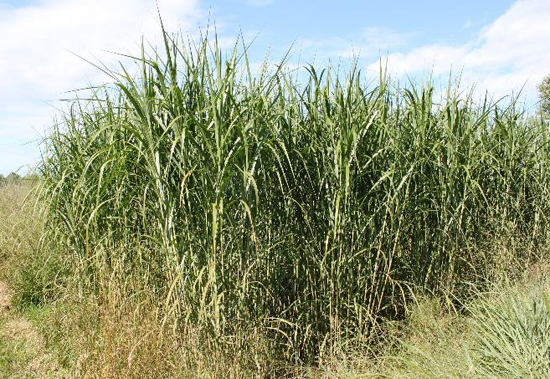
Switchgrass growing at the University of Vermont Horticulture Farm in South Burlington, Vermont. Credit: Vermont Bioenergy Initiative
Closed Loop-No Processing: Grass fuel is grown on-site where it will be processed for heating fuel. The grass is harvested as usual, and stored and burned as bales. This requires a specific heating appliance designed to burn whole bales and significant storage space for the bales. While it is not economical to transport bales over great distances, this model can work among neighbors. For example, a school or prison with this heating system can contract with a neighboring farmer to produce the fuel bales.
Small-scale On-Farm Processing: Grass is grown on-site where it will be processed. Stored bales are chopped in a hammermill and the grass is put through a small pelletizer or briquetter. The processing equipment can be stationary on the farm or mobile, moving between multiple farms. The pellet or briquette fuel can be used on the farm, such as in a biomass-heated greenhouse or chicken house, or it can be sold to neighboring users. The fuel produced is only suitable for commercial and industrial applications, and will not work well in residential heating appliances.
Regional Processing: Grass is grown within a 50-mile radius of a central processing facility that converts bales of grass from multiple farmers into briquettes. The processing facility should be co-located with a large heat load, such as a medium to large school or hospital, or even several buildings that will all be using grass fuel.
Consumer Pellet Market: Grass is grown by contracted farmers within a 50-mile radius of the pellet mill. The mill produces standard pellets for the residential and small commercial markets.
From the farmer’s perspective, all four models described above involve growing the grass. The difference lies in whether the farmer will be contracting with a centralized processor or doing their own processing, and in the latter case, whether they plan to use the fuel on-site or market it to other customers. The key to success for these models is to match the fuel produced to the needs of the user. For example, Vermont Technical College in Randolph, Vermont, heats part of the campus with a pellet boiler, so the school’s farm operation uses a mobile pelletizer to process grass from their fields into pellet fuel.
Much is known in the northeast Unites States about growing grass and a number of variety trials conducted around the region have pointed to certain species, like switchgrass, giant miscanthus and reed canary grass, as options that are highly productive and do well in this region. Grass stands are currently planted at the University of Vermont Horticulture Farm in Burlington and Vermont Technical College, and on several private farms like Borderview Farm in Alburgh and Meach Cove Farms in Shelburne. A collection of reports and guidelines for growing grass in the northeast is provided by the Vermont Bioenergy Initiative.
A key aspect of grass energy development is to install grass-fueled heating appliances on farms and in schools or other municipal buildings, institutions and commercial settings while also producing grass fuel. For these institutional and small commercial heating systems, grass pellets, briquettes, and whole bales could be used for fuel. Depending on the type of system installed, the processing equipment should produce whole bales, pellets or briquettes to match the fuel needs. Mobile pelletizers and briquetters, like the one in development by Shelburne, Vermont-based Renewable Energy Resources, could be a good match, or in the case of whole bales, standard grass harvesting equipment would be used to produce fuel.
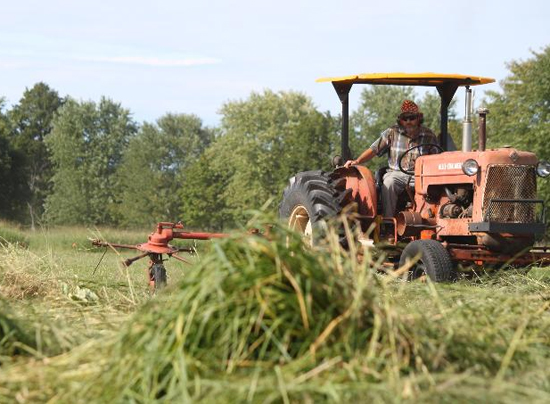
Switchgrass being harvested at Meach Cove Farm in Shelburne, Vermont. Credit: Vermont Bioenergy Initiative
While growing the crop and producing the fuel can be relatively straightforward, there are not currently extensive markets for the fuel. This presents a chicken-and-egg problem for the farmer and their potential customers. Farmers are hesitant to grow a crop with an uncertain market, and building owners and municipalities are not likely to install a heating system for which they can’t find a reliable fuel source. Close cooperation between fuel suppliers and customers is important, and long-term contracts can help build confidence between partners.
There are also alternative markets for grass crops that can be used in the interim while a fuel market is established. These alternatives include fiber for paper products, animal bedding, compost for mushroom growers, resin in particle board, absorbents for environmental clean-up, and dairy rations. Additionally, the fields themselves have value as wildlife habitat and stream buffers that prevent erosion and remove nitrogen and phosphorous from farm run-off. These alternative uses for grass are discussed in more detail in the report, “Grass Energy in Vermont and Northeast.”
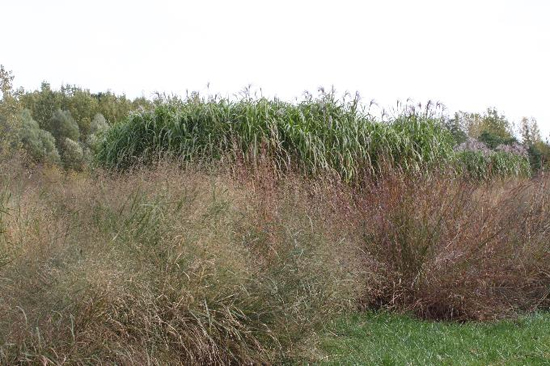
Miscanthus in its second year at Meach Cove Farm in Shelburne, Vermont. Credit: Vermont Bioenergy Initiative
An important consideration for growers is the economic feasibility of growing grass for fuel or alternative markets. Dr. Sid Bosworth, researcher and professor at the University of Vermont School of Agriculture and Life Sciences, has developed a grass energy cost estimator to determine the per-ton cost of production, located on his website. By comparing the cost of production to market prices, a grower can determine whether producing and selling grass fuel makes financial sense.
Considering additional benefits to the farm can be helpful, too. For example, using grass to help clean up runoff from the farm, thereby helping to clean up local waterways, can be a valuable marketing asset. Improving wildlife habitat with grass crops, conserving open land, and utilizing marginal soils are additional benefits. It’s hard to put a dollar value on land stewardship, but these are services to both the longevity of a farming operation and to the greater community.
Photo by Fotolia/nspooner





