The actions taken–by big government and big industry–to “solve” our energy problems are often befuddling at best and dangerous at worst. Can you, for example, imagine any acceptable rationale that a utility planner could offer to justify the last decade’s shift toward grossly inefficient all-electric homes? Or, if that one doesn’t leave you baffled, try to understand why our President wants to spend a large part of $66,000,000,000 (as well as a great deal of energy) converting an already useful–if dirty, in some applications–solid fuel (coal) into a gas (methane or hydrogen) … and then to persist in the folly by transforming the gases into liquid fuel (methanol, to name one).
Indeed, it’s easy (and even necessary) to view the capricious wanderings of our nation’s high technologists with a measure of cynicism … after all, their efforts aren’t known for consistently producing social benefits. However, some folks have chosen to take a more valuable approach to the often misguided (but well-meaning) ramblings of science. And recently, it was MOTHER EARTH NEWS’ good fortune to meet just such an individual … a young man named James “Rocky” Golden, who–along with his colleagues of the Mobile Steam. Society of Oak Ridge, Tennessee–has taken a highfalutin academic notion called “fluidized bed combustion” and turned it into a practical-on-a-small-scale reality!–THE EDITORS.
Though fluidized bed combustion was conceived in the 1920’s (separately, but almost simultaneously, by Fritz Winkler of Germany and W.W. Odell of the United States), scientists around the world didn’t begin to develop the technique (for use in industrial applications requiring great amounts of heat) until the late 1960’s. Much of the pioneering work was done in England, under the auspices of that country’s National Coal Board. And, more recently, China has made so many technological advances in the design of mid-sized units that the energy-poor nation now employs over 2,000 fluid beds to generate steam (for electrical production) from high-ash coal!
However, until last year the world engineering community didn’t consider this efficient combustion method to be feasible for small applications. As a result, funding for research aimed at scaling down fluid beds has been (and still is) lacking, so such work has been left to the hands (and bank accounts) of interested individuals. And one of the earliest of such independent proponents of small fluid beds was W.H. Fleischman, who began building cardboard models and delivering lectures back in 1976.
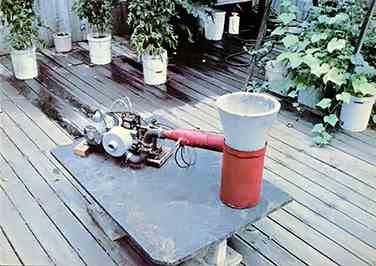
Fleischman and I were introduced through the Mobile Steam Society–a group of lunatic fringe scientists and engineers bent on using their spare time to develop a modern steam automobile–and, with his help, I built a six-inch-diameter prototype fluid bed capable of burning up to 90,000 BTU worth of coal per hour with respectable efficiency. [EDITOR’S NOTE: Before Rocky built his, “small” fluid beds had been those sized around six feet in diameter!]
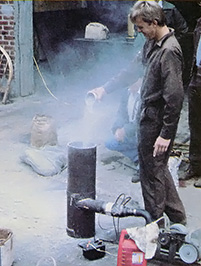
Then, at the May 1980 meeting of the Steam Automobile Club of America in Greensboro, North Carolina, MOTHER EARTH NEW’ staff got wind of the fluid bed’s potential. At that get-together the furnace was fed a variety of fuels … including not only coal, but also kerosene and even chicken feed. (Though it’s quite natural for folks who are unfamiliar with fluid bed combustion to be surprised by the device’s multi-fuel capability, it’s easy–once one understands how the little burner works–to see why it’s capable of very efficiently firing almost any material that contains carbon!)
Mount Saint Helens Tamed
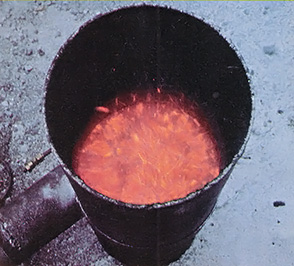
When you peer down the throat of a fluidized bed, you’ll see a bright red bubbling mass of fire that looks like the lava in a volcano. [EDITOR’S NOTE: The material’s strikingly liquid appearance is due to the method of heat transfer … rather than to any essential difference in the actual combustion itself.]
A fluidized bed, you see, combines carbon and air to yield heat … just as a conventional furnace does. The major difference between the two burners is that the fire in a fluidized bed takes place in a mass of tumbling inert (noncombustible) particles (1/8″ or smaller) that are supported by an upward rush of combustion air. (Visualize a vacuum cleaner blowing air up through a vessel containing sand.) The churning particles bump into each other continuously, passing the heat of the burning fuel back and forth by conduction … and give the fire tremendous thermal inertia (or resistance to temperature change, which is a result of the storage capacity of the large mass of inert material).
Rapid Heat Transfer
Since heat is immediately absorbed by the noncombustible particles in the oxidation area, a fluid bed doesn’t have the leaping flames that most of us associate with burning. Consequently, hot spots–regions of intense combustion that are usually associated with a conventional furnace’s inefficiency–are significantly reduced. Burning fuel in such a manner has several advantages over conventional modes of combustion:
Because the inert material is at burn temperature, any carbon-containing fuel which is introduced into the bed of tumbling solids will burn rapidly, passing heat back into the swirling mass surrounding it. Thus a wide range of fuels which have been considered unsuitable–because of either their low BTU content or their tendency to burn incompletely–can be successfully consumed in a fluid bed … including coal mine tailings (10 to 20% carbon), timber waste, agricultural byproducts, and even pelletized garbage!
Furthermore, heat produced in a fluid bed can be transferred to a heat exchanger much more rapidly than can that generated in a conventional furnace. Because the hot inert matter in the bed comes in direct contact with both the oxidizing carbon and the tubes of a heat exchanger, heat transfer is by conduction (directly from one medium to another) rather than by convection (from one medium to another by way of an intervening moving medium). Between 50 to 100 BTU per square foot per °F can be transferred by a fluid bed, while a conventional furnace moves only about 10 BTU per square foot per °F. Accordingly, a fluidized bed requires far less heat-exchanger area to extract a similar amount of heat.
Reduced Pollution
An additional benefit of a fluidized bed’s method of BTU transfer is that it allows the heat exchanger to be used to control the temperature of combustion. Since the coils are set directly into the flame area–instead of above it, as is the case in a standard furnace–the heat that is extracted reduces the burn temperature (the fire can actually be put out by this technique). Therefore, in the case of coal, the combustion temperature can be maintained at the ideal of 1550°F–as opposed to the 3000°F that’s sometimes generated in a normal furnace–which eliminates the clinkers usually associated with firing low-quality fuel. The reduced flame temperature also drastically limits the heater’s production of nitrous oxide–a key element in photochemical smog–which is produced in significant quantities only above 1800°F.
Finally, the chemical makeup of the inert bed material can actually reduce or eliminate the pollution problems associated with certain “dirty” fuels. For example, high-sulfur coal can be burned in a bed of limestone with virtually no emission of sulfur … a pollutant which, in the opinion of the Environmental Protection Agency, is a major cause of acid rain. In a fluid bed, the calcium in the limestone reacts with the sulfur in the coal to produce calcium sulfate (CaSO4 ), which can be used as fertilizer. And–while suitable “civilizers” for other problem fuels have not yet been established–there are probably a number of “cleansing” materials which may someday play a major role in providing us with low-pollution energy.
Many Uses
Small fluid beds similar to my own could be developed for use in almost any application where heat is needed. A six-inch-diameter unit can produce heat at any desired rate between 45,000 BTU and 240,000 BTU per hour (depending upon the fuel type and the rate of feed), a capability which gives it far more flexibility than a fixed-nozzle furnace has. It would be easy to use such a device to produce hot water or steam … to heat homes, dairy equipment, domestic water, etc. The internal exchangers could also be easily adapted so they’d provide hot air for drying, ceramic firing, and so forth. What’s more, crucibles can be immersed in a bed to provide rapid heat transfer for processes such as metal casting and glass blowing.