

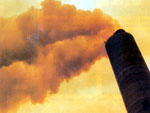


The Climate Stewardship Act didn’t make it through Congress
last fall, but the environment may still prove the winner.
The first attempt by Congress to address the threat of
global warming since 1998, the McCain-Lieberman Climate
Stewardship Act, failed to pass the Senate by a narrow
margin, but Sen. John McCain says he may reintroduce the
legislation as early as this spring.
McCain and the bill’s co-sponsor, Sen. Joe Lieberman,
D-Connecticut, say they are encouraged by the support the
failed bill received; the vote was a close 43-55. “We lost
a battle today,” McCain said, “but we’ll win over time
because climate change is real. And we will overcome the
influence of special interests over time.”
The Climate Stewardship Act would cap carbon dioxide (CO2) emissions from power plants, oil companies and factories,
and create an emissions trading system under which
companies that achieve more pollution reductions than
required can sell their excess reductions to other
companies to help them meet their commitments.
The aim of the legislation is to begin solving the problem
of global warming, which poses a wide range of threats to
the environment, the economy and public health. Carbon
dioxide, produced by the combustion of coal, oil and
natural gas, is the most abundant of the green house gases,
which are responsible for raising the Earth’s surface
temperature. Scientists predict global warming will cause
species extinctions, rising sea levels, an increase in
deaths from extreme heat, and the migration of tropical
diseases northward.
Kevin Curtis, National Environmental Trust vice president
of government affairs and a supporter of the
McCain-Lieberman legislation, says three weeks before the
October vote, the bill reportedly only had 32 votes firmly
supporting it and more than a dozen senators still on the
fence. “Our fear was that the bill might pull in fewer than
40 votes,” he says, which would have doomed it for the
foreseeable future. “But the majority of the undecided
senators broke in favor of the bill.”
According to information from McCain’s office, a
Massachusetts Institute of Technology (MIT) study estimated
the legislation would cost only about $20 per household.
Analysts predicted the impact on the U.S. GNP at no more
than 0.01 percent. A second study by the Boston-based
Thellus Institute predicted that if the bill becomes law,
it will reduce U.S. energy demands and save U.S. residents
$48 billion by 2020.
Sources: Amanda Griscom and Grist Magazine; Senator John McCain and Senator Joe Lieberman, and the National Wildlife Federation.
Northeast Crafts Plan to Cut Carbon Emissions
The northeastern United States isn’t waiting for Congress
to tackle the problem of global warming. The governors of
10 states, led by New York Gov. George Pataki, agreed last
July to begin a regional initiative to curb carbon dioxide
(CO2) emissions. Their goal is to establish a flexible,
market-based cap and trade program by April 2005.
Pataki and the governors of Connecticut, Vermont, New
Hampshire, Delaware, Maine, New Jersey, Pennsylvania,
Massachusetts and Rhode Island agreed to develop a regional
CO2 cap and trade program in an effort to reduce CO2
emissions from power plants. Maryland has indicated it may
participate in the discussions at a later date.
The plan would center on an emissions trading system to
require power generators to reduce emissions. The
initiative grew out of recommendations made to Pataki by
the Greenhouse Gas Task Force he appointed in June 2001 (www.ccap.org).
James Tripp, general counsel for Environmental Defense, a
national environmental advocacy organization, and a member
of the Greenhouse Gas Task Force, Says, “This is not only a
major regional initiative but a critical national precedent
as to how to deal with global warming.”
Ashok Gupta, director of the Air and Energy Program for the
National Resources Defense Council, says, “The debate in
the Northeast is no longer about climate science but how
best to use existing technologies to reduce emissions and
minimize energy costs at the same time.”
Source: Environment News Service (ENS).
Cleaner Power to the People
If you hate writing checks to pay for energy that comes
from a fossil-fuel-chugging power plant, you may have
another option at your command. A new industry has emerged
in recent years that allows customers to buy power
generated by renewable energy sources, such as wind, solar,
geothermal and biomass.
The electricity currently used in the United States comes
primarily from coal (52 percent), nuclear (20 percent) and
natural gas (16 percent). Ten percent comes from hydropower
and oil combined, while only 2 percent originates from
renewable sources. The environmental repercussions of this
imbalance are considerable.
According to the U.S. Environmental Protection Agency
(EPA), electricity generation is responsible for 2/3 of the sulfur dioxide, 1/3 of the mercury and 1/4 of the nitrogen oxides emitted annually in the
United States. In addition, use of fossil-fuel-based energy
sources contributes significantly to emissions of fine
particulate matter and carbon dioxide, a leading greenhouse
gas.
About 50 percent of U.S. electricity customers today have
the option of purchasing green power directly from their
suppliers. More than 400,000 actually are doing it.
The number of suppliers who offer green pricing options or
who are in the process of developing such programs has
grown to more than 350 utilities in 33 states. Included are
investor-owned utilities, rural electric cooperatives and
other publicly owned utilities. Green pricing is a separate
tariff designed specifically for the utility to sell green
power. In states with restructured electricity markets,
electricity customers often can choose from multiple
suppliers, some of which may offer green power programs,
too.
Even if your local utility does not offer green power
options, you still can purchase cleaner power from
regionally or nationally based companies that offer
“renewable energy certificates.” These certificates
represent electricity generated from renewable energy
sources. The physical electricity is sold into the regional
market where the power is generated, but the certificates
can be sold anywhere in the country, or the world for that
matter. (Here at MOTHER EARTH NEWS, for
example, we offset our energy use with green power
certificates purchased from Native Energy, a
wind-power supplier that focuses on developing American
Indian renewable energy projects.)
Renewable energy sources still are a bit more expensive
than conventional sources, but the price most of us pay for
electricity does not account for the environmental damage
and other external costs associated with the use of fossil
and nuclear fuels. We eventually pay for these hidden costs
in the form of tax dollars spent on regulations, pollution
control and increased health-care costs linked to air
pollution.
But how do you know that the premium you are paying is
actually supporting renewable energy development? As a
consumer, you have a right to ask what assurances your
green power provider can provide. Some certification
programs exist: Green-e and the Green Pricing Accreditation
Program, both administered by the Center for Resource
Solutions, are leading national certification programs for
green power.
For More Information:
Utility Green Pricing Programs
www.eere.energy.gov/greenpower/summary.shtml
Green Power Product Offerings in States with Competitive
Retail Markets
www.eere.energy.gov/greenpower/mkt_summ.shtml
Renewable Energy Certificate offerings
www.eere.energy.gov/greenpower/certif_summ.shtml
So, paying a premium for green electricity now will save
all of us money later. And, in comparison to other
household expenditures, green power isn’t that
costly either — only about $17 more per month for an
average household. Other benefits also may exist: Green
power customers sometimes are treated to special events or
discounts at local businesses, and a limited number of
utilities offer a fixed utility rate that protects green
power customers from fluctuations in fuel costs.
Source: Blair Swezey and Lori Bird, National Renewable Energy Laboratory, Golden, Colorado, and Solar Today Magazine.
Lessons in Living a Farmer’s Life
Now’s the time to sign up for summer learn-to-farm
internships and apprenticeships. If you’re a city slicker
stricken with the farming “bug” or a student in search of a
meaningful summer experience, you’ll find lots of
opportunities to learn the basics on organic farms across
the country and internationally. Here are some resources to
check out:
The National Center for Appropriate Technology’s ATTRA
(Appropriate Technology Transfer for Rural Areas) program
compiles an extensive listing of internships and
apprenticeships on organic farms, in intentional
communities and with associated organizations in the United
States and Canada. Check out ATTRA’s Sustainable FarmingResource List.
The Farm School in Athol, Massachusetts, offers in-depth
farm training courses, as well as summer activities for
young people.
World-Wide Opportunities on Organic Farms maintains a list of potential international positions,
which you can access after joining the organization. These
resources are great starting points, but remember to
thoroughly research any position before you sign up.
Decipher Those Food Codes
Some labels on food products tell us about the item’s
nutrient content. Other labels carry important information,
too — in industry codes that consumers don’t always
understand. But for shoppers dedicated to knowing how their
food was produced, such labels promise to be increasingly
useful in the future.
Most fresh produce, for example, carries a label with a
four-digit price look-up (PLU) code; “4011,” for example,
appears on conventional bananas. According to Alicia
Calhoun, technology and standards manager for the Produce
Marketing Association, if the produce is organically grown,
a “9” precedes that code, making organic bananas “94011.”
In the future, she says, if genetically modified whole
produce is introduced to the marketplace, it will be
identified with an “8” in place of the “9.”
In September, another sort of food label, a
country-of-origin label (called “COOL”), will begin to
appear on some foods because of an amendment to the 2002
Farm Bill. Fresh and frozen fruits and vegetables, beef,
pork, lamb, seafood and peanuts are affected.
However, a House of Representatives committee temporarily
halted funding for country-of-origin labels on meats last
fall, and other initiatives may delay funding for parts of
the program for a time. The debate over when to implement
COOL was prompted because some food manufacturers and
retailers have concerns about cost and complexity, and the
amount of time needed to properly implement the program.
The U.S. Department of Agriculture’s Agricultural Marketing
Service (AMS) is responsible for overseeing that
implementation. According to Kathryn Mattingly of the AMS,
the USDA does expect the COOL produce program to be
implemented, and even if a partial delay is OK’d by
Congress, wild and farm-raised fish will carry COOL labels
by September. Mattingly says COOL does not apply to
farmer’s markets, farm stands or small businesses.
Visit the COOL produce website for more details.
Yosemite Goes for Biodiesel. A biodiesel
production facility is being built at Yosemite National
Park. Delaware North Parks and Resorts, Yosemite’s official
concessionaire, says the facility will recycle used cooking
oil from park restaurants into biodiesel that, in turn,
will fuel park vehicles. Delaware North estimates the park
will repay its investment in the project in less than four
years.
Eco-sleuths in Training. The University of
Wales, Bangor, North Wales, in the United Kingdom, is
training a new generation of environmental sleuths.
Although the field of environmental forensics originated in
the United States, the University of Wales is the first in
the world to offer a course in the subject. Students study
chemistry, biology and geology, and prepare themselves to
give testimony in court cases involving pollution problems
and the assignment of responsibility for clean-up costs.
Stephen Mudge, course organizer, says, “Students learn a
logical approach to their science, including unbiased
observation and record keeping.”
Test Your Water at Home. If you’re
concerned about the water quality in or around your
homestead, you can analyze it with an inexpensive home
water test kit. Usually costing less than $20, these kits
detect lead, pesticides, chlorine, nitrates and bacteria.
Rhonda Janke, a Kansas State University researcher, tested
the accuracy of home water test kits: Those from Watersafe,
Hach, CHEMetrics and 3M gave accurate results. Such home
testing kits are more affordable than sending samples to a
lab, but should only serve as a starting point. “They are
like a preliminary screening at the doctor’s,” Janke says.
“If the home test indicates traces of a contaminant, you
probably want to send your samples to a lab.”
Except where noted, Green Gazette is written by Lindsey
Hodel.






