

Paul Ehrlich (Bing Professor of Population Studies and
Professor of Biological Sciences, Stanford University) and
Anne Ehrlich (Senior Research Associate, Department of
Biological Sciences, Stanford) are familiar names to
ecologists and environmentalists everywhere — as well they
should be. After all, it was Paul and Anne who gave special meaning to the
words “population,” “resources” and “environment” in the
late 1960s. (They also coined the term “co-evolution” and
did a lot to make “ecology” the household word it is today.)
But, while most folks are aware of the Ehrlichs’ popular
writing in the areas of ecology and overpopulation, far too few people have any idea
of how deeply the Ehrlichs are involved in ecological
research (of the type that tends to be published
only in technical journals and college textbooks). That’s
why it pleases us to be able to present — on a regular
basis — the following semi-technical column by
authors/ecologists/educators Anne and Paul Ehrlich.
Ecological Hope and Horror in Brazil
Among the highlights of our field trip to South America
last year, were the three weeks we spent in Brazil, which is the
largest country on that continent and the fifth
largest in the world. Even though Brazil is a “less developed” land, its future doesn’t seem
hopeless like many other countries. In spite of its huge size (greater than the total
of the U.S.’s “lower 48”), Brazil has only some 120 million
people. It is also rich in geographical and biological
diversity and natural resources. There’s little question
that this nation could solve its problems before
population growth and social and environmental
deterioration convert it into a permanent “basket case.”
However, whether or not it will do so remains to
be seen.
Sad Juxtaposition in Brazil
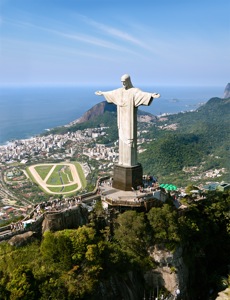
Rio de Janeiro, which was our first stop, can be seen as a
microcosmic model of Brazil’s main problem: “two-tiered”
development. Rio is in the most beautiful setting of any
large city we know . . . exceeding in loveliness even our
own San Francisco. The metropolis is built between the
coastal mountains and the sea, and — since the
mountains drop almost directly into the water — the
city is very narrow, clinging to lower slopes, beaches and
landfills.
The “cariocas,” as the residents call themselves,
are rightly proud of their gleaming white, world-famous
beaches lined with equally white and gleaming apartment
buildings and hotels. (Some of the beach-front condominiums
are actually worth more than a million dollars!) But, back from
the beach — sometimes only a few hundred yards away — the other
Brazil can be found. On the hillsides,
squatters have created large, crowded slums known as “favelas.”
Because of the city’s physical
setting, this juxtaposition of great wealth and great
poverty — characteristic of the world as a
whole — may be more obvious in Rio than anywhere else. This shows clearly in the metropolitan crime
statistics. More than a million muggings and armed
robberies annually have created what our Brazilian friends
described as “panic” among residents.
According to the Jornal do Comercio, more than
400,000 people in Rio — out of an area population of perhaps
7.5 million — have been robbed more than
once. Many such crimes are committed by juveniles, who
are both difficult to catch and nearly immune to punishment
under Brazilian law, which is a situation similar to that found
in such North American cities as New York.
Problems With Brazilian Agriculture
In contrast to Rio, which is a commercial center,
São Paulo — the epitome of the Brazilian economy’s
upper tier — is an immense industrial city with about 14
million people in its metropolitan area. The state of
São Paulo, is the
major revenue producer for the entire nation and many
Paulistas frankly view their city and state as a developed
nation embedded in an underdeveloped one.
São Paulo has heavy smog, many world-class
restaurants, first-rate newspapers and relatively few
slums. Its sprawling development gives the impression of a
Los Angelicized Detroit. The road between it and Rio, more
than 200 miles to the northeast, is often a
bumper-to-bumper jam of heavy trucks, because the nation
has neglected its rail system and is now paying the
price.
There’s excellent agricultural land in Brazil, particularly
in the South. In Paraná, we drove for hundreds of
miles through rich farmland — much of it planted in
soybeans, some in wheat — which reminded us of the North
American prairies. Brazil is clearly in a position to feed
itself, but it still imports food for economic/organizational
reasons: Sugar cane (for alcohol-fuel production) and
soybeans have been so extensively planted as cash crops
that wheat and even black beans — the staple protein food of
the Brazilian poor — must now be imported. (Lately,
black beans have quadrupled in price and the
nutritional state of the underprivileged has suffered
because of it.)
Migration in Brazil
In fact, the poor are simply being left behind in the nation’s
rush toward “development.” And their plight is probably
worst in the drought-stricken Northeast: the
bulging “hump” of Brazil centering on the city of
Recife.
In that region a combination of overpopulation, ecological
destruction and a feudal social system has produced a
sickening level of poverty. This situation has resulted in
large-scale migrations to the more prosperous South in
general and to São Paulo in particular. Hundreds of
thousands of individuals move to that city each year,
but many leave again when they are unable to tolerate the relatively
cold winters or — with their minimal
skills — are unable to earn enough to feed
themselves.
This migration within Brazil can be viewed as one
more manifestation of the global trend of people moving
from poor to rich countries, because the two tiers of
Brazilian society are nearly as economically disparate as
are, for instance, Mexico and the United States.
Adding to the problem is Brazil’s seeming inability to
control population growth, to improve the distribution of
wealth or to protect the nation’s fragile environment.
Although the most recent census shows a small decline in
the growth rate, Brazil’s demographic situation remains
grim, with the population projected to reach about 200
million by the turn of the century.
Health Minister Waldyr Arcoverde recently announced (over
the opposition of the Roman Catholic Church) that 1981
would be “the year family planning comes to Brazil to
stay.” But, as of yet, there is no sign of a serious program
of fertility control similar to that which was recently
launched in Mexico. Indeed, economist Herman Daly, who has
done much research in Brazil, recently wrote us that the
population debate there “has hardly progressed at all in 12
years.” As the country becomes more urbanized, a decline in
the fertility rate can be expected (since that’s been the
case in most developing nations), but certainly not fast
enough to prevent problems of overpopulation from worsening
enormously.
It takes at least a decade for a good family planning
program to become well established in a large country and
even the most effective of such undertakings must contend
with the inertia of population growth. Brazil will be
fortunate if it can halt growth before its population
reaches 250 million and it’s clear that even concerted
efforts to achieve a reasonable distribution of
wealth — if they’re initiated — will take
a long time to have a substantial effect.
The problem of overpopulation is, of course, intertwined
with problems of social justice and environmental
protection. For example, if the Northeast had a more
equitable social system and the region had not suffered
great environmental degradation from deforestation,
northeasterners might have shared the sort of prosperity
that has come to São Paulo, and the area’s birth
rate would undoubtedly have been lower. In turn, migration
pressures would also have eased, and ill-advised schemes of
Amazonian “development” (in part, the result of attempts to
resettle northeasterners) could have been avoided.
But the problems of the Northeast, like those of many other
poverty-stricken parts of the world, are not only rooted in
history, but perpetuated by an unwillingness of people in
wealthy areas and countries to face up to changes and
sacrifices that must be made if the poor are to achieve a
reasonable standard of living.
Ecological Concerns in Brazil
Ecologists, of course, are especially concerned over the
fate of the rain forest of Amazonia. This region
is the world’s single greatest reservoir of organic
diversity and is crucially important to the present and
future welfare of people. On the hopeful side, vast stretches of the Amazon Basin
still remain essentially untouched by modern society. But,
substantial areas are being deforested — very
often for the most temporary of gains. For instance, we
visited a region north of Manaus where a rain forest,
growing on very poor soil, was being cleared. In a short
time the bare soil will turn into pure sand and become
essentially worthless for growing crops and will
likely be unable even to support grazing animals. The
project is one result of an unfortunate set of tax laws
designed to encourage the “development” of the Manaus area.
Large corporations, operating out of southern Brazil, are
thus able to protect profits made elsewhere by carrying out
unprofitable, and destructive, schemes in the rain
forest.
Bad laws contribute to environmental destruction elsewhere
in the country, as well. A regulation of INCRA (the
National Institute for Colonization and Agrarian Reform)
that was initially designed to help break up huge estates (latifúndios ) has had the effect of
discouraging farmers from leaving any of their land in
forest or woodlots. Furthermore, regulations that are supposed to protect both
natural areas and indigenous peoples tend to be poorly
enforced by weak agencies. Most of the subtropical forests
of Paraná have been cut down to make way for
soybeans and other crops. Included in the deforestation was
a large part of the Iguassú Falls State Park, which
somehow got converted to farmland.
Although Brazil has — on paper — an impressive
system of national parks and reserves, there’s a severe
lack of money to protect them. And corruption, powerful
local interests opposed to preservation and public apathy
work against the system. As a result, intrusions and
disruptions are common in some protected areas now and the
future fate of many may be similar to that already suffered
by a portion of the Iguassu park.
The government is also shortsightedly encouraging the
chopping down of virgin forests to get wood for use as
industrial fuel. A Brazilian journalist described his
nation’s development policy this way: “If you can’t eat it.
. . burn it down.”
Native Massacres in Brazil
FUNAI (the Brazilian National Indian Foundation) seems to
have as little power to protect the land’s native people as
other government agencies have to protect its forests.
While we were in the country, news broke of six Xavante
Indians being killed and more than 50 made sick by
the arsenic dumped into the Couto Magalhaes River by estate
owners who wanted to exterminate the inhabitants of the
Parabubure reservation.
This was not the first time that the Xavantes had been
massacred in that area of the state of Mato Grosso. In
1952, almost all the women children, and elderly who
remained in Xavante villages were killed by men from local
estates (including the latifúndio
responsible for the recent atrocity). By 1980, the
Indians were completely driven from the area by continuing
attacks, which included biological warfare waged by
distributing flu-virus-contaminated objects! Apparently,
the most recent killings occurred because estate owners
couldn’t reconcile themselves to the creation of the
reservation — which, by presidential decree, absorbed
some 325 square miles of estates and brought the Indians
back.
Hope for Brazil
Brazil’s “hope” now lies in its still-reasonable balance
between resources and population, the presence of a
strong industrial base and the diversity and vitality
of its people. Although the country is relatively short of
oil, producing less than 20 percent of its petroleum needs, Brazil
has immense hydroelectric capacity. It has also, as most
MOTHER EARTH NEWS readers know, pioneered in the use of both
“gasohol” and ethanol to power its automobiles (which are
manufactured locally).
The government has attempted to curtail gasoline
consumption and reduce enormous oil import bills by
prohibiting the sale of petroleum-based motor fuels on
weekends. This has caused some resentment, because the
method chosen is viewed as less than ideal, there seems to be more than enough petroleum available at
the moment and there’s suspicion that
Petrobras, the government oil company, may be fraudulently
enriching itself through price manipulations. In addition,
using either gasohol or alcohol fuel (which can be bought
on weekends) sometimes creates maintenance problems,
including carburetor and manifold corrosion and engine oil
contamination and dilution.
Brazil has some coal (unfortunately
with a high sulfur content) and an abundance of non-fuel
mineral resources, including the world’s largest single
deposit of iron ore. The country certainly has adequate
human resources for development, ranging from skilled
farmers (many of Japanese descent) to first-rate
scientists. The latter may be a mixed blessing, however: one young physicist told us that the Brazilian military
had approached him to join a laser research group whose aim
was to develop devices for separating uranium 235 from
U-238, the crucial step in the manufacture of atomic
bombs.
We were also told repeatedly that Brazilian President Joao
Batista Figueriredo is in favor of protecting the nation’s
biological resources. But — unfortunately — multinational corporations,
Brazilian big-money interests and corruption continue to
work against him.
It’s unarguable, however, that Brazil’s fate will be
determined over the next decade or so, as its residual
pronatalism and the current push for hog-wild development
come in conflict with a growing environmental awareness. If
the nation moves toward ecological sanity, it could easily
become one of the great powers of the future. If it
doesn’t, it will follow the India/Bangladesh route. And if
the flora and fauna of the Amazon are destroyed in the
course of Brazil’s deterioration, the impact on global
ecosystems could be catastrophic.






