

News briefs on bugs vs. drugs, organic agriculture hot line, forest arson, a hybrid potato plant repels insects and disruptive military training flights.
Bugs vs. Drugs, Organic Agriculture Hot Line and Disruptive Military Training Flights
Bugs vs. Drugs
Swarms of a usually rare, small white butterfly are
gobbling up drug profits in Peru, where illegal coca
growers are battling to save their crops from the insect.
Known locally as malumbia, but otherwise
classified by scientists as Eloria noyesi, the
tiny butterfly eats nothing but coca leaves and this year
has appeared in unprecedented numbers. Many growers have
resorted to spraying their plants with DDT to eradicate the
winged drug buster. Government officials, on the other
hand, are considering raising large numbers of the
butterfly and dropping them over remote growing areas.
Flash Fertility
Although nitrogen accounts for about 78% of our atmosphere,
it isn’t available or useful to plants until it’s “fixed,”
or combined with other elements to make it biologically
“digestible.” Until recently, scientists have believed that
a handful of specialized organisms, among them bacteria on
the roots of such plants as peas and alfalfa, were
primarily responsible for producing fixed nitrogen. Now,
however, a research team has found evidence that suggests
lightning may yield as much as half the fixed
nitrogen in air. Lightning discharges ionize the air,
producing nitrogen oxide, which then reacts with ozone to
produce NO 2 and molecular oxygen, usable to plants and
animals. Though the process was known previously, it was
thought to be responsible for no more than 3% of
atmospheric fixed nitrogen.
Organic Agriculture Hot Line
At least 30,000 of the country’s 2.1 million farmers raise
their crops without using toxic herbicides and pesticides,
says the USDA, and this number is increasing rapidly. To
satisfy the burgeoning demand for general and technical
support in sustainable agriculture, USDA has established an
information center, known as ATTRA (Appropriate Technology
Transfer for Rural Areas), and has set up a toll-free access number. ATTRA’s staff includes experts
in such fields as agricultural economics and marketing,
soil science and pest control. For more information on
ATTRA, or on virtually any aspect of sustainable
organic agriculture, call ATTRA any weekday between
8 a.m. and 5 p.m. central time.
Forest Arson
In 1987, more than 2 million acres of national forestland
burned, making it the worst year since 1929, according to
the U.S. Forest Service. In the West, drought and lightning
were the primary culprits. But it’s a different story in
the Southeast. There, 70% of last year’s 15,571 fires
(which destroyed some half-million acres) were attributed
to arson. Forest arson has been particularly widespread in
the South for generations. Investigators say arsonists set
forests ablaze for varying reasons: to get revenge on
someone, to strike a blow at the state or federal
government, to generate excitement
or–ironically–to make money ($3.35 an hour)
fighting fires!
Stream Watch
Local and state agencies don’t have the money or manpower
to monitor all our nation’s streams, so in many cases
critical pollution problems persist unknown to the
authorities that could help solve them. At the same time,
hikers and other outdoor enthusiasts often are the first to
come across such situations–but don’t know who to
contact to report a problem. To help bring the two forces
together, The Izaak Walton League has published “A
Citizen’s Directory for Water Quality Abuses.” The booklet
provides state environmental agency phone numbers for
reporting pollution emergencies and for getting information
about streams and water quality. It also describes how to
recognize different kinds of water pollution and suggests
ways to help on-site. For a copy of the directory, send $1
to The Izaak Walton League of America, Arlington, VA.
Potato Self-Defense
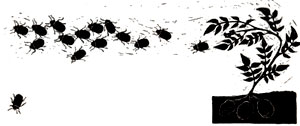
Scientists have succeeded in producing a hybrid potato
plant that manufactures its own insect repellent. While
examining the properties of some 1,000 different types of
wild potatoes, a USDA team found that the leaves of one
species–Solanum chacoense– contained
high levels of leptine. This natural toxin deters even the
Colorado potato beetle, this country’s leading potato pest.
Chacoense produces only very small tubers, but the
researchers successfully fused cells from the wild species
with those from commercial types and then grew the fused
cells into hybrid plants that produce acceptably large
potatoes (though still only about half the size of market
varieties). Leptine in big doses can be toxic to humans,
but the hybrid plants produce the chemical only in their
leaves.
Aerial Abuse
Residents in many rural areas have long complained of
disruptive military training flights over their homes, land
and livestock. To help people direct their complaints to
the proper authorities and to provide citizens with an
effective voice of protest, Citizen Alert and the Rural
Coalition have set up a 24-hour toll-free telephone
reporting service called Skyguard. Skyguard operators will
catalogue complaints, refer callers to legal help and
answer questions about military flight operations. To
report an incident or to request a jet identification and
information brochure, write Skyguard,
c/o Citizen Alert, Reno, NV.
Energy Economics
Our national economic competitiveness is largely determined
by how efficiently we use energy, according to a report
issued by the Worldwatch Institute. “If American
industries, buildings and transportation were as energy
efficient as Japan’s, the United States could trim $200
billion from its annual fuel bill,” say Christopher Flavin
and Alan B. Durning, co-authors of Building on Success:
The Age of Energy Efficiency. “Nations that want to
compete effectively in international markets have no choice
but to raise their energy efficiency to at least the
Japanese level.” Most Western industrial nations have
improved their energy efficiency by 15% to 30% since 1973,
saving more energy than they gained from all new sources of
supply. But we still waste enormous quantities. “As much
energy leaks through American windows every year as flows
through the Alaskan pipeline,” write the authors. The
report, one of a continuing series of excellent analyses of
globally important issues, is available for $4 postpaid
from the Worldwatch Institute, Washington, DC.
Home Cool Home
Homeowners looking for ways to beat the heat without
battering their budgets may be interested in either of two
free fact sheets offered by the Conservation and Renewable
Energy Inquiry and Referral Service (CAREIRS). “Passive
Cooling” suggests alternatives to air
conditioning–insulating, shading and other
cost-effective heat stoppers. “Moisture Control In Homes”
discusses the symptoms and solutions to moisture problems,
which in addition to causing mildew and wood rot are often
the culprits behind high utility bills. Ask for either or
both papers by writing CAREIRS, Silver
Spring, MD.






