

Lots of children, it seems to me, are bored much of the time after school and on weekends. But I’m not, because I run a neighborhood newspaper …and I think my “job” is fun and constructive. One of the things I enjoy most about the journalistic project is that I have total control over what kind of paper I put out. Editing it is like running my own business. Children usually don’t have the opportunity to try out new ideas, but I can with my own newspaper.
The idea for starting my first paper (I’ve done two neighborhood newspapers) came to me from a book called Eddie’s Big Deal, by Carolyn Haywood, which I read when I was six years old. I lived in a group of townhouses in Eugene, Oregon then, and started a paper called Hot News. I handprinted every copy of the first issue. After that, a neighbor let me use her “ditto” machine for free. The purple-print duplicator could copy only on one side of a sheet, so the Hot News was a one-page newspaper. It came out once a week.
Later our family moved to Arroyo Grande, California. There I started a journal called the Tierra Street Hot News, which I distributed to the 23 houses on Tierra Street. A teacher who lived next door to us ran the paper off on a ditto machine at his school, so my cost of publishing was only the price of the duplicating paper.
Next, I enlarged my newspaper to cover two streets, and started calling it the 2 Street Press. By that time, the county school office had agreed to do my printing, by photo offset, if I’d pay for the paper. I was then able to tape photographs and children’s drawings on the pages. And, since that machine worked by a process called duplex, I could print the 2 Street Press on both sides of my sheets.
After six months, I expanded the newspaper again, in order to cover three more streets, and I changed its name to the 5 Street Recorder. I passed the paper out for free and used my allowance to pay for the expenses. (It cost $1.50 to print 135 copies of each issue.)
In October of 1980, I expanded once more. Today the paper covers ten streets, comes out twice a month, and is named the Pike Press.
I now charge 25¢ a month for subscriptions and have a company nearby print the paper for $8.50 an issue. I also buy film for $1.75 a month and pay $4.00 to get it developed, so the total cost of making the Pike Press for one month is $22.75. Since I have 95 subscribers, the paper breaks even.
People are interested in news. They enjoy seeing their ads or items in the paper. We advertise garage sales, cars, babysitting, and more. News may include the details of a vacation, neighborhood sports events, or kids’ news such as a report on a child who lost a tooth. Little boys and girls like to put fun items in the paper, such as “Jason is the fastest runner in the world.”
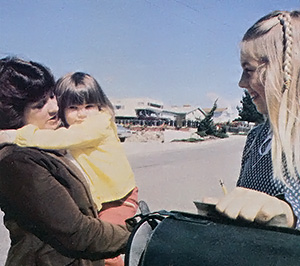
In order to get stories for the Pike Press, I go from door to door and politely ask people if they have any news to share. I go back to visit anyone who wasn’t home the first time I came around. If people don’t have anything for one issue, I don’t give up on them. They may have some news for the next one.
I also do interviews for special columns such as “Our Neighbors” (which tells about a family), “Super Kid” (which puts a youngster of 4 to 12 in the spotlight), “Teen Super Star” (for 13- to 18-year-olds), “Pamper Kid” or “Super Baby” (for babies), and “Tot Terrific” (for children 1 1/2 to 3). I ask questions like “What do you want to be when you grow up?”, “What are your hobbies?”, “What is the greatest thing that has ever happened to you?”, “What is your age and grade?”, etc. And I always take pictures of the subjects to use with the article.
After the people have answered all my questions, I write up the stories, using the facts from the interviews. Then I bring the finished articles back to the people I wrote about to check the facts and see if they want to make any changes. This is important because you have to be very sensitive to other people’s feelings.
Once, before I started checking on stories, I interviewed a family for “Our Neighbors.” The mother told me to write that she had foster children because she was very proud of making a home for them. But when the story came out in the paper, the children’s friends made fun of them. The youngsters had been pretending that their foster parents were their real father and mother. The children got upset, and the whole family blamed it on me.
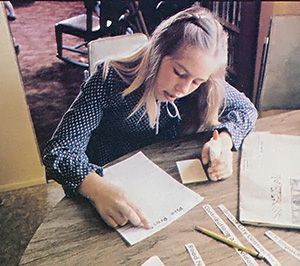
After I have all of my news, ads, and interviews, I start getting the paper ready to be published. I type it, but if you can’t get to use a typewriter yourself, then print it out neatly. (Either way, it’s best to use the kind of typing paper you can erase with a pencil eraser or to buy some white Liquid Paper Correction Fluid so you can brush it over any mistakes and write or type on top of them.)
If I find that I don’t have enough material to fill the paper, I go out and look around for more news. I might ask a child to draw a picture on a small piece of paper. Then I write the child’s name and address on the picture and glue or tape it to my newspaper sheet.
Another thing I do is to cut pictures out of magazines. I tape each one in its space and write under who it is and something about the person. I also write jokes, include a puzzle, or add something about a mystery person.
It takes me four hours an issue to get the subscriptions and collect the money for each issue. I then spend six hours getting all the ads and news items. Interviewing and photographing require only two hours. Typing and editing the paper take four hours. Then it takes me one hour to have the Pike Press printed, and two and a half hours to distribute it. Altogether, I spend 19 1/2 hours putting out each issue. But no paper will be any good unless you take the time to make it good!
I think the Pike Press has really brought this neighborhood together. Since I started it, many people have been able to meet other people they wouldn’t have met without a neighborhood paper.
Lots of children’s activities have been organized through the newspaper, too. One lady had a neighborhood Easter egg hunt. Mothers have given potluck dinners to show films that were checked out from the library, and boys and girls have gotten together to make cutout cookies and string cranberries and popcorn for Christmas. One family even organized kids to clean up an empty lot!
Everyone, young and old, likes the Pike Press. When I deliver a new issue, most of the children gather to wait for their copies. Parents have been really proud of their child when he or she has been featured as a “Super Kid.” Many lonely elderly people have been happy with the paper because it helps them feel they are a part of the neighborhood. And when new families move in, they are especially glad they chose our neighborhood because of the PikePress and the friendliness of all the people.
The Pike Press helps my neighborhood, and editing it has been a big help to me, as well. Running my own newspaper has taught me a lot of things that I’ll need to know when I begin my adult career …in journalism)
Some Selections From Pike Press
•> 651 Lancaster: Derek’s soccer team the Cougars won trophies for winning every game except one.
•> The dog Snoopy at 641 Lancaster St.
will bark at you but don’t be afraid. All he wants is attention. He
would like it very much if you stopped to pet him. He is a very nice
dog.
•> 791 Paul Place: If you need a babysitter for New Year’s Eve see Sherry.
•> Read a book a day!
•> 610 Del Sol: We put in a new roof on the weekend of the 13th and 14th.
•> Mr. Leos of 605 Del Sol who is
HAPPILY married with 7 kids has a special message for his beautiful
wife. “I love you Bettie because you’re sexy.”
•> The Tot Terrific for this issue is
Theresa Blackner. She is 22 months old. She likes to look at books and
go to see the ocean. Her birthday is Dec. 9th. She has a little brother
named Jake who is 5 weeks old. Theresa recently rode a cow on a ranch
and went to Disneyland. She learns very quickly. Theresa is potty
trained. Her father is a mechanic at Cal Auto in San Luis Obispo.
Theresa is a bright young girl and I’m sure she will grow up to be
someone important.
•> 661 Tierra: Who’s missing a friendly, shaggy, black poodle? He hangs around here.
•> 1231 Russ Court: Jenny has a teddybear that can wear her clothes.
•> 621 Elm St.: 1950 Buick For Sale. In excellent working condition.
•> Your Opinion by Aaron Haber
I asked many people what their New Years Resolutions were, and here are a few of the answers:
- “stop biting fingernails”– Frances Miranda
- “to give what it takes in ’81”–David Shargel
- “to lose 15 pounds”– Carolyn Tabor
•> We are sorry to hear that Christy at 601 Lancaster had a cold this week. From “The Gang.”
•> 670 Tierra: We had eight relatives over for Independence Day.
•> Work hard and never give up!
MOTHER EARTH NEWS feels strongly that youths can be creative “doers,”
working toward more ecological and self-reliant lifestyles … whether
their tasks be raising chickens on a farm or maintaining rooftop
container gardens in the city. To support the endeavors of our often
overlooked “underage” citizens, we’re glad to publish well-written
articles from younger children and teenagers concerning projects they’ve
undertaken. However, we recommend that all young authors query (that
is, send us a letter telling about the story you’d like to do) before
writing a full article.






