

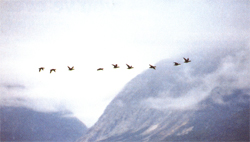
Annual Migrating Duck Populations Declining
The U.S. Fish and Wildlife Service estimates that only 66 million ducks migrated south last fall–some 8 million fewer ducks than in 1987. Part of the blame can be placed on last year’s drought. Because of hay shortages, lands normally protected as nesting grounds under the USDA’s Conservation Reserve Program were opened by emergency order to haying, almost at the peak of the breeding season. But that doesn’t explain the more serious long-term decline in average annual migrating duck populations, which have plummeted by nearly half since the 1940s. As recently as the ’70s, the annual migrating duck population averaged 92 million birds. The major cause of the problem, say researchers, is loss of quality habitat; less than half the country’s original wetlands are intact, and despite conservation programs as much as 500,000 acres of wetlands continue to be destroyed each year. Farming and tree planting account for 87% of the annual loss of wetlands and also contribute another factor in the decline of duck populations: increased applications of pesticides and herbicides that not only contaminate nesting and feeding grounds directly but also kill important food sources required by waterfowl. The nation’s millions of back-yard bird feeders provide sustenance for countless birds; well, actually they’re not entirely countless. Each winter for the past two years, participants in Cornell University’s FeederWatch program have taken the time to identify and count the members of species visiting their feeders, thus providing ornithologists with invaluable data on bird population levels, geographic distributions of various species, and the effects of weather, habitat, food types and other environmental factors. FeederWatchers pay $9 a year to support the projects and agree to count the numbers of individual visitors of each species at their feeders for one or two consecutive days each week for 20 weeks. Though the commitment is substantial and requires not only time but skill at identifying birds, thousands have participated. “I’ve always felt guilty about the hours spent bird watching instead of on household chores,” reported one volunteer. “Thanks for making an honest woman of me!” For more information on the program, visit the Project FeederWatch website.
U.S. Grain Production Down
Last year, probably for the first time ever, the United States produced less grain than it consumed (196 million metric tons versus 206 million metric tons), says Lester Brown, president of the Worldwatch Institute, in State of the World 1989. What’s more, Brown points out, this year’s stockpile of carry-over grains (the supply remaining in bins just before the next harvest) is likely to be the lowest since the years immediately following World War II. Another bad harvest in the next few years could mean mass starvation in countries that rely on U.S. grains–unless, says Brown, we stop using one-third of the nation’s grain crop to feed livestock and, instead, use it as a reserve to feed the hungry. Unfortunately, the likelihood of dwindling grain stores is heightened by worldwide soil erosion and population growth. Each year, says Brown, the world’s farmers are expected to feed 86 million more people with 24 billion tons less topsoil.
Gypsy Moth Infestation Controlled by Bt
In 1984 the most serious infestation of gypsy moths ever recorded in the West occurred in Lane County, Oregon, an area largely dependent on its timber industry. Over the ensuing four years, Oregon’s Department of Agriculture fought the pests with aerial applications of Bacillus thuringiensis, or Bt, a biological insecticide long used by organic gardeners to control cabbage loopers and other caterpillar pests. The department’s choice of insecticide raised considerable ire among timber companies, most of which favored using stronger, wider-spectrum, more persistent chemical pesticides such as Sevin or Malathion. But the results of the Bt program, measured by annual counts of male gypsy moths lured to traps baited with sex pheromones, speak for themselves. In 1984, more than 19,000 male gypsy moths were trapped in the 227,000-acre area. In 1985, 1,286 males were caught; in 1986, 81 moths; in 1987, 41; and last year, just one. Spraying won’t be necessary this year, and careful monitoring of pheromone traps will allow officials to spot future infestations early, making entirely benign control measures effective.
Lead Content in Human Bones Significantly Increased
Americans and Britons today have as much as 1,000 times more lead in their bones than did people from ancient cultures, according to research conducted at the University of California, Irvine, and reported in Science News magazine. Anthropologists discovered the disturbing increase when they analyzed the lead content of bones from the bodies of contemporary residents of England and the U.S. and compared the results with analyses of bones and teeth from two archaeological digs: One was on the California coast near Malibu, where Chumash villagers lived around A.D. 1000, and the other in Arizona occupied by Anasazi Indians between A.D. 1000 and 1300. In a similar study conducted a decade ago, modern bones were found to contain 500 times as much lead as those of Peruvians living 1,600 years ago.
High Ozone Levels Adversely Affecting Crop Production
One other factor that may be adversely influencing the world’s production of grains and other crops is increased levels of atmospheric ozone. Though a previous national study indicated that crop reductions of up to 12% could be produced by high ozone levels, subsequent research suggests that much greater damage may be expected with some sensitive crops–wheat among them. In tests of a spring wheat crop last year, scientists at the Ithaca, New York-based Boyce Thompson Institute for Plant Research found a 30% yield reduction due to high ozone concentrations in the area. “Farmers need to realize that air quality as affected by high ozone concentrations represents a significant production cost factor, because they have to plant more acres to grow the same amount of crop,” says BTI plant pathologist John Laurence.
Fungus Attacking Flowering Dogwoods Spreads
Dogwood anthracnose, a deadly fungus attacking flowering dogwoods, is spreading rapidly in the East and Pacific Northwest, and the prognosis is discouraging: Native dogwoods apparently have no resistance to the disease. To test whether regional species variations might be resistant, Frank Santamour of the National Arboretum grew dogwood seedlings from trees from 17 states and then transplanted them in the Catoctin Mountains, in Maryland, where they would be infected naturally with anthracnose. All the trees “were completely gone,” says Santamour, within two and a half years. Scientists don’t know the origin of the fungus, or even the species of the fungus, and no effective treatment has yet been found. Weather “and about 10,000 other things,” says Santamour, will determine how fast and how far the disease spreads.






