

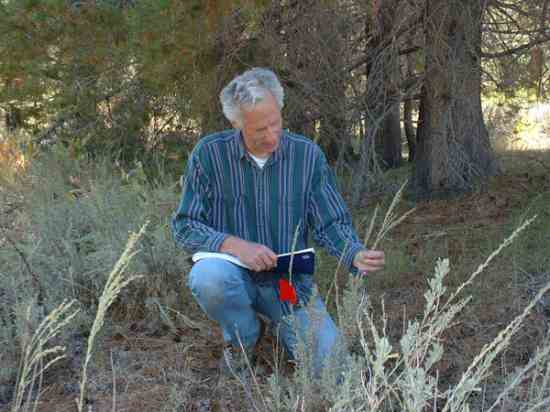
Reposted with permission from UC Davis Department of Entomology.
If you’re a sagebrush and your nearby kin is being eaten by a grasshopper, deer, jackrabbit, caterpillar or other predator, it’s good to be closely related. Through volatile (chemical) cues, your kin will inform you of the danger so you can adjust your defenses.
If you’re not closely related, communication won’t be as effective.
Newly published research in the Proceedings of the Royal Society B: Biological Sciencesshows that kin have distinct advantages when it comes to plant communication, just as “the ability of many animals to recognize kin has allowed them to evolve diverse cooperative behaviors,” says lead researcher and ecologist Richard Karban, a professor in the UC Davis Department of Entomology.
For example, fire ants can recognize kin. “Ants will destroy queens that are not relatives but protect those who are,” Karban said.
That ability is less well studied for plants, until now.
“When sagebrush plants are damaged by their herbivores, they emit volatiles that cause their neighbors to adjust their defenses,” Karban said. “These adjustments reduce rates of damage and increase growth and survival of the neighbors.”
“Why would plants emit these volatiles which become public information?” he asked. “Our results indicate that the volatile cues are not completely public, that related individuals responded more effectively to the volatiles than did strangers. This bias makes it less likely that emitters will aid strangers and more likely that receivers will respond to relatives.”
The research, “Kin Recognition Affects Plant Communication and Defense,” is co-authored by two scientists from Japan and two from UC Davis: Kaori Shiojiri of the Hakubi Center for Advanced Research, Kyoto University, and Satomi Ishizaki of the Graduate School of Science and Technology, Niigata University; and William Wetzel of the UC Davis Center for Population Biology, and Richard Evans of the UC Davis Department of Plant Science.
To simulate predator damage, the researchers “wounded” the plants by clipping them and then studied the responses to the volatile cues. They found that the plants that received cues from experimentally clipped close relatives experienced less leaf damage over the growing season that those that received cues from clipped neighbors that were more distantly related.
“More effective defense adds to a growing list of favorable consequences of kin recognition for plants,” they wrote.
The researchers performed their field work on sagebrush (Artemisia tridentata) at Taylor Meadow, UC Sagehen Creek Field Station, near Truckee. They conducted four field experiments over three years “that compared the proportion of leaves that were damaged by herbivores over the growing season when plants were provided with volatile cues clipped from a close relative versus cues from a distant relative,” the scientists wrote.
For closely related kin, they snipped stem cuttings (clones), potted them, and then returned the pots to the field. They determined relatedness “by using microsatellites that varied among individual sagebrush clones.”
The result: “Plants responded more effectively to volatile cues from close relatives than from distant relatives in all four experiments and communication reduced levels of leaf damage experienced over the three growing seasons,” they wrote. “This result was unlikely to be caused by volatiles repelling or poisoning insect herbivores.”
Karban, who has studied plant communication among the sagebrush at the site since 1999, likened the plant communication to neighbors “eavesdropping.” They “hear” the volatile cues of their neighbors as predators damage them.
Plants do communicate, Karban said. A basic form of plant communication occurs when it is being shaded and it responds by moving away.
“Some definitions of communication require that both the sender and receiver benefit by engaging in the behavior,” the researchers wrote. “Sagebrush is a long-lived perennial, making estimates of the costs and benefits of communication difficult although plants that responded to volatile cues from damaged neighbors experienced greater survival at the seedling stage and greater production of new branches and inflorescences over 12 years.”
Karban said that the volatiles released by “experimentally damaged plants are highly variable among individuals.”
“In the future we plan to examine this chemical variability to determine which chemicals are active as signals and why they exhibit so much variability,” Karban said. “Ultimately, we would like to be able to understand the chemical nature of the volatile cues, how plants use them to communicate, and whether as agriculturalists, we can control host plant resistance to herbivores.”??The work was supported by grants from the Japan Society for the Promotion of Science (JSPS) and the U.S. Department of Agriculture.






