

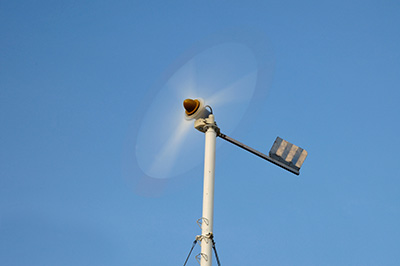
Last summer, John Eckland of Great Falls, Virginia built himself a windplant. The contraption wasn’t at all fancy. Just large enough to provide most of his household’s electrical needs. John’s only problem (and it’s a common one among users of wind power) was that the device turned out to be as unpredictable as its natural power source. Sometimes, when brisk breezes kept the rotor whirling constantly, it produced more electricity than the Ecklands could use, while on calm days it couldn’t always meet the family’s needs.
So, in an attempt to equalize the imbalance of supply and demand, Mr. Eckland approached his local utility, the Virginia Electric Power Company (VEPCO), about buying his surplus power and providing backup electricity on the windmill’s slack days. The company agreed … but on terms that left a lot to be desired! VEPCO offered to purchase the extra power generated by Eckland’s windmill for under a penny perkilowatt hour (much less than it charges its customers), and wanted John to pay much higher than usual rates for the occasional backup power he’d require.
However, with the assistance of Institute for Local Self-Reliance (ILSR) staff members, the Virginian investigated a new federal law called the Public Utilities Regulatory Policy Act (PURPA). This statute seeks to encourage independent energy production by requiring power companies to interconnect with small, independent power producers at fair rates. For example, a utility must now buy power from its independent suppliers for the equivalent of what it would cost the company to generate that amount of power itself.
John Eckland studied the PURPA law, discovered what appeared to be several violations in the utility company’s handling of his case, and brought the matter to the attention of VEPCO’s president, the state utility commission, and the attorney general of Virginia. Not long after that, VEPCO’s rate department agreed to renegotiate, and–after a series of meetings–the independent producer won a fivefold increase in the company’s purchase price and a tenfold reduction in the monthly service charge applied to part-time subscribers.
Until recently, there haven’t been a lot of independent energy-producers like John Eckland around. That situation has begun to change. In fact, this country is experiencing an unprecedented transformation in the nature of its electrical power supply. Last year, there were 5,500 power plants in the United States. By 1985 there will probably be 50,000 such facilities. Most of these will be small hydroelectric systems and cogeneration plants (which produce both heat and electricity).
Such tremendous growth in the number of small-scale power plants should result in a greater degree of energy self-reliance for homeowners, small businesses, neighborhoods, towns, and maybe even entire cities, but that independence will not come automatically. While the regulations of the PURPA law are fairly specific, they also allow for considerable latitude on the part of utilities and state regulatory agencies. For example, PURPA eliminates the utilities’ traditional monopoly on generating capacity, but–at the same time–it also grants those concerns a monopoly on purchasing power.
To further complicate matters, enforcement of the regulations PURPA contains has been left up to state regulatory authorities, which, of course, has resulted in unequal promotion of independent power production in different areas. Even though the intent of PURPA is clear, then, its irregular enforcement still subjects enterprising homeowners or small scale businesspersons to an extremely lopsided negotiation process unless they thoroughly understand their own legal rights and the rate structure of their local utilities. [EDITOR’S NOTE:Worse yet, the constitutionality of PURPA is currently being challenged in the Supreme Court. If the judiciary finds against the regulation, small scale energy-producers will be back on square one, so to speak.]
However, anyone who’s willing to invest some time in studying the situation should find that a little “homework” can make a big difference at the bargaining table. So, to assist folks in getting started, the ILSR has helped to prepare a booklet entitled Promoting Small Power Production: Implementing Section 210 of PURPA. The publication contains background information on the law, describes how individuals can qualify as independent power-producers, offers tips on interconnecting with local utilities, and more.
For the past several years, the good folks at the Institute for Local Self-Reliance in Washington, D.C. have worked to help urban residents gain greater control over their lives through the use of low-technology, decentralist tools and concepts. We strongly believe that more people (city dwellers and country folk alike) should be exposed to the Institute’s admirable efforts … which is why we’ve made this “what’s happening where” report by ILSR staffers one of MOTHER EARTH NEWS’ regular features.






