

My first sight of the Andes
was exactly as I’d imagined them since I was a child: white, sharp points laid
row upon row, like the teeth of a shark yawning at the sky. Crowned with
permanent ice, the mountains stand with their feet in green, humid tropics on
the Amazonian side while their western flanks include some of the driest
deserts in the world. Peru
is a nation of surprises, where an intrepid traveler with light baggage may
encounter some 90 of the world’s 125 classified ecosystems.
Our plane carried just this kind of
traveler — a dozen Heifer International devotees from the United States
who’d come to bear witness to the works we had supported for years with our
hearts and wallets. We would see places as diverse as Peru, from the dizzying altitude of Cuzco (where we’d find
out “dizzying” is not a metaphor), down to some of the world’s
most marginal inhabited lands in the coastal deserts. I had been told that just
a few dollars’ worth of assistance wisely spent, in these harsh places, can
make the difference between famine and survival. This is what I came to see for
myself.
When our plane touched down in a
dust-covered coastal town, I shed my jacket in the heat and struggled to recall
what month this was: November. Peru’s
Southern Hemisphere calendars would call it spring, but here in the state of Piura — just a few
degrees south of the equator — the season is nearly always just called dry. We
emerged from the plane into a town that felt profoundly reminiscent of the
Arizona-Mexico border, where I lived for many years. In the skin-prickling
aridity I felt strangely at home — doubly so as I chatted with Fidel Calle
Calle, a staff member from Piura’s
Heifer office. As we passed through the city I was struck by another familiar
sight — mesquite trees, old and enormous, shading the benches of the town
square. Beyond the hopeful, spruced-up little park, Piura’s crumbling adobe structures began to
betray the truth — this is mostly a poor town with
desperate outskirts unraveling in every direction.
We crossed the Rio Piura, a scant trickle
over bone-white stones in a broad riverbed. The rainy season, technically, is
January to March, but many years pass with no rain at all. Every few years El
Niño revs up a good head of steam and drops some moisture. It’s good for the
land — the trees grow then, Fidel explained. This year the prediction was for
medium rains.
At our hotel we changed into farm clothes,
climbed into several pickup trucks and
barreled out of the city. Fidel steered
us skillfully around three-wheeled mototaxis and crowds of people pursuing the
business of their days, in endless districts of houses built as minimally as
any I’ve ever seen. Connected one to the next like flimsy condominiums, running in long banks beside
the road, the shops and residences were all made of crisp-looking, leafy dry
bamboo cut from the riverbanks. The walls looked as substantial as a grass
skirt, with roofs even more provisional. Of course, with no rain or cold to
keep out, a structure that offers shade and privacy is presumably good enough.
The office’s pickup was equipped with what we called
in my childhood “4-60 air-conditioning” (roll down all four windows and hit the
gas). We inhaled the day in hot gulps. Between stretches of dry forest lay
flat, white-crusted fields — former rice fields, Fidel explained, abandoned
after years of being irrigated and fertilized until the land could bear no more
insult. Flood-irrigation evaporates quickly in this climate, leaving behind
dissolved mineral salts that accumulate year upon year until the soil is
ruined, too salty to support life.
We’d passed into a region of abandoned fields where
the white, salt-crusted land looked strangely like tundra. Here and there a
corn monoculture rattled crisply in the heat, evidence that some farmers were
still trying. We drove up onto a long dike that had been built to hold the
river away from houses and farms, in those unimaginable times when there might
be too much rain. We bumped along for some dusty miles on the narrow road that
topped the high dike, looking down on the desolate land, until we zoomed past a
startling green oasis. Fidel stopped abruptly, executed a hair-raising
turnaround atop the dike, and delivered us back to where a broad-shouldered
farmer waved us down with a smile.
This was Julio Chero, farmer of six acres and leader
of a community of 25 or so families who are living in an experiment. His
family’s home is simple, no more substantial structurally than any we’d seen
earlier, but the sheltering microclimate surrounding it offered relief from the
desolation of this countryside. This small farm was the first thing we’d
encountered that felt like shelter.
From inside a bamboo enclosure we heard the soft
bleating of sheep. Heifer had given him five. Now he has 25. He’s sold a good
many and, of course, he has passed on the gift. But more important to him than
the gift of the sheep, he says, has been the gift of knowledge that Heifer also
brought this community. Three agricultural workers from the Heifer office who’d
come out with us greeted the family companionably.
“These men taught me everything about what you see
here,” Julio said with his arm around one of Heifer’s staff agronomists. They
come out daily to work with farmers, teaching them crop diversification,
rotation, permaculture, composting and organic pest management. Julio waved us
into his fields to show us how he has incorporated these ideas. We walked among
rows of thriving crops: five kinds of beans, which he rotates, always following
corn with a legume to replenish the soil’s nitrogen. Mango, avocado, banana and
guayanaba trees formed shady hedgerows between the fields.
“Diversifying our crops is not just better for the
land, it’s better for us,” Julio explained. “Our family eats more different
kinds of food than we did before, more protein especially: meat twice a week,
and beans year-round.” At the end of a row we stopped to gaze at the desolate
field beyond Julio’s: empty, salinized land, to all appearances the end of the
world. But no, Julio insisted, not the end — even such damaged land can be
recovered, with time and effort. His fields were like that too, when the
project began.
The new crop techniques are directed toward improving
rather than further depleting the soil. Julio plows in sheep manure and fallen
leaves before planting, using much less chemical fertilizer than before, to
produce more corn. For pest control he grinds up a pungent weed. “This one
here,” he said, yanking it up by the roots and passing it around for us to
examine — a sticky aster with a scent of marigolds. He ferments the macerated
plant material and sprays it on his corn, effectively controlling earworms
without killing the soil with more chemicals. Everything is recycled. Even the
new, Heifer-built cement stove in the family’s outdoor kitchen is part of the
cycle; they cook their food with corncobs rather than using up the scant
mesquite forest by cutting firewood.
The difference between Julio’s soil and his neighbor’s
was astonishing. It was easy to see why Julio had become a community leader,
putting to use the knowledge he receives from Heifer’s Piura-based consultants
and passing it on to other project participants. If I’d come here to be made a
believer, I realized, I needn’t travel farther. This diversified farm stood as
an emerald island of life among the used-up monoculture fields surrounding it.
We were witnessing something beyond sustainability — this was resurrection.
Julio deflected our praise. “I didn’t invent anything
here,” he said. “Our fathers did these things. The land was all they had, and
things like manure and biological controls. They saved seeds and had
improvement plots to strengthen their seed lines. They knew farming. We came to
do it another way, which we thought would be easier, relying on things we could
buy, or chemicals supplied by the government — if we could get them. That’s
what hurt the land. Now we’re learning to rely on ourselves again.”
Compartir recursos — “passing on the gift” — is an event that draws people in from miles
around. We were invited too, to watch the ceremony scheduled that afternoon in
a small village in Baja Piura. In the village’s dusty center, a hand-lettered
banner decorated a pavilion made of branches, and a white-shirted band of schoolboys
with drums and trombones were tuning.
As I stepped out of the truck it crossed my mind that
we’d happened onto the arrival of some local celebrity. Then I read the banner
— Bienvenidos Familia Heifer — and realized the celebrity was us. A cheer
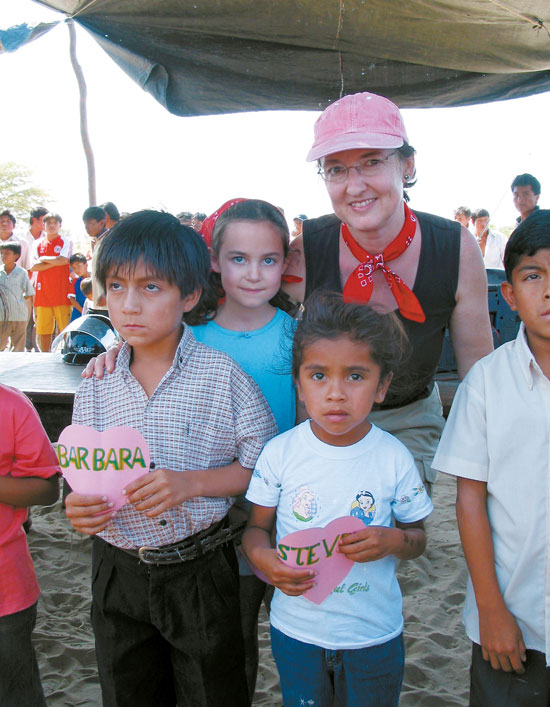
went up from the crowd as the boys with drums escorted us to the pavilion. A row
of first-graders gamely held up pink paper hearts, each one lettered with one
of our names. Our group ranged in age from 70-something down to my 8-year-old
daughter Lily, each of us having come to learn in our own way what our support
for Heifer International really means in a big, parti-colored world. Walking
toward the sun-bronzed faces of a hundred or so expectant villagers, I had a
shaky moment in which I wondered if I could possibly be what they expected me
to be. I scanned the row of kids for the paper heart that said “Barbara,” and
my shy moment passed. I bent down to kiss the shrinking violet of a schoolboy
who had the task of greeting me. They expected nothing of us, beyond a symbolic
acceptance of gratitude. Heifer has changed this village. They wanted to show
us how.
We took our seats on a long bench in the shade of an
open shelter built out of sticks and branches. The festivities began: first,
the marinera, a local dance interpreted by a teenage girl — barefoot and lithe
in a long black skirt and yellow ruffled blouse — and a boy, dignified beyond
his years in boots and hat, waving a white kerchief. To the recorded music from
a battery-powered cassette player they moved sinuously and precisely, circling
and raising their chins together like mating cranes. It was a breathtaking
gift, a moment of beauty from this place to take home with us. Next came
singing and a morality pageant about responsible behavior. The crowd laughed at
the school kids’ antics but also began to buzz with anticipation. We weren’t
the only ones who’d come a long way for this occasion. The crowd around us
suddenly felt enormous as more and more people arrived from other villages to
witness the event they’ve all heard about: compartir recursos!
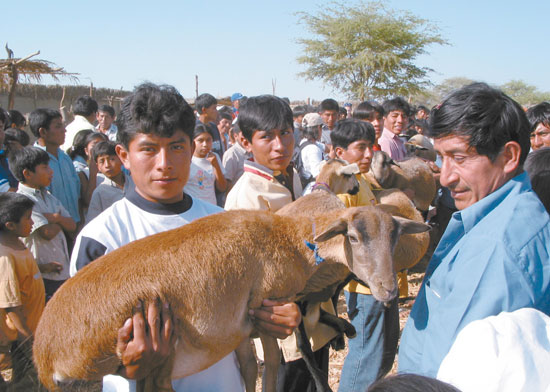
A simple idea, put into practice, becomes magic. On
this day, some 20 families that had received sheep or goats through the Heifer
project were going to share the offspring of these animals with 20 other
families. The village had agreed upon a list of people who were most in need —
but there were not enough animals, so 20 recipients’ names had been drawn by
lottery. The selected beneficiaries now lined up against a wall at one side of
a large corral. Out of sight, sheep and goats bleated behind a fence as their
owners prepared them for the ceremony. As the crowd assembled I walked over to
a tiny widow dressed in black who was soon to receive the gift.
“Will these be the first animals you’ve ever owned?” I
asked her in Spanish, hoping my question would not insult her, if the answer
was no. She leveled me with a flat gaze. “Of course,” she said. “I’ve never
owned anything. I’m poor.”
I gulped, accepting an utterly indisputable definition
of “poor.” I studied her face, realizing that I’d received the impression
“elderly” only from her clothes and demeanor. Her skin had endured a lot more
sun than mine, and her hands, undoubtedly, more hard work, but she might have
been about my age. I retreated to what every mother considers safe territory
and asked, “Do you have children?”
“Six sons,” she replied. Or sons and daughters,
possibly — in Spanish the noun for a mixed group is masculine. I looked around
for some of these sons or daughters. For an occasion this important it seemed
they ought to be here, but this woman stood alone.
“Are they here?” I asked.
“They’re all dead,” she answered, again without much
emotion, and once again I adjusted my mental notion of small talk.
“I’m sorry,” I said. She nodded curtly. Her emotions
in this moment were surely too large to discuss with a stranger. What was about
to take place was not, for this woman, any sort of sentimental pageant. It was
survival.
We stood together silently then, listening to the
subdued bleating on the other side of the corral where animals were being shepherded
by their handlers toward new ownership. I tried to imagine this woman’s sense
of who those shepherds were, over there, and what she must be feeling toward
them: gratitude, of course, and perhaps some degree of awe. These neighbors
were now benefactors, people who knew new things — animal husbandry, the luxury
of household provision and perhaps most amazingly, the prosperity of having something to give away.
I wondered how this woman’s life would change. Soon,
perhaps already as I write these words, she’ll have milk, manure for a garden,
eventually meat to eat or sell. In a few years she will have something else.
From one flat word, poor, her self-portrait will grow more complex as it comes
to include the words compartir recursos, a ritual whose importance
derives not just from the receiving, but also the giving. With luck and health,
she will live to stand on the other side of a ceremony like this one.
Suddenly dust flew and the corral filled with the
noise of hooves, shouts and laughter. Eager animals pulled their handlers across
the divide. Tether ropes wound up into knots as the skittish animals were
handed across. A few men embraced, and several more wiped tears from their
faces. Some members of our visiting group took pictures. For my own part, I could
only watch and try to understand the depth of human transformation that lay
behind the simple act of a tether rope changing hands.
Since the day I first saw a colorful Heifer brochure
promising that my gift of a flock of chicks or a goat could change someone’s
life, I’ve believed that promise in an abstract way. Each time I wrote a check
or volunteered, I pictured kids gathering eggs or a boy waving a branch at a
water buffalo, driving it toward the plow. I imagined mothers milking goats and
making cheese, preparing rich white protein to feed their children. Now that I’ve
been on a Study Tour, I can verify that those happy images are true. High in the
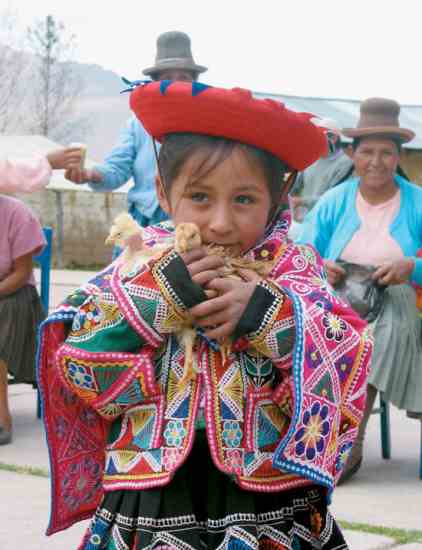
Peruvian Andes we saw women grinning from ear to ear as they received baby chicks
into their aprons, round bowler hats and the bright folds of their skirts. We
watched their daughters chase the pullets across a schoolyard, excitedly
counting their eggs while the hens were barely hatched. In a remote desert in
the lowlands, we watched a mother pat out goat cheese with her hands, dribble
honey over it from her own hive, and bend down to give a nourishing bite to her
toddler — after first sharing some with us, her guests. I was lucky enough to
witness the pride and burgeoning health of families all over Peru who explained
to us how they cared for their animals, how they used their new resources and
skills to improve the health of the surrounding forests and soil, how they’d
begun to count on a future they could not have imagined a few years ago.
What I never really understood before this trip,
though, is what it means to pass a newly secured future on to a neighbor. The
eradication of poverty involves more than satisfying physical needs. It means reaching,
somehow, the soul of a woman who has lost husband and children and describes
her entire life with the single word “poor.” Her grief goes beyond hunger, I
imagine, into a sense of human irrelevance. To trust that our lives have meaning,
everyone needs to effect some tangible change in the world. It’s why I donate
to Heifer. Why should I think I’m alone in that desire?
In Baja Piura, after the dust of the ceremony had
settled, I ate dinner with Luis Gómez Abramonte, a staff member from Heifer’s Piura office. An
agricultural ecologist, he did research at the university before taking the job
here. He greatly prefers working for Heifer, he said, because of the practical
effectiveness of the work. Expansion is automatically built into the project
through each recipient’s contract to pass on the gift. Heifer has now reached more
than 2,000 families in the Piura
area alone. I had a hundred questions, and sorted through them to try to get at the basic thing I
wondered about: Does it always work this well? Does every recipient become a
benefactor?
Luis answered me patiently: Sometimes animals get sick
and fail to reproduce, though this is rare because the project provides
veterinary training. This, too, is a gift passed on, since every technician trained
in animal care agrees to train others.
I persisted, “But when there is an increase — a
profit, you could say — it gets shared?” My doubts arose from a lifetime of
having been scolded as a ridiculous optimist, I suppose — too many warnings
that human nature is ultimately greedy. “Everyone always passes on the gift?”
Luis smiled. “For most participants, that passing-on
is the best day of their lives. Why wouldn’t they show up for it?”
Why, indeed.
Barbara Kingsolver grew up in Kentucky and was trained as a biologist
before becoming a full-time writer. Her books include Small Wonder, a
collection of essays, and Last Stand: America’s Virgin Lands, prose
poetry set alongside the photographs of Annie Griffiths Belt. She lives with
her husband, Steven Hopp, and two daughters on a farm in southern Appalachia. For more information about Heifer International
or to donate go to www.heifer.org.






