

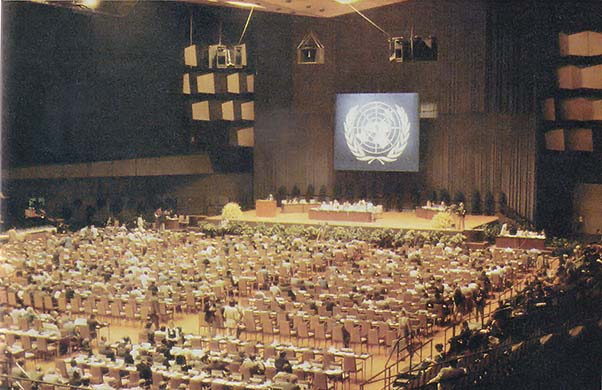
In 1979MOTHER EARTH NEWS’ own Copthorne
Macdonald returned from an extended European trip, during which he attended the U.N. Conference of
Science and Technology for Development (UNCSTD) in Vienna .
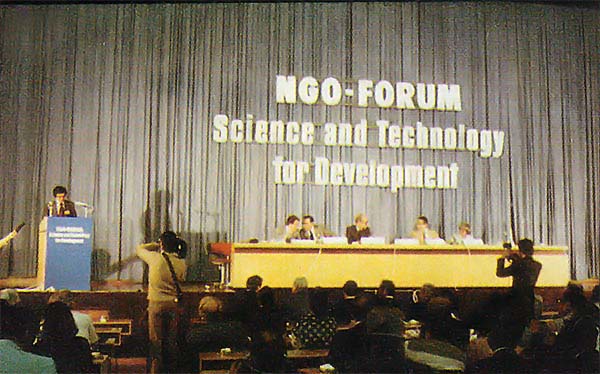
. . the Non-Governmental Organizations Forum (NGO Forum)
held in the same city . . . and Britain’s Community
Technology Festival (COMTEK). This was the first in a series of reports on these economic development conferences and technology forums.
Just imagine for a moment that you’re a government
official in a poor land … a country where many babies
don’t live to see their first birthday. Given the
opportunity, you’d certainly be willing to make a deal with
a multinational corporation to have that firm build a
pharmaceutical plant in your nation … especially if the
company agreed to limit the plant’s profits to a reasonable
level above its costs. After all, such an arrangement would
provide your people with a reliable supply of inexpensive
drugs … which might help save some of those children from
dying, right?
Wrong! You see, the “fine print” in the
arrangement says that the “raw” chemicals used by the
pharmaceutical plant must be purchased from other companies
owned by the same corporation. Now you might have thought
the stipulation unimportant during the negotiations, but
the truth of the matter is that the supplier firms will
probably charge up to 1,000% more than the open market
price for the raw materials … so the finished medicines
won’t be inexpensive at all!
Unfortunately, this example
isn’t some far-fetched, barely possible scenario. It’s an
only slightly modified case history of one of the
many rip-offs perpetrated against developing countries by
multinational corporations. It was in the hope of
eliminating at least a portion of just such injustices–and,
in effect, of getting a technological “fair deal” from the
rich lands that are the home base for most international
corporations–that representatives of 120 have-not nations
banded together at the U.N. Conference of Science and
Technology for Development.
Small Concessions (Or None at All)
Although the United States (as well
as many other developed countries) claims to be perfectly
willing to share its technology with poor nations, the fact
is that, in western lands, at least-the governments don’t
often own much technology. Instead, such knowledge
is usually in the hands of large corporations . . . and is
only sold by the firms at their price and on their terms.
The have-not countries that attended UNCSTD (they were
represented by a coalition called the Group of 77) hoped to
eliminate the unfairness that’s a part of many transfers of
technology from wealthy lands to poor ones. However, their
initial proposal (which would have resulted in a binding
international agreement to eliminate the monopolistic and
exploitative practices of multinational corporations) was
defeated.
A second issue that concerned the impoverished
nations was the question of distribution of research and
development funds. The latest U.N. figures show that
international firms spend almost $100 billion each
year, worldwide, on R & D . . . but that only 3% of the
money is spent in the poor lands that could best benefit
from the extra income. The Group of 77 hoped to obtain a
commitment on the part of rich nations to use their
influence to raise this share to 7%. In the end, however,
the requested 4% increase was whittled down so severely
that have-not lands had to settle for less than a 0.5%
larger share of the research and development “pie.”
Perhaps
the single most positive accomplishment of the
entire U.N. Conference was an agreement to establish a
worldwide information sharing system that would benefit
Third World people. The developed countries voted to
provide “the fullest possible access to available
information on the technologies, terms and conditions of
supply, and activities of transnational corporations and
enterprises in the fields of science and technology.” The
agreement sounds wonderful, but such words as “possible”
and “available” tend to be hard to get a grip on. We can
only wait and see whether national governments will,
indeed, force multinational corporations to divulge any
significant information.
Alternative Gatherings
While all the power at UNCSTD was in
the hands of the various national governments (which often
don’t, as you know, consider the needs of their poorest
citizens), there were two “counter conferences” in Vienna
where the human side of technology could be–and
was–discussed.
The first was the Non-Governmental
Organization Forum, which provided a meeting place for
1,400 representatives of 360 organizations and information
networks concerned with technological development as it
relates to filling basic human needs. Among the groups
represented were the International Foundation for Science,
the Max Planck Institute, Friends of the Earth, the Sierra
Club, and our own New Directions Radio Network.
Of course,
the NGO Forum didn’t have any appreciable influence on the
nation-to-nation proceedings that took place in UNCSTD, but
it did provide its participating organizations
with an opportunity to exchange ideas about how each one
can best influence its own government toward honesty and
responsiveness to the needs of the world’s poor … and how
the groups can bypass governments and work,
themselves, to solve specific human problems.
The Alternative Forum and Vienna’s “Eco-Village”
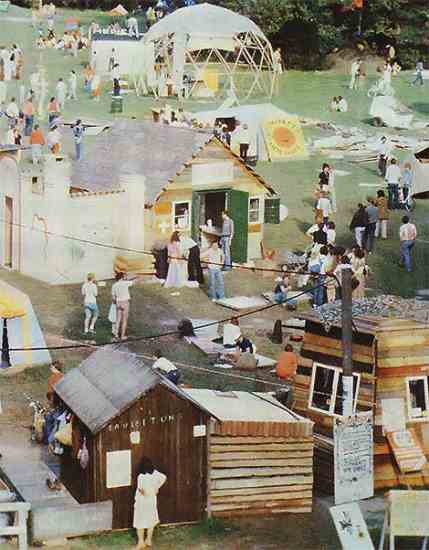
The second of Vienna’s “counter-conferences” was called the
Alternative Forum. It was the brainchild of a coalition of
Austrian groups and individuals concerned with alternative
lifestyles, energy, etc.who managed to talk Vienna’s city
fathers into setting aside part of an urban park as the
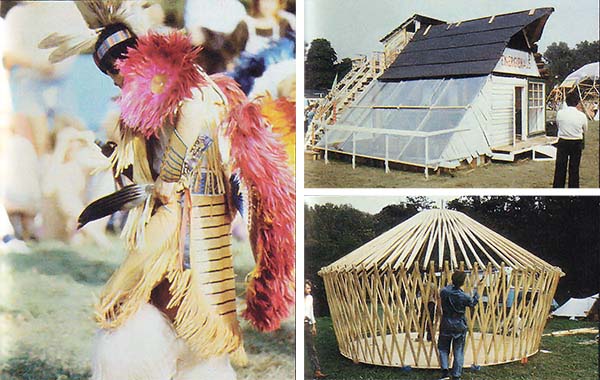
site for a temporary “ecological village” (called
“Oko-Dorf”).
The community was built in less than two
weeks-by a small number of people using scrap materials-and
it may not have been quite what Viennese officialdom had in
mind. Oko-Dorf did, however, provide a gathering place for
interested men and women from around the world.
In
addition, the ecological village was the site of a number
of informal workshops, organized by a group called
Community Action Europe. These courses were divided into
four basic groups of topics classified under the labels
“Earth,” “Air,” “Fire,” and “Water.”
The Earth group
wrestled with the problems of food, housing, health, and
alternative economic systems . . . Air dealt with
communications and organizations … Fire centered on
energy . . . and Water discussed children and human
relationships in general.
Oko-Dorf was a place of
celebration and art, too. One evening, for example, the
Buffalo Child Society (a group of Cree Indians from western
Canada) put on a series of their traditional tribal dances.
On the following night, the Mullkraft Theatre from
Stockholm, Sweden performed its “Energy Ballet”: a mythical
tale that began with the original connection of fire and
hearth . . . then depicted the use of fire for
destructive purposes and the transformation of the
wheel of community into the wheel of industry. Such changes,
the program warned, could result in tragedy for us all.
In
summary, a lot more was accomplished–and more helpful
knowledge changed hands–at the meetings outside
UNCSTD than within that United Nations gathering.
I’ll detail some of the information (and report
on Britain’s Community Technology Festival) in the next few
issues of MOTHER EARTH NEWS.






