
In the matter of strength, a man’s a puny creature. You cannot carry a deer in your jaw, you cannot fly two thousand miles or two feet on your own, cannot ant-like lift ten times your weight. Man’s mind must multiply his trifling strength. But a race of men that has developed aerosol cheese spread leans heavily on its technology, and tends toward caterpillar tractors to move its garbage cans. A few people, watermen especially, rely more on clever thought and simple machines, and know that puny strength can be craftily applied to immense advantage. One of the oldest and simplest machines is the block and its tackle, an idea of such wonderfully spare reason that it seems magical, running uphill against the stream of nature. Its principle is just this: if one line suspends a weight, it bears all the load; if two lines suspends a weight, each bears half the load; if the lines are rendered movable, the weight can be moved with half the effort. There are a few cautions in using blocks. The sheaves must be of sufficient diameter and width for the size of the rope; too tight a turn will damage the fibre. Keep the pivot pin oiled. Figure a safely factor of five; the line you use should have a breaking strength of five times the expected load.
The Busy Shore: The Block and Tackle System

1 / 18
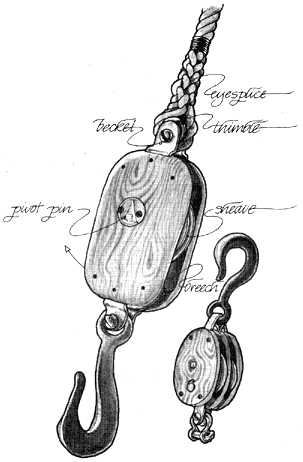
The parts of a block and tackle system.
ILLUSTRATION: MOTHER EARTH NEWS STAFF
2 / 18
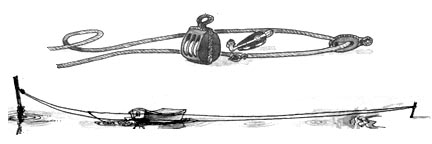
You're especially likely to see a block and tackles system wherever boats are used.
MOTHER EARTH NEWS STAFF
3 / 18
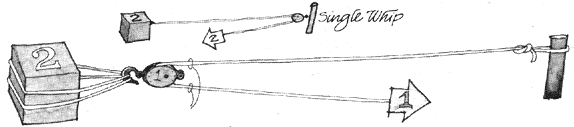
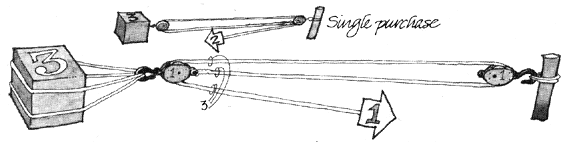
A RUNNER yields a mechanical advantage of 2x when the pull is away from the weight; but toward the weight, a single block only changes the direction of the pull.
MOTHER EARTH NEWS STAFF
4 / 18
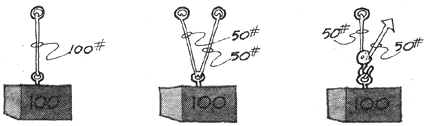
Dividing a weight between two ropes assures that each bears only half the load.
MOTHER EARTH NEWS STAFF
5 / 18
When the GUN TACKLE is rove to advantage (when the pull is in the proper direction) its advantage is 3x; rove opposite, the mechanical advantage is 1.5x.
MOTHER EARTH NEWS STAFF
6 / 18
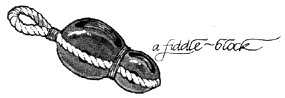
The fiddle block, a variation on the block and tackle concept that places one pulley above the other.
MOTHER EARTH NEWS STAFF
7 / 18
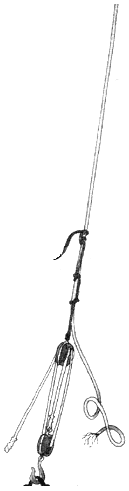
A luff tackle with a tail sinnet instead of a hook is called a HANDY BILLY, and is used for many jobs aboard ship, especially for setting lines taut. The sinnet is half-hitched once or twice around the line to be set, then made fast with a Rolling Hitch.
MOTHER EARTH NEWS STAFF
8 / 18
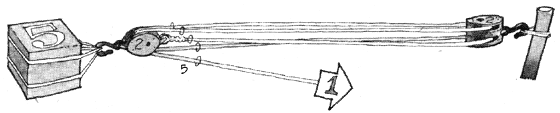
A DOUBLE TACKLE is for heavy work, offering a mechanical advantage of 5x, but requiring much rope and a long haul.
MOTHER EARTH NEWS STAFF
9 / 18
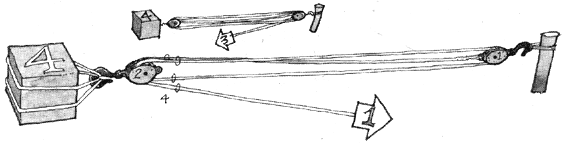
The LUFF TACKLE, with a mechanical advantage of 4x, is used a great deal aboard ship.
MOTHER EARTH NEWS STAFF
10 / 18
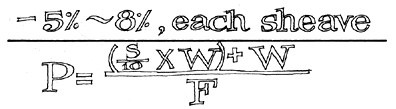
Like all moving machines, friction takes its due, and each sheave demands a part of the effort. Sailors figure that 5-8% is added for each sheave, and a formula estimating a somewhat greater loss is used by fishermen (Pull on the active tine = P; W = Weight lifted; F = number of falls, or lines, from the moving block.)
MOTHER EARTH NEWS STAFF
11 / 18

The SPANISH BURTON is a specialized tackle for short hauls, used for bringing anchors, stores, and dories aboard.
MOTHER EARTH NEWS STAFF
12 / 18
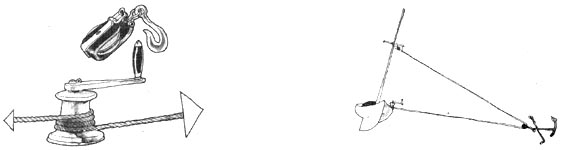
Aboard ship, a winch is often the source for raw power. With a snatch block, the power can be transmitted and directed for almost any purpose. Sailors regularly run aground, and almost as regularly kedge themselves off with their own winches.
MOTHER EARTH NEWS STAFF
13 / 18
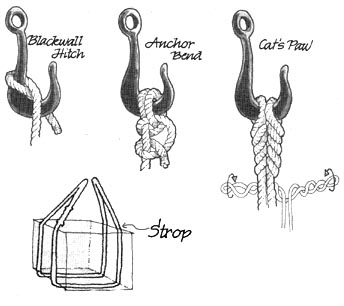
Hook bends make a line fast to a block's hook. The BLOCKWALL HITCH is simple and secure under steady pull. An ANCHOR BEND is more secure for hoisting jerks. Because a single line might slip, a STROP is often spliced up for hoisting; both bights are slipped over the hook, or one is passed through the other and the single bight is secured to the hook with a CAT'S PAW.
MOTHER EARTH NEWS STAFF
14 / 18
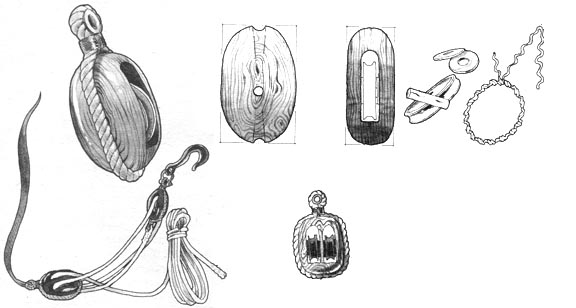
Gee whiz, but blocks are expensive; probably because they are marketed for construction companies and spiffy yachtsmen. You can make beautiful blocks in any case-rope-stropped blocks whose shells are shaped, drilled, and mortised from blocks of locust, elm, ash, madiera, ironwood, or lignum vitae. Sheaves, washers, pins, and thimbles can be had at a good chandlery. The block is stropped with a rope grommet made from a single ropestrand relaid into itself. It is forced around the shell, holding in the pivot, and seized tight with marline. H.G. Smith's The Arts of the Sailor gives the true 'gen on rope-stropped blocks and other watery marvels—fine book.
MOTHER EARTH NEWS STAFF
15 / 18
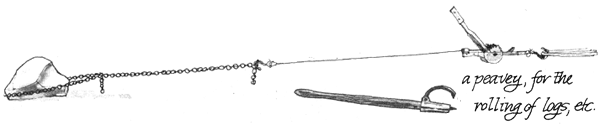
A patent come along can be very handy. A couple of folks can move damn near anything by applying and multiplying their strength cleverly... we are strong in our heads.
MOTHER EARTH NEWS STAFF
16 / 18

A neglected labor-saver is the old-style barrel. Its subtle workings are no less stupendous and historically important than blocks & tackles. One man can move and direct huge loads by rolling it on its converse sides.
MOTHER EARTH NEWS STAFF
17 / 18
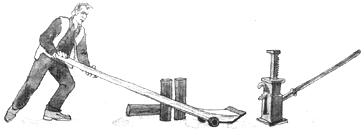
Boatyard workers are accustomed to moving 35 ton vessels with four jacks, some wooden rollers, and a winch. Moving smaller boats, a Johnson bar—a large pry-bar with wheels—is useful.
MOTHER EARTH NEWS STAFF
18 / 18
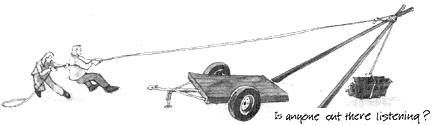
Two sturdy spars lashed into a simple A-frame can be used to lift and move great weights. Vehicles bogged in mud can be lifted right out with a big A-frame.
MOTHER EARTH NEWS STAFF

Need Help? Call 1-800-234-3368
Popular Now

Fire Cider Recipe by Rosemary Gladstar
Fire cider benefits are numerous, it is a traditional remedy known for strengthening the immune system. Get this fire cider recipe by Rosemary Gladstar to boost your health, including two extra recipes.

Make a DIY Waste Oil Heater
With this DIY waste oil heater you can heat a shop or garage, or even your home. The fuel is "free for the hauling."

Build a DIY Wind Generator for Home with a Car Alternator
Turn a car alternator into a homemade wind turbine by building this cheap and easy DIY wind generator.


