



Bats (Firefly Books, 2011) by Phil Richardson helps to show readers the truth about bats. While bats get a bad name for their connection to mythical vampires and their nocturnal habits, Richardson shines light onto the species and shows that’s bats are amazing and complex creatures for various reasons. The following excerpt is information about bat conservation.
Bats are under threat in many areas of the world. Some have declined to such an extent that the numbers remaining may not be enough to sustain the species. Some species, such as the Guam flying fox, Pteropus tokudae, the Puerto Rican flower bat, Phyllonycteris major, and the New Zealand greater short-tailed bat, Mystacina robusta, have become extinct in recent times. Species most at risk are those living in isolation and those living at low densities; any changes to their environment could wipe out the species. Some fruit bats on isolated Pacific and Indian Ocean islands, such as the Comoro black flying fox, Pteropus livingstonii, and the Marianas flying fox, Pteropus mariannus, are at great risk of extinction. Some microbats living in one small area are also threatened such as the Kitti’s hog-nosed bat, Craseonycteris thonglongyai, on the Thai-Burmese border.
Biodiversity and Food Chains
Threats to bat populations matters not just because bats are fascinating creatures in their own right. Our increasing familiarity with the term biodiversity from television, newspapers, magazines and other media reflects the importance biologists place on this aspect of conservation. They are realizing that the more diversity there is in animal and plant populations, then the healthier is the environment.
The easiest way to appreciate what is involved is to recall the concept of food chains and webs from biology lessons at school. It all starts with the producers, the plants that manufacture the food in their leaves by photosynthesis. Animals such as caterpillars then join the chain and eat the leaves, other animals such as birds eat the caterpillars, and so on up the chain. If a species dies out, then there is a break in the chain, and predators that relied on that species could also die or grow weaker as there is less food available. If, like the microbats, an animal is at the end of the food chain and it becomes extinct, then the creatures that it preyed upon will increase in number and compete with others for food and space, so upsetting other food chains.
The fruit bats and some microbats have an even more direct effect. By pollinating plants and dispersing their seeds in the course of feeding, they ensure the survival of many species of trees and other plants and the recolonization of cleared forest. So we have more diversity, but how does it affect us humans? Many of us have become so used to hunting and gathering our food from supermarket shelves rather than in the forests that we forget about the vital importance of food chains. All our food is reliant on plants, and the plants are mostly reliant on animal visitors to pollinate them, creatures such as bees, birds and bats that are all part of food chains.
Maintaining a Balance
There is another important point, a single insect-eating bat may eat hundreds of insects a night, and there are few other nocturnal insect-eaters. Most birds for instance, feed in the daytime on a different set of day-flying insects. Take away a small roost of a hundred bats and there will be a large number of extra insects flitting around the area each night. So bats help to keep a balance in the natural world. Furthermore, they are a great help to humans, as farmland, gardens and house timbers all suffer attacks from insect pests and bats are instrumental in keeping down their numbers.
Hands-on Conservation
One of the most effective steps people can take to help microbats is to increase the number of roosting sites available to them.
Bat Boxes or Bat Houses
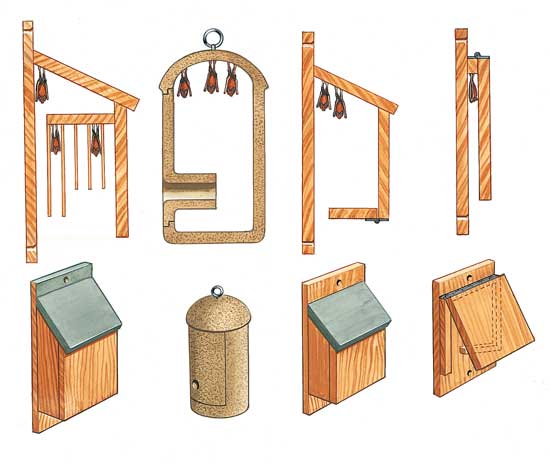
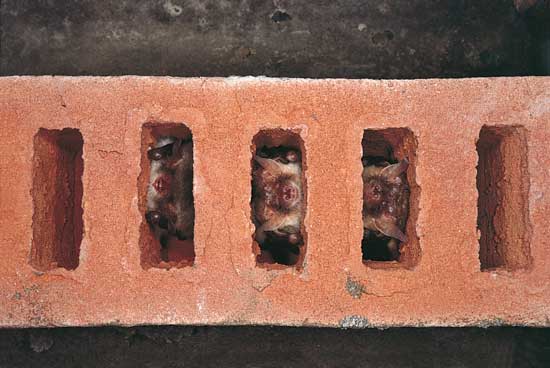
Installing bat roosting boxes, similar to bird nest-boxes but with a narrow entrance underneath rather than a hole in the front, helps increase the number of roosting sites. The size and design need to be tailored to different species, but as long as the bat can crawl from the entrance upwards and hang in a sheltered, dry place in darkness at the top then it should be suitable. Bat boxes are of particular importance in areas such as coniferous woodland, or deciduous woodland where mature trees with holes and hollows are cut down, which contain few or no natural roosting places.
Basically the bat needs to be able to crawl in through a narrow gap, then crawl up to roost out of the draught of the opening. Some species, such as pipistrelles, prefer to squeeze into a roost, so partitions inside may help. Wood is easy to shape, but no preservatives should be used in case they affect the sensitive bats. Boxes made of woodcrete (a mixture of sawdust and cement) last much longer and provide higher humidity levels in summer. Bat houses should be erected on trees or high posts facing different directions to provide variable temperature roosts, and as high as is possible. Strips of carpet wrapped around the trunk of a tree and tacked to it at the top have worked, as have corrugated iron bands and plain boards. Bats have even been found roosting between the bat box and the tree and not using the box itself!
Providing Garden Attractions
If you want bats to visit your garden, then some habitat management may be in order. Try planting shrubs, such as jasmines and honeysuckles, which give off scents at night. The scent attracts night-flying insects and these in turn attract the bats. Insects build up in number where there is shelter, so ensure there is a high hedge or fence or even a row of conifers to protect the garden from the prevailing winds. A garden pond acts like a magnet to insects and bats will feed over it and sometimes swoop down for a drink, too. If you have one, turn on the security light or other outdoor illumination and insects will be attracted, and then the bats will come to feed.
Countryside Management for Bats
Similar habitat management on a much larger scale is starting to happen in state controlled woodlands, where maintenance of firebreaks throughout the wood is linked to insect conservation. Mowing is carried out at certain times linked to insect breeding cycles, and the edges of firebreaks are allowed to grow up a little to add extra diversity. Insect numbers increase and the bats can obtain plenty of food along these avenues.
Tree planting is being linked more to conservation rather than to just providing a commercial resource, so native trees are being replaced when non-native ones are harvested. Old, dying trees are no longer grubbed out, but allowed to rot slowly and provide a whole range of insects that recycle the wood and are, in turn, recycled by the bats. Also the bats can continue to use rot-holes for roosting.
Farming practices are being slowly changed to help wildlife, too. In Europe, subsidies are being given to allow some farmland to remain fallow. There is more financial encouragement to plant hedgerows and laws are now in place to protect old hedgerows after decades of hedgerow removal to increase field size for more efficient crop production. Bats use hedgerows as route-ways to their feeding areas and find more insects where native flowers have been allowed to grow around field edges and in fallow ground. Many farmers are becoming more aware of the benefits of working with nature. The hedgerows provide some shelter from the wind and help prevent soil erosion, and the increased number of insects helps with pollination of some crops.
Biodiversity Agreements
In Europe, biodiversity agreements have resulted in the feeding areas of some of the rarer bats being protected. This means that huge areas of the landscape are managed in a better way for bats and no undesirable influence is allowed to impinge. Some of the horseshoe bats are protected in this way.
Creating Hibernacula
In temperate climates the importance of hibernation sites is well known to bat conservationists. In the UK some bat workers have embarked on the major project of building tunnels to serve as hibernacula for bats. Huge constructions of large concrete pipes angling into the ground for 20 meters (65 feet) or more, and covered with a thick layer of insulating soil. Some of these pioneering conservationists have dug into chalk cliff faces and made caverns suitable for the species in the area. One of the biggest and most ambitious of such schemes to date was built around a pre-existing mine where the air flow was slow, so that any hot air from summer would not allow the cold air of winter to flow in and make it suitable for bats. A local enthusiast decided to build a two-storey concrete building over the entrance and paint parts of it black. During the day the black absorbed the heat from outside and warmed the air inside. This warm air rose and caused circulation around the whole tunnel system, creating a natural air-conditioning system. In addition, summer roosting places were made available for bats in the outside structure. The numbers of bats using the tunnel in winter has increased dramatically since the work, and no less than ten of Britain’s 16 resident species of bats are now found there.
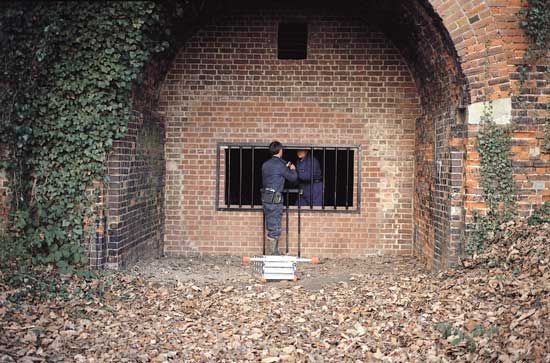
As well as improving such sites by modifying the air flow, which can alter the humidity as well as the temperatures within them, hibernacula can also be greatly enhanced by providing more hanging places for the bats. Many wartime bunkers have been turned into excellent hibernacula by covering them with about 1 meter (3 feet 3 inches) of earth to insulate them. Disused railway tunnels make good sites, but have too much air blowing through them, so blocking one end creates a more stable environment. Modifications such as these need to be carried out with official authority approval and with full agreement from statutory nature conservation bodies. It is too easy to mean well, but find that your adjustments have made the site excellent for a locally common species and useless for the national rarity that used to occur there!
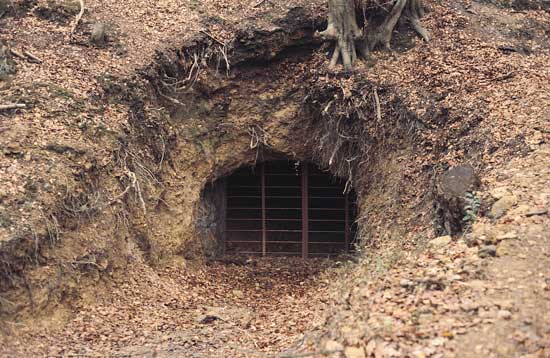
Perhaps the quickest and greatest improvement that can be made to hibernacula is by preventing human access. Some people love to explore underground and they can, by accident or design, inflict damage on roosting bats. Hibernating bats will begin to arouse if the temperature changes by less than 1 degree Celsius (1.8 degrees Fahrenheit). A person standing under a hibernating bat will warm it more than that. As one moves underground, the air is disturbed and warmer air may be wafted onto bats hibernating in a colder area.
Bats are disturbed by noise, too, and not just by sounds such as talking or banging against rocks. They are especially sensitive to high-frequency sounds, and so will be upset by such noises as the rustling of a nylon anorak or the clinking of coins, which give out high-frequency sounds as well as noises we can hear.
Bats in hibernation survive by slowly burning up stored fat. By the end of the winter all of this fat will be used up and, hopefully, insects will be flying again. However, when bats are disturbed during hibernation, they begin to burn up more of their precious fat in order to wake and move to a safer, quieter place. If they suffer too many disturbances, bats will die of starvation.
Erecting horizontal bars across entrances will allow access for the bats, but keep the public out, as long as the bars are the correct distance apart. Usually a gate is included, so that bat surveyors can enter and check all is well each year. Serious cavers should not be excluded from their hobby, but there will be times when the bats are in residence when it is better to avoid entering a site. Close liaison with the cavers is important as they often have plenty of knowledge of the best underground sites for bats. Putting up a noticeboard explaining why the site is closed off may prevent the vandalism that sadly has sometimes been inflicted on such gates.
Protecting Roosts in Houses and Other Sites
Much success has been achieved in protecting bats that are roosting in houses in Europe and the USA by talking to the house-owners and asking them to look after their guests in the attic. After a little education about the importance of bats and the struggle they have in life, many owners are only too happy to help and will carry out annual counts to monitor population levels.
Sooner or later, buildings used as bat roosts need repair. If the work is carried out with care, both the site and the bats can be saved. The bats tend to roost in such places for only part of the year, so there is likely to be a time when there will be none present to disturb. The basic conditions of the existing roost can be copied in the renovations, such as a similar size entrance slit in the same place, the same roosting area and no obstructions outside the entrance. Sometimes, parts of the old timbers can be re-used by the roost’s entrance so the new home smells familiar to the bats.
In England any remedial work on ancient parish churches around the country first requires a report from a church architect. After lobbying from bat conservationists, bats were included on the official report form, so if signs of bats are present then the correct authorities must be notified before work can commence. Including an extra tick box on the forms has meant that hundreds of bat roosts have been saved each year.
In some countries, sites may be protected to help the local employment situation. As well as the importance of the roosts in large bat caves to guano miners there is an increasing tourist industry springing up around spectacular bat roosts. The huge roosts of free-tailed bats are so stunning that tourists happily find them included in their itinerary. The roosting caves in Texas and New Mexico are world-famous and now geared up to cater for thousands of visitors a week passing through to look at the bats. Tourists visit the bigger cave roosts in Indonesia and Thailand too. Interestingly, the protection in the latter can be self-regulating. One tour guide took his party to the roost early and went inside to try to disturb the bats for a more spectacular emergence. The disturbance caused disruption for weeks afterwards and the other tour guides put matters right with a few well-chosen words to the offending guide.
Large fruit-bat camps in Australia, India, Indonesia and New Guinea are also now on the tourist trails. As well as the guides, local businesses all benefit from such bat related tourism.
Bat Watching
Watching bats will provide many memorable experiences; joining one of the many bat watches organized by local bat groups is the easiest way to start. Although bats may be seen flying around any habitat at dusk, it is best to go where they gather in some numbers and can easily be seen in the afterglow of sunset. Lightly wooded edges of lakes are good places to see bats, and it is important to position yourself so the water is between you and the sunset. The brighter sky will reflect in the water and give you a better view of the bats.
Different species arrive to feed at different times, some will feed around the water’s edge, some among the trees and others out over the water. Look out for the different ways the various species fly, some twisting and turning, some following direct paths, some high, others low. When it is really dark, shine a spotlight across the water surface. This highlights the millions of insects on which the bats are feeding, and now and then a bat will fly into the beam. It is possible to illuminate with the beam a particularly large insect as it flies around for the last time and see a bat swoop down and catch it. You will gasp at the daring of the bats’ aerobatics, experience the thrill of the chase as they feed, and be stunned by the skill of these remarkable flying mammals. If you can obtain a bat detector, then a wonderful evening becomes amazing and the exciting ‘movies’ suddenly acquire a sound-track.
Education
Generally information about bats is scarce and the little that does exist is often wrong. Many people have formed their main impression of bats from horror films, so it is hardly surprising that they develop false ideas about them. Bat conservation organizations around the world are now publishing more and more information about bats in books, in the media and on the Internet, and slowly the public perception is changing. Bats are becoming known as harmless, endangered creatures and certainly nothing to fear. Many bat conservation organizations have a junior wing, with publications aimed at the younger enthusiast. But conservationists give talks in schools, and often the teacher learns as much as the students. Adult education is as important as that of the youngsters and educational talks on bats are now commonplace in many countries.
Bats and the Law
Bats and their roosts have been given protection by law in most parts of the world to some degree. In Britain, for example, all bats and their roosts are protected, as are the feeding areas of some species. In the USA, the rarer species are protected across the continent and different states have their own laws, some protecting species at their roosts.
Enforcing the law is another matter, but having a law in place tells people that the leaders of their country believe that bats are worthy of protection. This is an important message to get across. Big businesses, local councils, religious authorities and government departments all have reputations to uphold, and they generally try to avoid breaking the laws regarding bats.
Causes of Death
By far the biggest influence on bat populations results from human activities. Deforestation is killing off many thousands of individual bats and, in some cases, wiping out entire species. Even when some trees are left, they may be exposed to storms and blow over. The soil is soon washed away and the plants that sustain bats by providing insects or fruits can no longer grow. Roost sites are being chain-sawed away. The human impact on the landscape is now immense. Woodlands, fields and other habitats are dug up and replaced by roads and cities, and this affects the bats’ feeding or roosting needs.
In the developed world, agriculture has been highly mechanized and insecticides are widely used to produce high crop-yields. Some of these poisons are ingested by bats and may affect their life expectancy or reproductive success. Researchers have evidence that these poisons can be laid down within the bats’ bodies in the fat reserves used for winter hibernation, so that they act like ticking bombs. The bat survives only until it starts to burn up the fat.
Generally, there are far fewer insects around now than before the wide-scale use of these poisons, so there is less food for the bats. It is likely that the population crashes of free-tailed bats in Mexico were due to the introduction of these powerful modern insecticides into the ecosystem. In the UK such a pesticide (lindane) was widely used in attics to kill wood-boring beetles, and it was also found to kill any bat that came into contact with the treated timbers for at least two years after the spraying. Thousands of roofs were being treated annually, but now a safer pesticide (permethrin) is being used, due to the pressures of conservationists and the law. These are just some of the major indirect causes of deaths, but many others face bats.
Direct Mortality
Direct causes of death usually have less of an impact. Some native people eat bats as part of their traditional diet. With a stable human population, this is usually sustainable, but with modern influences on health, many populations of people are rising dramatically and the bats cannot cope with the greatly increased level of killing.
Natural predators of bats are few. Among the birds, there are some raptors that specialize in catching bats emerging at dusk and some opportunistic owls too. The bat falcon, Falco rufigularis, of the New World and the bat hawk, Machaerhampus alcinus, which occurs from Africa right across to New Guinea, wait outside cave roosts at dusk. Their agile flight enables them to catch emerging bats. Also waiting may be owls, but these are mostly more adept at catching ground mammals and insects flying more slowly and straighter than the bats.
Domestic cats can hear the high-frequency calls of bats and may lie in wait on a high roof for the bats to follow their usual flight path, then snatch them out of the air. Some snakes will lie in wait in the cave entrance and reach out to grab a passing meal. Locally, such predation can be devastating, as on the Pacific island of Guam, where the introduced brown tree snake, Boiga irregularis, has decimated bat populations.
Natural disasters occur, cave roofs collapse, caves flood, tree roosts blow over in the wind, weather patterns change so fruit or insects are not available at a time of need, hurricanes hit an island and strip it of fruit and cover. Individual bats miscalculate and get trapped on barbed wire, are knocked down by cars, hit power lines, fall into ponds or meet some other untimely end. They have been found floating in toilets, electrocuted in a light switch in a house under construction, caught in mouse traps, impaled on car aerials, and drowned in water tanks in house roofs. In India it is sad to see the corpses of Pteropus giganteus, one of the largest species of flying foxes in the world, on the overhead power lines. They land on the top wire and swing down, just touching the bottom wire to conduct themselves into oblivion. Smaller bats hang up with impunity.
Myths Exploded
As blind as a bat. Wrong. All bats have good eyesight, especially in dark conditions.
Bats fly into your hair. Wrong. Why would they want to? Microbats have such a superb echolocation system, they can easily see a single hair stretched in front of them and avoid it.
Bats in the belfry. Rarely true. Bats in churches are often in the nave or chancel. They do not like the noise of the bells, or the cold conditions and the pigeons. If the belfry is disused, however, then bats may move in.
Bats drink blood. Most of the world’s bats eat insects and fruits, and out of a total of almost 1,100 species only three species in tropical areas of the Americas take small amounts of blood.
Such false assumptions as those outlined above are constantly repeated around most of the world and, being rarely questioned, are often assumed to be true. No wonder people are nervous of bats if they are misled into thinking that they are blind, cannot see where they are going, will fly into their hair and then drink their blood!
Disease
Disease can wipe out local populations of bats. Little is known about diseases afflicting bats, and few have yet been identified, but they are thought to have had a major effect on some of the fruit bat populations. Roosting colonially, the whole population is likely to be affected. The endemic Solomons flying fox, Pteropus rayneri, was surveyed in Choiseul in 1995 and its population was found to have decreased from 50,000 to 15,000 in just ten years. A disease thought to have been brought into the island by domestic animals was believed to be one of the main reasons for this serious population crash.
Estimates of over a million bats dying in winter hibernacula in the northeast USA since 2006 have been reported. All have fungus on their noses, and sometimes on their wings, so it has been dubbed ‘white-nose syndrome’ and is attributed to the snowy-white fungus, Geomyces destructans. The bats seem to arouse when infected, fly around, when they should be conserving energy, and so burn up stored fat and die from starvation. Extensive testing still has not determined how the fungus causes death nor has any cure been found. In the meantime tens of thousands of bats are dying each winter, principally the little brown bat, Myotis lucifugus. Presently the effects are restricted to this one area of the world. The fungus has been found on a few bats in Europe, but they have not died from it or any associated pathogens, nor have there been mass-deaths.
Published by Firefly Books Ltd. 2011 / Copyright © 2011 Natural History Museum / Images © Phil Richardson






