

The following news items originated from multiple sources.
Anatolian Shepherds Save the Herd
For many years my family lived just outside Durango,
Colorado, surely one of the most beautiful places in the
United States to set up a household and raise children.
Armed with years of experience tending a cattle farm, we
became a ranching family and gambled on deriving all the
household income from raising beef cattle.
I was on my way to the mailbox one winter morning a few
years after we moved in, when I saw my first set of
mountain lion tracks. I was thrilled, eager to catch sight
of this “rare” and “shy” predator that I’d heard so much
about from the news and public television. How naive I was.
Just a few weeks after seeing those tracks in the snow, I
lost my first head of cattle–its 2,000 lb of bone and
muscle crisscrossed with the claw marks and jagged bite
wounds of the mountain lion.
In the months that followed, we lost thousands of dollars
in exotic livestock and on several occasions came very
close to being attacked ourselves. The lions that hunted
our property showed no fear of humans whatsoever. They
walked up our driveway in broad daylight, attacked our
animals and pets at random, and ignored our shouts, our
sticks, and our dogs as we futilely tried to drive them
away. Late one fall afternoon, a house guest of ours pulled
into our driveway only to have a lion jump onto the car
roof and paw at the windows.
We were not the only family experiencing problems. After
getting a few neighbors together to discuss our cattle
losses, I learned that my family was lucky. Our closest
neighbor, who raises Red Angus cattle, was so plagued by
lion kills that they were compelled to move their yearlings
into an enclosed pen next to their house, and to illuminate
the pen with floodlights all night long. Less than a week
after using the pen, they awakened to find every one of the
animals in the pen killed or badly maimed by lions. Last,
an acquaintance who lived some miles away told of her
husband being attacked as he bent down to open the water
spigot in his field. It was difficult to imagine that this
man posed a threat to, or cornered the lion in any way,
while he was standing in the middle of his field.
I don’t intend to wage war against the mountain lion. In
their natural habitat, they are magnificent creatures. And
their reasons for a newly expressed aggression against
humans and cattle are clear; loss of natural territory to
man, combined with protection from hunting, have made the
once dwindling lion and cougar a more pronounced presence
both in the wild as well as the `burbs. But we had
to find a way to protect our property and children.
An answer finally came from a fellow rancher who had some
luck with guard dogs. “Our dogs have never been able to do
a thing,” I replied. “One was even killed when it gave a
lion some trouble:” He assured me that the dogs he was
referring to, Anatolian shepherds, were not run-of-the-mill
house pets, but some very serious animals. He further said
that since buying his first pair of Shepherds, he hadn’t
had a single loss. I was sold.
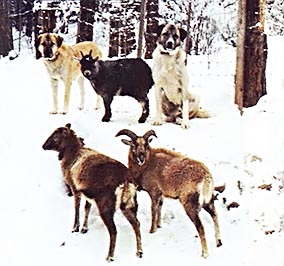
I was surprised to find that when Boaz and Tess arrived at
my house, they weren’t the snarling, drooling hounds of
hell that I had anticipated, but simply large, handsome,
and surprisingly friendly dogs. Specifically bred in their
native Turkey for the purpose of defending property and
cattle against intruders only, these 150-lb. dogs identify
with owners remarkably well and are particularly gentle
around children. Furthermore, they are bred to intimidate
first and foremost, and to attack only if necessary. So
they pose little threat to those people who wander
mistakenly onto the property. Backing off will solve the
problem immediately. There were several occasions when we
know the dogs and lions faced off, because we could hear
the lion’s snarls over the dogs’ growling, but we never
found any dead or injured lions, a testament to how
intimidating the dogs are.
Not only have we not suffered another lion kill, the dogs
have also been effective as protection against coyotes,
stray dogs, skunks, hawks, eagles …even rattlesnakes. I
heartily recommend them to any home that is forced to share
space with predators as an alternative to the gun. Though
not exactly cheap at anywhere from $500 to $1,000 each,
they will pay for themselves, by saving the life of just
one head of cattle. Contact the Anatolian Shepherd Dog Club
for more information on Anatolian shepherd availability in
your area.
— Kris Bryant
Ethanol Extraction Improvement
Corn is not only a favorite at summertime barbecues, but
also a major source of ethanol. Under a cooperative
research and development agreement with the National
Renewable Energy Laboratory (NREL) in Golden Colorado, and
the New Energy Company of Indiana, some surprising advances
have been made in boosting the efficiency of the
traditional dry milling process of corn. They have
discovered a new process that makes ethanol extraction 13%
more efficient.
The traditional dry milling process breaks down the
starches in the corn kernel with enzymes and then ferments
the sugars with distiller’s yeast to make ethanol. Because
the starch makes up only 72% of the corn kernel, the new
process uses the leftover stillage from the distillation
process, which contains starch, fats, fibrous material
(cellulose, lignin, and hemicellulose), and protein. The
fiber is then taken from the stillage, broken into sugar,
fermented, and the ethanol is again extracted. The
remainder becomes feed.
The purpose of ethanol is not to replace gasoline, but to
make existing supplies of the fossil fuel last longer. It
could also make a significant contribution to the cause of
reducing pollution. When added to gasoline, ethanol boosts
octane and reduces carbon monoxide emissions. NREL is now
conducting experiments with a variety of resources, such as
switchgrass and trees that can be harvested at short
intervals, in hopes of getting the same results. The main
problem with using the new process is that, for the time
being, the ethanol extract is more expensive than gasoline.
The cooperative’s next task is to address that economic
issue. It is certainly a step in the right direction,
however.
Saving the American Chestnut
Those chestnuts roasting on the open fire at Christmas were
probably Italian. Thanks to a turn of the century blight-a
devastating fungus that all but wiped out the American
variety–foreign nuts have played an increasingly
large role in nationwide chestnut sales. But University of
Florida researchers say an experiment is under way that may
help pull American chestnuts out of the fire; or maybe put
them back in again. They have been successful recently in
growing a hybrid chestnut resistant to the blight. “There’s
a huge potential for commercial production of chestnuts in
our country.” said Gary Brinen, a UF extension agent.
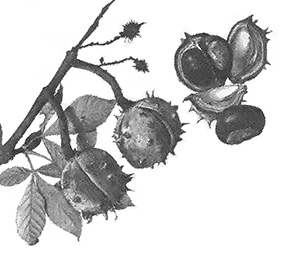
Labeled the Dunstan chestnut, the hybrid was initially
developed by breeder Robert Dunstan in the 1950s by
crossing a single blight-resistant chestnut growing in Ohio
with a Chinese variety also naturally resistant. Dunstan’s
grandson, R. D. Wallace, has finished development by
growing 100 acres of blight-free chestnuts in his tree
nursery in Alachua, Florida. He reports that the new
Dunstan trees produce sweet, flavorful nuts superior in
taste and size to both foreign breeds and even their
original American cousins.
Before the blight, chestnuts were an important source of
food for the early settlers, natives, and wildlife of North
America. Now Americans consume less than one ounce of
chestnuts per person annually. “One out of four trees in
North America was an American chestnut before the fungus
from Asia attacked their bark and branches in 1904, wiping
out just about every chestnut tree by the early 1940s,”
Brinen said. “We lost about 3.5 billion trees during that
time.”
–Jani Spede






