Did my previous MOTHER EARTH NEWS amateur radio article excite you about the possibility of dialogue-at-a-distance via your own personal communication system? If so, you’ll be happy to know that–in the best “MOTHER EARTH NEWS tells you how” tradition–we’ll be around in this and future issues to help you add this particular alternative to the matrix of others you’re putting together.
One-way media such as books and magazines are great…they’ve helped change my head about a lot of things. But we also need to rap, to engage in dialogue, to try our newly hatched ideas on other human beings and get their reactions and input. I hope you’ll join us in doing just that.
The emphasis in this column will be different from that of the ham magazines (which stress the mechanics of radio). Instead, New Directions’ interest is people and their need to communicate. For us, the hardware exists as a means to a human end…an instrument to help us expand and develop our humanity through contact with many who would otherwise be out of reach. We’ll use the technology, and learn what we must about it, but we’ll think of it as a tool –like a knife or a plow or a stove–possessing neither wondrous magic nor hidden devils.
Every technology has an effect on life and Mother Earth. What is the impact of ham radio? Well, a typical rig requires a few pounds of various materials for its creation, and an average power input of a hundred watts or so while it’s being used (the same amount that’s needed to work a 100-watt light bulb). The equipment has a useful life of many years, and produces no emissions harmful to living organisms. Some large ham antennas are considered eyesores (as, on occasion, are windmills). Simple wire aerials, however, are seldom noticed.
The question of whether or not the human benefits of do-it-yourself radio are worth this price is a personal value judgment. Obviously, my evaluation is that they are.
Gathering Places
The on-the-air meetings mentioned in MOTHER EARTH NEWS are underway. The New Directions Roundtable is a scheduled get-together in which an individual presents an interest or concern of his own and a group rap session on that subject follows.
Initially, presentations are on 14,253 kilohertz at 3 p.m. EST and on 7,163 at 5:30 p.m. EST, Sundays. Discussions begin immediately thereafter on 14,243 and 14,283 for the early session, and 7,163 and 7,233 for the later session. (if you’re a ham who wants to get involved and you don’t hear any of the above activity, drop me a line. Circumstances may have necessitated a change of time or frequency.)
Needed immediately are gathering places where we can meet like-minded folks. Since some frequencies may not work out, for one reason or another, participant lists will be kept as up-to-date as possible in future issues of MOTHER EARTH NEWS. Remember that these are target frequencies subject to prior occupancy by other hams. If “our” location is occupied, tune a few kilohertz to either side.
We also need a distinctive call. How about “CQ New Directions”? As our numbers grow we can get more specific with signals such as “CQ Homesteaders” or “CQ Wind Power”. (“CQ” is a general call inviting any station to answer.)
A serious thought, gentle folk: Let’s be good neighbors to our more tradition-oriented brethren on the ham bands. Those who have lived a life 40, 50 or 60 years long based on a certain set of values and assumptions will naturally feel threatened and upset whenever their beliefs are questioned or challenged. If we care about these people as fellow human beings, we’ll gently encourage openness while remaining open and avoiding a smug attitude ourselves. (Once we’re convinced we have “the” answer, it’s all over for us too.)
Let’s be on guard, then, against drifting into the righteous self-satisfaction of a new elitism. The truths I accept today I accept tentatively, and increasingly realize that they will no doubt prove to be partial. The tradition-oriented hams are into some valid partial truths too. The task is to stay open to all inputs, and keep sifting.
Some Basics
“Hey! What’s with this ‘frequencies’, ‘kilohertz’, ‘CQ’ and all that?”
OK–now that the message to the “already” hams is out of the way–gather ’round, all you “want to become” hams. First subject: technical terms and abbreviations.
When we’re first exposed to a concept that is new to us, it generally takes a number of words to get the idea across. Once the meaning is grasped, however, the whole explanation can be replaced by a word or two–a technical term–and it’s not necessary to use the long-winded statement every time we want to refer to the concept.
I intend to use plain English as much as possible in this column and to minimize the technical jargon, but there are some common time saving expressions and abbreviations that you’ll want to know. My intention is to define these new terms the first time they appear, if their meaning isn’t made clear by context.
Let’s begin with frequency, something that most of us already understand in musical terms. For example, middle C struck on the piano makes some of the strings vibrate up and down 256 times per second. The motion causes the air to compress and decompress at this same rate, and we hear a sound which some can identify as middle C. If the note A is struck, we hear a tone of 440 cycles per second or 440 hertz. (About 10 years ago some erudite group did away with the very descriptive term cycles per second and substituted hertz in honor of Heinrich Hertz, one of the founders of radio.) We perceive vibrations in the air at frequencies ranging from 20 hertz to 15,000 or 20,000 hertz (15 or 20 kilohertz ) as sounds.
Another set of very interesting and useful vibrations exists, not in the air, but in electric and magnetic fields. This “electromagnetic” radiation occurs at frequencies ranging from the audio level up to astronomically high rates.
Some frequencies of electromagnetic radiation can be perceived directly by our bodies. If a device happened to emit radiation at 545,000,000 million cycles per second (megahertz) we would detect the emission as green light. If the frequency were 10,000,000 megahertz, we would feel it as radiant heat.
Most such vibrations, however, are not detected directly by our senses. Ultraviolet (UV) light, X-rays, gamma rays and cosmic rays are all too high in frequency. Other unperceived levels of radiation–which vibrate at a slower rate than light or heat–are the so-called radio frequencies. They’re all around us right now, unnoticed.
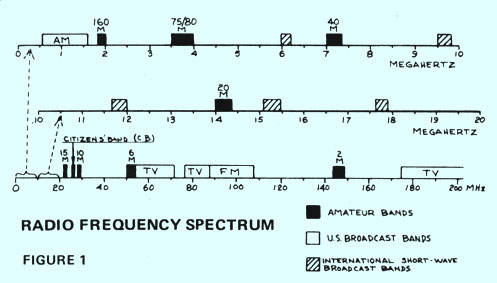
Ham radio has been assigned frequencies in this scheme. Note that the various communication services are assigned not just single frequencies but bands of frequencies. The AM broadcast band, for example, extends from 540 kilohertz to 1,600 kilohertz. The stations are spaced at even 10 kHz intervals within these limits, so that there are 106 spots available. (Since the range of a broadcast station is limited, many can be assigned to each frequency without interfering with one another.)
Hams, too, have their own place in the electromagnetic field. In fact, they have more than one: Through some remarkable human foresight (or bureaucratic error), amateurs have been allotted many different bands in various regions of the radio spectrum. Moreover, they’re not told–as broadcasters are–to operate on specific frequencies within their territory but are free to move around within prescribed limits.
How Ham Radio Works
A ham radio transmitter generates energy at a specific frequency and feeds it to a launching device called an antenna. This mechanism may be simply a wire of appropriate length, 30 or 40 feet above the ground, or a more complex structure of aluminum tubing. In either case, it takes the energy and thrusts it out into space.
What happens then depends upon many factors. If the antenna is simple, the energy heads away from it in straight-line paths and in almost all directions. At frequencies around 100 megahertz (those assigned to FM and TV broadcasting), it almost invariably keeps going in those same paths. Since the earth curves and the people who are to receive the transmission live on its surface, they must not be far away from the source or this line of-sight signal will pass high above them.
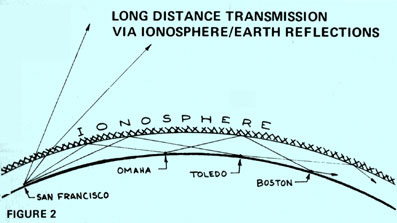
The signal will more often than not pass over them, that is, if it weren’t for an interesting phenomenon in the 3 to 30 megahertz (3,000 to 30,000 kilohertz) range. The atmosphere 50 to 200 miles above the earth becomes ionized. That is, the intense solar energy which bombards the earth is able to pry electrons off the few gas atoms floating around at that altitude. This charged ionosphere acts like a mirror to the energy of certain frequencies arriving at certain angles, and bounces the transmission back down to the planet’s surface. There it may be picked up by a receiving antenna and/or reflected off the globe back toward the ionosphere. Under optimum conditions, transmitted signals can bounce halfway around the world via multiple reflections.
Which frequencies will be reflected, and how much energy will be lost in the “mirror”, depends on the time of day or night, latitude, season of the year and various happenings on the sun. Solar flares mess up transmission. Sunspots are helpful, but come and go in an 11-year cycle. Since we’re approaching the worst part of their current period, there are only three amateur bands particularly suited to New Directions Radio at the present time (as compared to five useful bands at a sunspot maximum).
What we can expect in the way of radio wave propagation–transmission characteristics–on these three bands is summarized below:
   Normal Transmission Capabilities of the 80, 40, and 20 meter Amateur Bands
                                       |      ------------- Range in Miles --------------
   Amateur Band  |    Frequencies      |    Midday       Early Morning/     Late Evening/Dawn
                                                         Early Evening
   ------------------------------------------------------------------------------------------
   75/80 meters    3,500 -  4,000 kHz    0-250           0-20, 100-1,000     0-20, 200-2,500
      40 meters    7,000 - 73,000 kHz    0-20, 100-800   0-20, 300-2,000     0-20, 1,000 up
      20 meters   14,000 - 14,350 kHz    0-20, 700 up    0-20, 1,000 up      0-20 only

   Notes: The 75/800 and 40 meter bands are subject to high static interference levels on summer evenings, after dark.

   The 40 meter band is shared with foreign broadcasters and interference can be troublesome at night.

   On the 20 meter band, the conditions are usually good to some distant part of the world from early morning to mid-evening.
Note the poor coverage of nearby areas in many cases: The signals actually bounce or skip over adjacent territory and return to earth at a greater distance. Each of the bands is split up into smaller sub-bands according to class of license and permitted modes of transmission, but propagation is fairly uniform on all frequencies within a given range.
So much for the transmission of a raw signal. Now let’s make this “carrier” take a message along with it. The process of adding intelligence to the transmitted energy is called modulation and here are the more popular variations:
MORSE CODE OR CW gives the most miles of transmission per watt of transmitter power under normal conditions. It also requires the simplest and least costly equipment. The main disadvantage is the slow rate of information transfer. . . as few as five words per minute for a beginning novice, up to 20 or 25 wpm for a very proficient operator. (Now you know why all those dumb abbreviations used by ham operators got started!) In sending code, the telegraph key simply turns the transmitted energy on and off.
VOICE OR PHONE modulation is much more popular today than any other mode of ham operation. Modern single sideband (SSB) transmitters simply take the natural audio frequencies of the human voice (300 to 3,000 hertz) and move them to a frequency in an amateur band: 14,200,300 to 14,203,000, for example. The miles per watt of “reach” with this method are not as great as with code, although the system has much better range than commercial stations generally realize in the AM broadcast band. The disadvantage of SSB is that the signals sound unintelligible–like Donald Duck–unless carefully tuned in on a receiver designed for single sideband reception. (Most portable shortwave receivers, for example, do not have the necessary BFO–beat frequency oscillator –to make SSB-carried voice understandable or SSB-modulated code audible.)
SLOW-SCAN TELEVISION OR SSTV is a technique by which pictures are converted to audio frequencies in a special TV camera or scanner. The weird whistling sound which results is then sent by a regular single sideband voice transmitter. At the receiving end the “sound” is reconverted to a picture which is “painted” in yellow light on a special picture tube. (The SSTV equipment, bought new, costs about $600 in addition to the cost of the basic SSB voice transmission equipment.)
RADIO TELETYPE OR RTTY is a possibility for all you former typists out there in the woods. Surplus teletype machines are available for $100 or so and can be attached through an adapter box (more money) to an SSB voice transmitter. You type on your keyboard, and the ham at the other end gets your message printed out on his machine.
FCC Licensing
Why should I need a license from the federal government just to bounce a little energy off Mother Nature’s bountifully provided ionosphere?” It’s the old question of governmental control versus anarchy. Regulation always seems to end up being unfair to someone. Without it, however, the weak tend to get clobbered.
You can argue the question all you like, but we still have to face the fact that operating a ham transmitter without a license subjects one to the very real possibility of a $500/day fine. The licensed ham who knowingly communicates with an unlicensed station (or breaks any other FCC rules) subjects himself to that same penalty and runs the further risk of losing his operator’s permit. That’s a heavy trip to lay on someone else. Let’s work the airwaves strictly “by the rules” so we don’t give anyone so inclined a “legal” excuse to wipe out alternative-oriented radio.
“Well, what can I do and what can’t I do if I get a license?” First–in addition to using the various modes already mentioned–you’ll be able to eliminate some long distance phone bills if you can contact a ham with a phone patch who lives in the same local telephone calling area as the person you want to talk to. (A patch is a device that connects the transmitter and receiver audio of an amateur radio station into the telephone circuit.)
You can also take advantage of a new FCC rule with interesting ramifications for communes. The regulation says, “The licensee of an amateur station may permit any person to participate in amateur radio communication from his station provided that a [licensed] control operator is present and continuously monitors the radio communication to ensure compliance with the rules.” Which means that anyone in the group can operate the equipment, use the station call letters–do the complete ham radio thing–just as long as one member has a license, is present, and listens to what’s going on. Another plus for communal or cooperative operation is the low per-capita cost of the equipment when several people share one station.
Furthermore, you can operate away from the home station location. . . in the woods, from another house, on a bike, in a truck, or on a boat in the middle of the ocean. Many foreign countries will let you transmit from within their borders if you have a U.S. license.
Except for the Novice level (which is intended just to get you started), ham licenses are renewable for five-year periods upon payment of a $4.00 fee. No additional test is required. Once you’re in, you’re in. Unfortunately, the application fee for a new permit is up to $9.00.
While there’s no way to contact another ham on demand (unless he leaves his receiver on and tuned to your calling frequency), you’re free to operate as much as you want to and can set up schedules to meet friends on the air at a given time, on or near a given frequency.
Along with these privileges, the FCC lists a strange mix of prohibited activities. Using your station for any “pecuniary or business interest” is forbidden. So is “broadcasting” to the general public, transmitting music, sending secret codes, using “obscene, indecent, or profane words, language or meaning”. There are also a few other restrictions that come a bit closer to common sense.
Getting That License
A whole lot of stuff has been published on how to get your ham license. Some of it’s good, some so-so, and some is junk you wouldn’t want at any price. I’m in the process of collecting and wading through a stack of books, pamphlets, and code courses, but won’t have the job completed and reviews ready ’til next issue. For those who can’t wait, here are some partial results.
THE RADIO AMATEUR’S LICENSE MANUAL, published by the American Radio Relay League. This is a big bargain and an absolute must. It contains complete details on the licensing procedure, locations of FCC examining points and schedules of tests, study questions and answers for all classes of license, and the complete FCC amateur rules and regulations. The work is updated frequently to include recent rule changes, so send to ARRL for your copy…the one in the library, or even for sale by your local radio store, is probably out of date.
AMECO RADIO AMATEUR QUESTION AND ANSWER LICENSE GUIDE, available from Comtec Books. Not a substitute for the ARRL License Manual, or as big a bargain, but a good supplementary source of study material for the Novice and General Class licenses. Worth the price.
I’ve had an opportunity to review four code courses so far, and will have a detailed analysis when all the results are in. The only one I’ve yet seen that I can recommend without any reservations is the Pickering Radio CODEMASTER CM-1. The tape provides instruction and practice material up to nine words per minute (somewhat beyond the Novice requirement). Another tape, CM-11/2, provides additional practice material at higher speeds to prepare for the Conditional and General Class exams from Pickering Radio Company.
‘Til next issue. Peace.
Cop (WØORX)
Copthorne Macdonald is the inventor of slow-scan television–a method of amateur radio transmission that allows ham operators to both hear and see each other during shortwave broadcasts. Cop hopes, through this series of articles, to organize an SSTV communications network among MOTHER EARTH NEWS people.
New Directions Gathering Frequencies
 Amateur Band  |    Frequencies      |    Modulation    |   License Class allowed
                                          Mode(s)            to Transmit
 --------------------------------------------------------------------------------
 75/80 meters       3,733 kHz             Code              N, C, G, A, E
                    3,898 kHz             Voice             C, G, A, E
                    3,853 kHz             Voice, SSTV       A, E

    40 meters       7,133 kHz             Code              N, C, G, A, E
                    7,233 kHz             Voice             C, G, A, E
                    7,163 kHz             Voice, SSTV       A, E

    20 meters      14,283 kHz             Voice             C, G, A, E
                   14,253 kHz             Voice, SSTV       A, E

 G = General   A = Advanced   E = Extra   N = Novice   C = Conditional