
Over the last 18 months, several studies have begun a fresh debate about whether battery-powered electric vehicles are really better for the environment than gas-powered ones. The key point is asking how much the source of the electricity that powers an EV contributes to its green credentials. The answer: significantly.
Christopher Tessum, author of a November 2015 University of Minnesota study on how the various ways to power a car affect human health, told Popular Mechanics that many alternative fuel vehicles don’t end up leading to significant decreases in “air quality-related health impacts.”
Tessum added, “The most important implication is that electric vehicles can cause large public health improvements, but only when paired with clean electricity. Adapting electric vehicles without taking steps to clean up electric generation would be worse for public health than continuing to use conventional gasoline vehicles.”
A working study on the environmental benefits from driving EVs published by the National Bureau of Economic Research in June 2015 came to a similar conclusion, with more of a focus on geography. “What we find is that the benefits are substantially different depending on where you are in the country,” Stephen Holland of the University of North Carolina, Greensboro, who co-authored the study, told CityLab. “The real big take-home message is: location, location, location.”
Why Does It Matter Where I Live?
The key problem is that many parts of the United States still rely on electricity generated by fossil fuels. According to the EPA, the electrical power sector accounted for 32 percent of the country’s total greenhouse gas emissions in 2012, with fossil-fired power plants being the largest source of CO2 emissions. The worst offenders are coal- and gas-fired power plants. According to Tessum, without the continued development of cleaner electricity, EVs powered by fossil fuels would eventually be worse for public health than conventional gas-powered cars.
This is called the “long tailpipe” argument. While EVs have zero tailpipe emissions, their true “tailpipe” comes out of the large smokestacks you see above power plants. As science overwhelmingly tells us, electricity generated from fossil fuels contributes toward unhealthy air quality, acid rain and global climate change.
In the short term, if you live in an area where fossil fuels are not the primary source of electricity generation, then there is little to no argument that your EV is better for the planet than a gas-powered car. You can check where your power comes from with the EPA’s “Power Profiler.” Simply enter your zip code and compare the fuel mix and air emissions rates of the electricity in your region to the national average, which is 30 percent gas-powered, 37 percent coal-powered, 19 percent nuclear and 12 percent hydro and non-hydro renewable.
Does This Mean I Shouldn’t Drive an EV?
Taken at face value, these two reports seem to indicate that you should only drive an EV if you live in an area that generates a substantial amount of clean electricity. However, according to a two-year study published in November from the Union of Concerned Scientists, that statement is misleading. The UCS study concludes that over their life cycle, current EVs powered by current electricity sources still beat current gas-powered cars in lifetime global warming emissions.
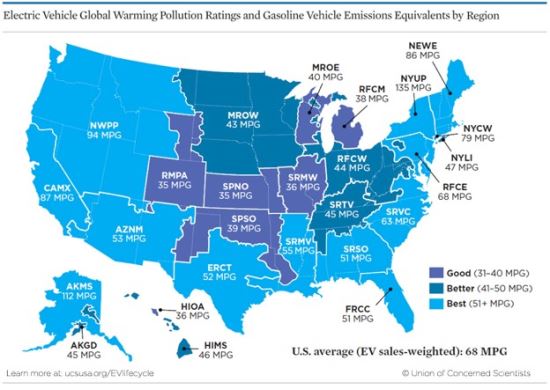
By applying the cradle to grave methodology, the UCS says EVs produce less than half the global warming emissions of comparable gas-powered cars (even when factoring in the higher emissions during manufacture, courtesy of the EV’s lithium-ion battery). According to the study, the average EV produces global warming emissions equal to a 68 miles per gallon (Mpg) fuel economy gas car. While UCS concedes that EVs contribute a not-insignificant amount of global warming emissions from their operation, driving the average EV in any region of the country produces lower emissions over its lifespan than the average gas-powered car clocking in at 29 Mpg. Additionally, the potential for EVs to be powered by clean electricity exists, much more so than with gas-powered vehicles.
This graphic fromthe Union of Concerned Scientists illustrates how driving an EV in each region compares with driving a gas-powered car when it comes to emissions. The regions are based on the group of power plants that serve as each one’s primary source of electricity.
To determine how green driving an EV in your area is today, use the UCS’s EV Emissions Tool. This calculates how much global warming your EV will produce based on your locally available power sources. For example, a Nissan Leaf charged in South Carolina will produce as much pollution as a gas-vehicle getting 70 Mpg, whereas in Idaho it would be closer to 104 Mpg. But wherever you are, according to the UCS, an EV is still greener than a gas-only car.
Can My EV Ever Be Truly Green?
A long-term, national shift away from generating electricity via fossil fuels would result in EVs being powered by energy from entirely renewable sources. That is a true zero-emission vehicle. Thankfully, however, you don’t have to wait for your local power company to install wind turbines before you can achieve this. You can take matters into your own hands.
To accurately regulate the cleanliness of the electricity your car uses, create your own. If you own your home, install solar panels on its roof to generate clean electricity, then purchase and install a Level 2 Electric Vehicle Supply Equipment unit (EVSE). These charging docks can be hardwired or plugged into your home (via a NEMA 14-50 outlet) and will charge your EV in as little as four hours (you can charge with a regular 110-volt outlet, but that takes 8–12 hours for a full charge).
The prospect of installing solar panels on your home once meant a bill in the tens of thousands of dollars. Today, options for financing and leasing can often result in lower monthly bills than you pay your power company. By pairing solar panels with an in-home EV charger, you can suck clean energy right from the sky and power your EV with virtually zero cost to the planet and, eventually, zero cost to you.
Jennifer Tuohy loves to use technology to help us live a more sustainable lifestyle. She gives tips on how driving an EV car and having a home charging station can reduce your carbon footprint. If you are looking to install an electric car charger in your home, visit the Home Depot to see all your EV charger options.
All MOTHER EARTH NEWS community bloggers have agreed to follow our Blogging Best Practices, and they are responsible for the accuracy of their posts. To learn more about the author of this post, click on the byline link at the top of the page.