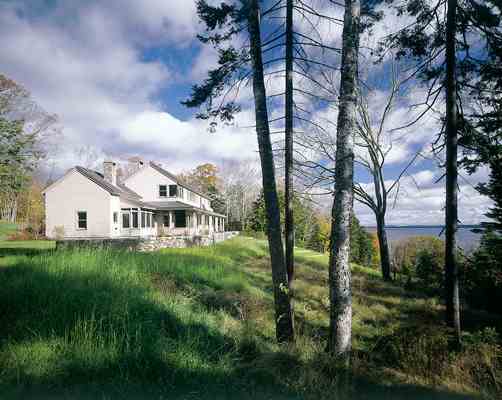
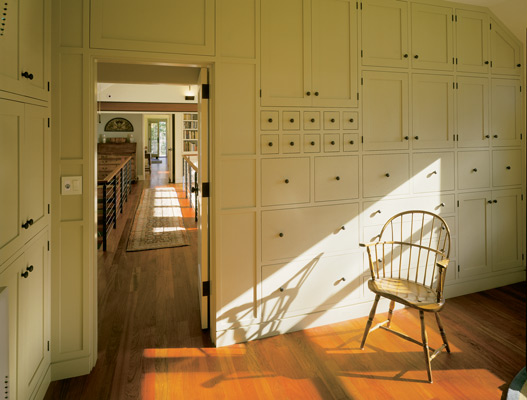
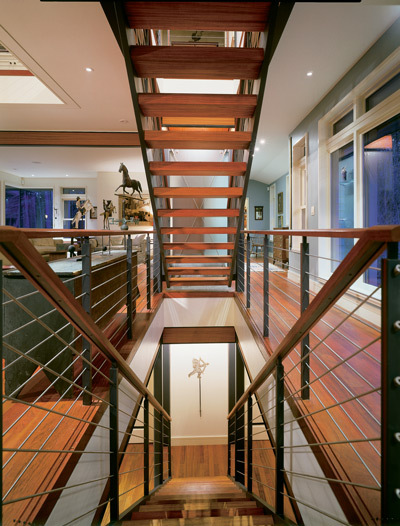
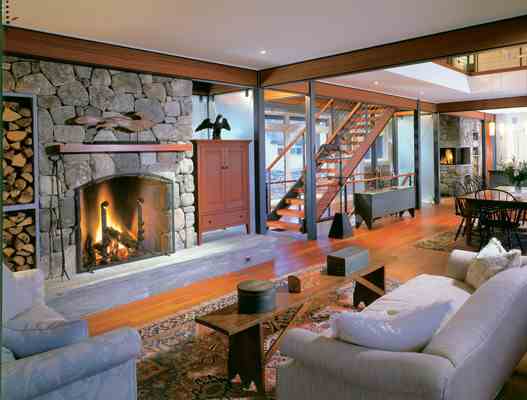
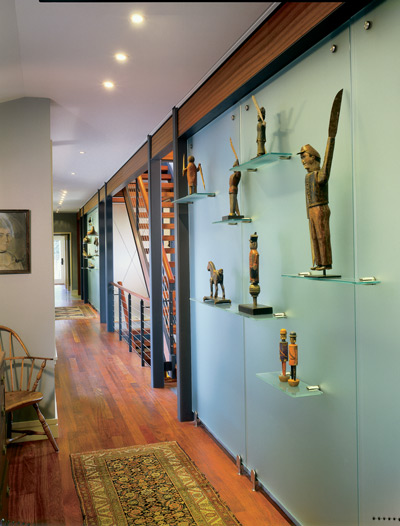
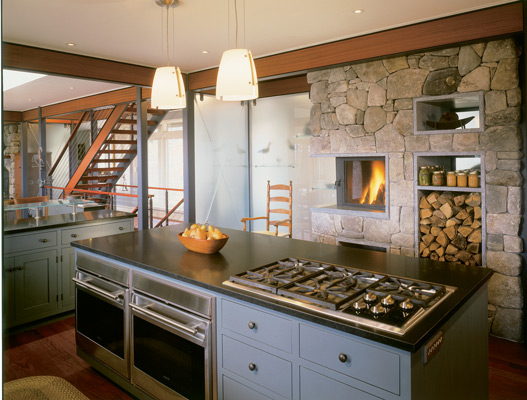
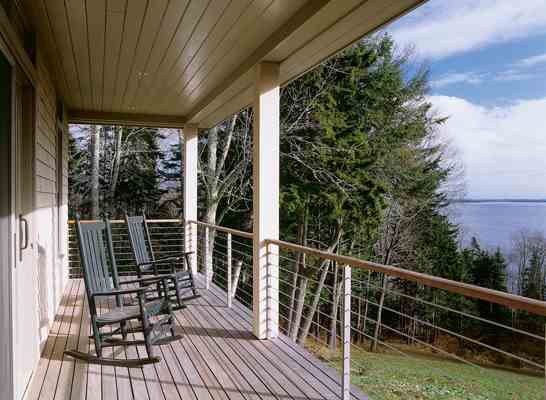
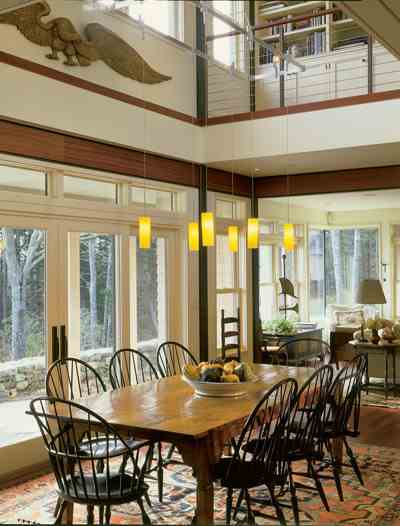
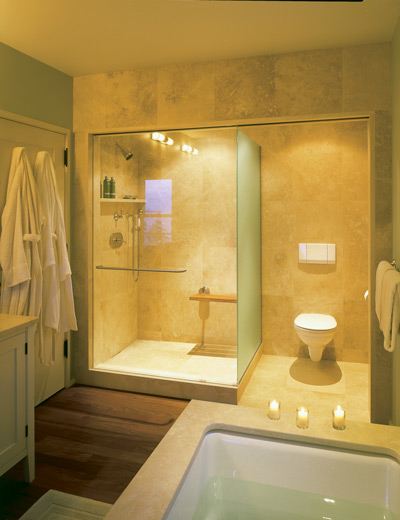
Clad in unpretentious wood-shingle siding, Sally and Tony Grassi’s coastal Maine home looks every bit the stoic New England farmhouse. Yet beneath its traditional exterior is cutting-edge environmental innovation: A blend of geothermal and solar power generates the energy the couple uses, plus the home employs a host of environmentally sensitive building techniques.
Tony and Sally’s goal was to create a nontoxic, eco-friendly home that reflects their environmental ideals. They declared independence from nonrenewable energy and banned PVC, a planet-polluting plastic, from their house. They also insisted on sustainably forested, formaldehyde-free wood for both framing and finishes.
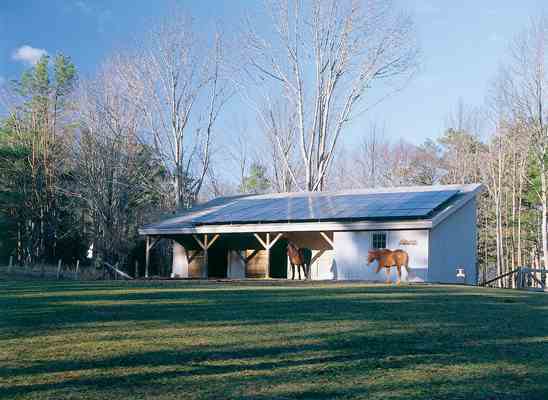
Set back from the ocean on an 18-acre parcel of field and forest, the house and accompanying buildings occupy the site of a house removed by a former landowner. “We didn’t want to make a new scar on the land,” Tony says. The couple built a cluster of buildings around a central courtyard: the main house (with kitchen, living room, dining room, office, master bedroom and guest room), a guest house (with three more bedrooms) and a workshop/garden house. A pony barn, which houses the complex’s solar panels, is farther away in an open field. No trees were cut to make room for the new buildings.
“We wanted to keep the house small but have enough room for our extended family for holidays,” Sally says. Locating most of the guest rooms in a separate building allows them to turn off the power there until company comes.
Learning and leading
The Grassis worked closely with architects Dwayne Flynn and Matthew Elliott of Elliott Elliott Norelius Architecture and builder Jay Fischer of Cold Mountain Builders. “Lessons from the Grassi house continue to influence our firm’s decisions on new projects,” Flynn says. “Tony and Sally were intensely involved in choosing materials. They wanted to know how everything was made, how durable it was and whether it was reusable or recyclable in the distant future.”
The retired couple was also concerned about the health of their home and those working on it. “Before we decided to build, we visited new houses for ideas, and I was struck with how poorly they were built and how toxic they smelled,” Sally says. “I never dreamed we’d be discussing chemical terms such as PVC, dioxin and PBDE like professionals, but doing our homework helped us build a safe home.”
Even with the architect and builder firmly on board, the Grassis faced a problem common to many green homebuilders: skepticism from subcontractors. But they were firm in their requests, and in the end, many of the alternatives they found cost the same or slightly more than conventional materials. Plus, they were just as easy–and safer–for contractors to work with. “We learned you have to be a bulldog and not give up easily,” Sally says. “We made trade-offs, but we were pleased to hear that a lot of our subcontractors now incorporate green materials into all their work.”
Cleaning up energy
Tony and Sally were committed to achieving zero dependency on fossil fuels. The couple chose a geothermal system that gathers heat from the earth via a well (which also supplies drinking water) and pumps it throughout the house through radiant floor tubing. The floor mass then holds the heat throughout the day, keeping the house warm. The heat in the well water is captured by a heat pump and used to heat water for household use. The used, cool water returns to the well where it is reheated by the surrounding earth.
Geothermal systems require electricity to run the pumps. The Grassis didn’t want electricity from a coal-fired plant, so they pay extra to buy renewable energy from their local utility. The solar photovoltaic system provides much of the electricity for the geothermal system and their other electric needs. This combination of solar electricity and purchased renewable energy allows the house to operate with zero carbon emissions.
The Grassis’ education has broader ramifications. “I look at the whole world differently,” Sally says. “After learning what goes into manufacturing building materials, I think twice about everything I buy. Should I get another toy for the grandkids? Made of plastic? Painted in China? Nine times out of ten the answer is no.”
Tony echoes his wife’s sentiments. “Building a house ought to reflect your value system. We did everything we could to do the responsible thing.”
The good stuff
? Geothermal heating, cooling, hot water
? Solar panels
? Passive solar building orientation
? Zero PVC in home (HDPE, fiberglass and cast iron used instead)
? Native, pesticide-free landscaping
? Porous, recycled-asphalt driveway for stormwater drainage
? Fly-ash concrete in foundation
? FSC-certified wood and lumber
? FSC-certified cedar for roof and siding shingles
? Aluminum-clad, low-E, argon-filled, insulated windows
? Main-entry doors made from reclaimed Douglas fir
? Low- and zero-VOC paints and finishes
? Lead-free flashing and chimney caps
? Formaldehyde-free plywood and particleboards
? Use of steel (high recycled content) and open trusses for support structure
? Paper-free gypsum panels to prevent mold and mildew growth in bathrooms
? Formaldehyde-free, blown-in insulation in walls (R-30 rating)
? Non-ozone-depleting, formaldehyde-free spray-foam insulation in roof (R-60 rating)
? Efficient halogen and fluorescent lighting
? Mostly used furniture; reupholstery with organic, chemical-free fabrics
A chat with the homeowners
What books are on your nightstands?
Bridge of Sighs by Richard Russo; Lab 257 by Michael C. Carroll; Secret Life of Lobsters by Trevor Corson; Sudden Sea: The Great Hurricane of 1938 by R.A. Scotti.
What’s great about where you live?
The natural beauty of the Maine coast and forest, including the birds and animals. We especially love the way the sun and moon rise over the ocean.
If you could invite anyone to dinner, who would it be?
Barack Obama.
Do you use Netflix or the local video store?
We rent from the local video store because it’s owned by our neighbor and we want to support the local economy.
Guilty pleasure?
Long hot showers. There’s not really much guilt involved because we get “free” hot water as a byproduct of the geothermal system.
How to build green without breaking the bank
Project architect Dwayne Flynn explains how he built green for the same cost as–or less than–conventional.
? Buy local materials to reduce the embodied energy required for long-distance shipping. Ask your locally owned building-supply store if it can match the prices of a retail chain.
? Try PureBond formaldehyde-free plywood, available nationwide,
? Get formaldehyde-free fiberglass insulation; it’s now widely available at comparable cost to chemically treated fiberglass.
? Paint with low- or no-VOC finishes. Some paints work better on sheetrock, others on wood, so test before using.
? Compare FSC-certified wood. The Grassis’ Brazilian cherry flooring from EcoTimber cost the same as nonsustainable hardwood.
? Use fly ash concrete, which reduces the amount of high-embodied-energy Portland cement in the mix.
Five green finishing touches
Of all the elements Tony and Sally Grassi love about their home, five stand out as favorites.
1. Wood. All wood came from sustainably forested local trees or is certified by the Forest Stewardship Council (FSC). Instead of pressure-treated timber, which can contain arsenic or copper, the Grassis chose natural hardwood such as black locust.
2. Steel. A substitute for formaldehyde-containing laminated beams, recycled steel supports add a modern architectural element and contribute to the home’s open effect.
3. Glass. Tony and Sally like lots of natural light and an outdoor feel, so they used insulated, low-E windows with aluminum cladding to reduce weathering from ocean spray.
4. Radiant heat. Underfloor tubing provides even, comfortable heat at a lower thermostat setting than forced air and eliminates the dust circulation associated with forced air.
5. Native landscaping. The couple is eradicating invasive, non-native species left by previous owners because they threaten native forest growth. Their landscaping features native plants with no chemical pesticides or fertilizers and just a few grass patches for their grandchildren to play in.
Secrets of (almost) PVC-free building
Sally and Tony Grassi wanted to keep PVC (polyvinyl chloride), a plastic with a notoriously toxic lifecycle, out of their home. Manufacturing PVC requires hazardous chemicals, including chlorine gas and lead, and creates dioxin, which contaminates air and water and endangers factory workers. PVC produces deadly smoke when it burns.
The only place where PVC exists in their home is in the electrical wiring. Here’s what they learned while building:
Wiring. “You can’t get wire for residential use that’s not PVC-clad–but we really tried,” Tony says. Research uncovered another startling fact: Most PVC-covered wire contains lead to make it supple. The couple opted for lead-free wiring so the installers wouldn’t be exposed while handling it.
Waste pipes. Request old-fashioned, nontoxic cast-iron plumbing.
Electrical boxes. Metal boxes are readily available and cost the same as PVC. The underground electrical conduit is fiberglass rather than PVC.
Piping. PEX (crossed polyethylene) is used in water supply lines and radiant-floor tubes. The Grassis avoided copper tubing because arsenic can leach from copper mines.
Curtain drains (French drains). Instead of using PVC to manage drainage around the home’s foundation, opt for high-density polyethylene (HDPE).
Geothermal well lining. Most geothermal wells are designed with PVC pipe as liners. Because they drink from the well, the Grassis used environmentally preferable polypropylene, which is considerably more expensive than PVC. However, its insulative properties help make the geothermal system more efficient, mitigating some of the cost.
Architect: Elliott Elliott Norelius Architecture, (207) 374-2566
Builder: Cold Mountain Builders, (207) 338-4552
Landscaping: Mohr and Seredin Landscape Architects, (207) 871-0003