

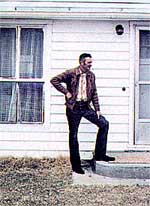
John Olberding is definitely a man who’s taken the Johnny
Cash song “One Piece at a Time” to heart. For several
years, John watched — from his vantage point in a
nearby pizza parlor — truckload after truckload of
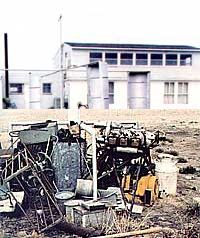
perfectly usable goods being carted to the county landfill. One day he decided to see if he could turn a few of
those “treasures” his way.
To do so, Olberding got himself a job at the dump and quickly gained permission to take home whatever he
could use as long as he didn’t attempt to make a profit
from his windfalls. So, one piece at a time, John loaded
the throwaways into the rear of an old red van, hauled the
stash to an empty lot for storage and — when he had
accumulated enough free material — began building his
dream house.
With the help of a few out-of-pocket bucks (the scavenger
tells most folks that he’s spent “about $1,000,” but admits
that the actual figure is probably closer to $700), John
built a three-bedroom, one-and-a-half bath two-story home that’s complete with a
three-car garage, an enclosed breezeway and a basement. He even had enough leftover “freebies” to furnish the
interior of the dwelling!
John’s house is no thrown-together shamble of shingles,
either. The structure is entirely sided in metal coated
with white, baked-on enamel — “Excess” material that a
local contractor saw fit to pitch out in large quantities. The building is also assembled like a fortress. Olberding
framed his dream house in 3-by-6s, instead of the normal 2-by-4s, and then he put the boards on 12-inch — rather than
the standard 16- or 24-inch — centers. Furthermore, since
people didn’t seem to care what kind of wood they were
throwing out, some of John’s framing was done with oak.
Even the garage is as solid as the proverbial rock: 3-by-14
and 3-by-16-foot beams brace the front, and the ceiling is made
up of 2-by-6 and 2-by-8-foot boards, which was all lumber that the scrounger
thought he should use simply “because it was there.”
“There’s at least four inches of insulation stuffed into
every open space I could find,” John says. “The wood, the
insulation and the metal siding were among the easiest
materials to get, so I didn’t skimp on them.”
In fact,
those three items were so plentiful in Olberding’s
“ware-heap” that a couple of his neighbors have built
two-story houses (on the same theme as John’s) using the
leftover leftovers!
The list of his free-for-the-carting housing materials
doesn’t stop at the front door, either (by the way, that
portal is a solid oak throwaway that John fitted with a
tossed-out antique knob). All the doors, windows, bathroom
fixtures, appliances, living room furniture, cabinet doors
and even a walk-in refrigerator for meat storage made their
way in the back of the red van from the landfill to
Olberding’s residence.
Some castoff items were available in such steady supply
that John actually had to dream up ways to use them. For
example, most of his floors are two layers deep in
carpet — which makes a walk through his “trash house”
feel like a stroll across a well-sodded golf
course — and even then, there was enough rug material
left over to cover some walls and hand rails. Finally, when
John could think of nowhere else to use the versatile
carpeting, he simply traded his surplus for a complete
bedroom suite.
Of course, even though some items were thrown away in
prodigious quantities, others were a little scarce. John
had a great many white ceiling tiles, for example, but they
weren’t all the same style. So he simply mixed the
different tiles to create a patterned effect. The basement
blocks also have a unique appearance: They’re a mixture of
bright orange and concrete gray. (John explained that the brightly
colored building blocks had come from a torn-down A&W
Root Beer stand.)
The list of landfill windfalls goes on and on. John muses
that people often throw things out for virtually no reason
at all. For example, his refrigerator has a small
scratch on its side, but its innards work just fine.
One gent carted a rototiller to the dump that looked fine to
our landfill lookout. When John asked, the man explained
that he’d had to gas a hornet’s nest from under the tiller
the previous fall, and when he started the engine up in the
spring, it caught fire. Olberding replaced the burned
spark-plug wire and the tiller has faithfully turned his
garden ever since. In another instance, a lady informed the
scrounger that she didn’t think there was anything much
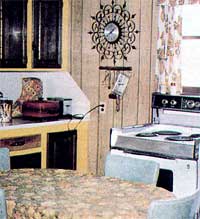
wrong with the clock she was throwing out. Sure enough,
John replaced the battery, and the timepiece has run “like
clockwork” on his kitchen wall for the last three years.
As you might expect, Olberding has seen some interesting
human dramas during his stint at the landfill. One time a
young man backed up to the dump site in a
pickup — spewing gravel from beneath the
wheels — and furiously heaved out a load that included
a stove, a dresser and a large selection of women’s
clothing. Later that week yet another rapidly
driven pickup arrived, this time with an angry lady at the
wheel. She hurled out a collection of guns, fishing poles,
and men’s clothing. Now whenever something of this sort
occurs, the landfill employees try to pick up the discards
and store them in a warehouse in case there’s a change of
mind on the part of the people discarding the valuable
merchandise. But in this case, neither party returned even after the divorce was final.
John Olberding’s unconventional approach to housing design
didn’t stop with his method of obtaining building
materials. He’s also put together some pretty nifty
recycled equipment for taking advantage of alternative
energy sources. John’s furnace, for instance, is set up to
use solar energy, electricity, wood or fuel oil …
depending on which one happens to be the easiest and least
expensive to acquire at the time. Furthermore, the
trash-can tinkerer has built a wind machine that
keeps his tank of bait fish well aerated during the angling
season.
Of course, you don’t build a house from toss-outs without
having a good bit of ingenuity — and John has
demonstrated his ability to see a treasure in another
person’s trash. What’s more, we all know that erecting a
dwelling calls for a lot of sweat-of-the-brow effort. John
spent six and a half years — nights, weekends and
vacations — building his house. But, he says the result is well worth the effort expended.
Olberding says that he had the house appraised at around
$60,000 a few years back, so he’s obviously been well
compensated for his work. But, the biggest reward, in John’s
mind, is the personal satisfaction he’s gained.
“I’m pretty proud of myself,” Olberding says. “There’s been a
great deal of unexpected interest in this project, and I
feel pretty darn good about that. If I could just get folks to
realize how crazy it is to throw out all this perfectly
usable material — and if I could convince landfill
operators that people who want this ‘junk’ should be
allowed to use it — I’d be happy.”






