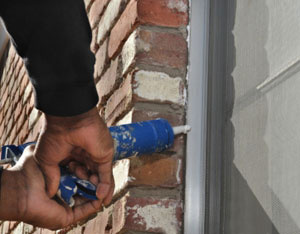
If heating and cooling costs of your home now rival your mortgage costs, the most important thing you should do is to seal up the building. Most existing homes are like Swiss cheese. If you could add up all the tiny leaks in the building envelope – the walls, foundation, and roof – they’d be equivalent to a 3-foot wide by 3-foot high window left open 24 hours a day, 365 days a year.
Sealing those leaks can dramatically reduce energy costs, saving you a fortune and making your home much more comfortable. You could easily cut your annual heating and cooling costs by 10 to 30 percent, perhaps more. It all depends on how leaky your home is.
Sealing the leaks in the building envelope is inexpensive and highly effective. It offers one of the best returns on investment you will get on an energy upgrade.
To locate leaks, you can hire a professional home energy auditor. He or she will perform a blower door test, which will tell you how leaky the house is. It will also identify leaks, which then can be sealed with caulk or weather stripping. A home energy audit could run from $300 to $500, depending on the size of your home.
You can also perform your own energy audit to detect leaks, although it’s a bit more difficult. On a windy day, simply walk around your home with some incense. Hold it next to potential leaks – for example, around the perimeter of windows and at the junction of the floors and walls. Air blowing into your home will deflect the smoke plume. Seal it with clear or paintable silicone caulk. Weather stripping should be applied to windows and doors, as needed. To learn more, you may want to pick up a copy of my book, Green Home Improvement. I also teach numerous nearly free workshops on home energy efficiency at my educational facility in Missouri.
Above: Sealing leaks in your home can save you a fortune in energy costs. Photo by ISTOCKPHOTO/DAVID H. LEWIS
Contributing editorDan Chirasis a renewable energy and green homes expert who has spent a lifetime learning life’s lessons, which he shares in his popular blog,Dan Chiras on Loving Life. He’s the founder and director of The Evergreen Institute and president of Sustainable Systems Design. Contact him by visitinghis websiteor finding him onGoogle+.