

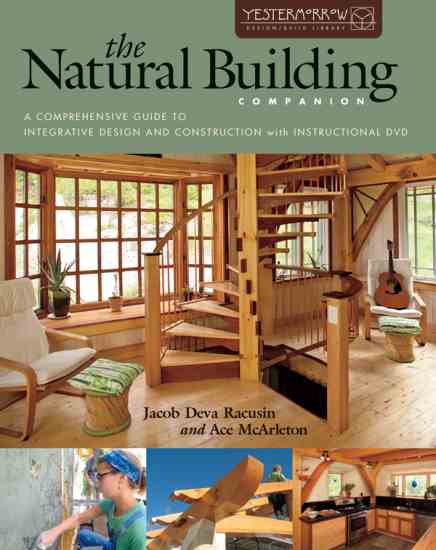

Natural buildings not only bring satisfaction to their makers and joy to their occupants, they also leave the gentlest footprint on the environment. In The Natural Building Companion (Chelsea Green, 2012), a complete reference to natural building philosophy, design, and technique, Jacob Deva Racusin and Ace McArleton walk builders through planning and construction, offering step-by-step instructions. The following excerpt is from chapter 11, “Before Construction.”
You can purchase this book from the MOTHER EARTH NEWS store:The Natural Building Companion.
Building Codes, Building Permitting, and Homeowners’ Insurance
Building codes are often seen by designers and builders as an obstruction to overcome in making progress on their project. A healthier and more productive approach may be to approach codes respective to their intent, which is to create a set of guidelines for safe and appropriate construction. While it is true that codes can be onerous and frustrating, especially for innovative and developing technologies that have yet to gain full acceptance in the code community, they do keep a lot of people safe and help avoid a lot of building mistakes. Certainly the more restrictive the code, the more likely conflicts and problems are to occur with innovative practices. Jurisdictions without mandated building codes provide ample opportunity for unfettered exploration — as well as for the building of poor-quality structures. Ultimately, most of the potential ease or difficulty lies with the proclivities of the code official, who has the ability to take an ignorant or narrow-minded interpretation of the codes or to invite an open-minded and logical discussion into the application process.
Codes vary widely across North America. While there are national standards in the United States and Canada, they are further refined and enforced by state or province, county, and/or municipality. This jurisdictional specificity is responsive to circumstances such as seismic conditions and climate that vary from region to region (e.g., California’s seismic engineering requirements, and frost-depth minimums for certain foundations in New York). Accordingly, a design that is compliant in one state may be well out of compliance in another. Some states, such as Vermont, have no statewide or county building codes, and therefore the only building code jurisdictions that must be respected are those of the few cities in the state (the state’s towns do not have building codes). Vermont does, however, have a mandatory statewide energy code that must be considered in the design, construction, or renovation of a building.
Code inclusions for natural building technologies vary widely as well within established codes. In the case of both earthen (such as adobe and rammed earth) and straw bale, there are regions of the United States, such as the Southwest, that have specific code inclusions that mandate compliance with prescribed code regulations. This has the benefit of ensuring successful permitting of a project, providing that there is full compliance with the code. The obvious downside is that restrictive code requirements force the hand of the designer and builder in uncomfortable ways; a clear example is the provision in New Mexico’s straw bale code that restricts the use of load-bearing straw bale construction. Many other jurisdictions have guidelines for appropriate construction practices in their codes that may influence conversations with code officials but are not requirements for compliance. A few restrict the use of certain techniques entirely, while most make no mention of them whatsoever.
The majority of jurisdictions do not have a full restriction or a formal required code and instead feature a total absence of code requirements for natural building. This means that conversations with code officials can be expected upon submission of the permitting application. Herein lies the heart of the process of gaining permitting approval for a natural building project: developing a strong relationship with the code official. Behind all the rules and regulations, there is a person with whom you as an applicant will be working to understand how the project can navigate the code requirements of your jurisdiction; the nature of this relationship — adversarial or amicable — will greatly affect the outcome. Here are some tips on how to work with your code official:
• Know the code. Take the time to familiarize yourself with the code for your jurisdiction by contacting your local building department. Having a strong understanding of the language and substance of the code will not only help you understand the parameters of your design but enable you to have an intelligent and well-informed conversation with your code official, which is valuable to your success.
• Begin a conversation. The integrative design process centers on the inclusion of all major parties in the design process to allow real-time response to concerns and inputs from all vantage points. Include the code official in this process, and start early so his or her concerns can be understood and actively addressed in the design phase, rather than after the design has been completed. While a code official does have power in the relationship, approaching the interaction by engaging in proactive dialogue in a language he or she can understand is by far the most effective strategy in presenting your case.
• Create good plans. Drafting is the visual language of code officials, and having a complete, well-detailed, and well-notated set of drafts will keep ambiguity at bay. The greatest concern of the official is the unknown, so graphically identifying as many of the details surrounding unfamiliar techniques as possible will help the official be more comfortable. Understanding the code and the official’s concerns enables you to make inclusions in the drafts that point out your intention to build a code-compliant building and make it easier for the official to say yes.
• Cite precedent. Being able to cite existing precedent — ideally within the same jurisdiction, or in regional jurisdictions — can go a long way to help demonstrate viability of the technology. An existing case study can prove the effectiveness of an unfamiliar building modality. If you can find another code official supportive of the natural building technique you are using, request his or her permission to be used as a resource when communicating with your code official.
• Get stamped. You may well find yourself in a jurisdiction that requires the stamp of an architect or an engineer. If you are not already planning on working with one of these professionals, then understanding whether or not this requirement applies to you will be especially important. Connecting with a professional who has experience in working with natural building technologies will be very helpful in ensuring that you not only receive the stamp but also receive positive feedback and suggestions for design improvements from an experienced professional.
•Educate and explain. Be prepared to answer many questions concerning your project from a skeptical code official. To be able to influence your official toward finding favor with your plans, you must have done your research and be able to provide not only good explanations but strong studies or sources that back up your claims. Refer to the resources for part 2 of this book for information concerning structure, thermal performance, moisture, and fire prevention.
• Have a positive attitude. As we mentioned at the beginning of this section, it is very important to approach the conversation with your code official not as an adversary but as a partner. Her or his job is to ensure that buildings get built to the code specifications of that jurisdiction, not to prevent buildings from being built. Your job is to help make that happen by making your project easy to approve. Expect to be met with skepticism and doubt. Rather than acting defensively, use this opportunity to learn as much about your official’s concerns as possible, so that you can continue to provide helpful information and refine your design appropriately.
• Be persistent. An initial rejection is not the end of your project. Continue to work with your code official to try to find ways to answer his or her concerns to reach a successful outcome. If this is not possible, discussing your case with more senior officials in the building department or within the municipality or state government may help move your application forward. A formal appeal process may ultimately be necessary; at some point, enlisting support from a lawyer or consultant who specializes in building-code appeals may be a worthy investment to help usher your project through an onerous process. Research all the steps of the appeal and how the process works, and be sure to prepare yourself accordingly to defend your case well. A legitimate plan must be approved before you can start building.
• Be patient. Approval will take time — days, weeks, even months. Code officials are not likely to respond favorably to feeling pressure to comply with your construction schedule, so be prepared to summon extra stores of patience to methodically follow through the permitting process in the time it takes. After all, there is little else you can do but be patient.
There are many different efforts under way to bring natural building techniques into building codes. At the time of this publication, a section on straw bale construction — including plastering — is working its way through the process of inclusion into the next version of the International Building Code (IBC). Adobe construction — referred to as “unfired clay masonry” — is already included in the Uniform Building Code (UBC), a national building code in the United States. Organizations such as the Development Center for Appropriate Technology of Tucson, Arizona, have been working tirelessly to remove barriers to code acceptance for natural and green building techniques in the building-code-development community.
All of this work will ultimately make it easier for projects to receive permits, without the required expense of an architect or engineer’s stamp. It also means that there will be a greater chance that further development of these building techniques will be stymied by outdated and poorly crafted code mandates. In their book More Straw Bale Building: A Complete Guide to Designing and Building with Straw, Magwood, Mack, and Therrien state, “While codification [of straw bale buildings] could make approvals simpler to obtain, it also poses the risk of freezing the technique before adequate experimentation leads us to sound standard practices.” They point out that the current prescriptive nature of most natural building codes — mandating specific construction practices — will someday yield to performance-based codes, allowing greater flexibility in application to achieve the same results (Magwood et al. 2005, 148–49). As more of the double-edged sword of codification’s blade is exposed, we as natural builders will do what we’ve always done best: adapt to the circumstances in which we are working. In the meantime, we will be continuing to advocate for well-worded and flexible code language, and enjoying the freedom currently offered us by a relative lack of code standards.
Homeowners’ insurance is another logistic that can be more difficult for the owner of a natural building than for the owner of a conventional one. Ultimately, the same basic considerations for financing and permitting apply to the world of insurance. Insurance agencies are a risk-averse lot, and fear of the unknown is a big issue for insurance agents when considering alternative construction practices. While it is critical to be fully honest and forthright concerning the nature of the building, this may not be the correct audience with whom to tout the innovative and experimental techniques employed in the building. If concerns arise, be prepared to cite precedents in your region; find other insured buildings in your community or region as examples. Providing solid documentation addressing particular concerns is also helpful, and doing so in a respectful and constructive manner, as with code officials, is an important tool to gain acceptance from your insurance agent.
Other Permitting Considerations
Code compliance of your building design is only one permitting hurdle to leap. Depending on whether you are in a rural or urban environment and on the regulations of your region, you will need to secure a host of other permitting approvals and tackle a series of other administrative logistics to move toward construction.
• Local zoning ordinances are designed less around the nature of the structure and more around development patterns for the region; considerations will range far and wide, including height of the building, location on the site respective to the edges of the property, and type of use (residential, commercial, industrial), among many others.
• Energy codes are in place in many states and may or may not be tied to a building code, if one exists. These codes are frequently a balance of prescriptive and performance requirements, and they cover many parts of the building’s design, including insulation, air barrier, combustion equipment, ventilation, window and door performance, and more.
• Septic/wastewater permits will likely be required, if hookup to a municipal sewer is not available. This requires digging test pits on the property to identify suitable soils for supporting a septic system. In Vermont, statewide mandatory septic regulation is far more restrictive than building codes.
• Water-supply testing for a private well or spring may also be required; some jurisdictions may not allow accessing water from springs, requiring a drilled well.
• A clean property deed/title, beyond being a smart idea for your assets, may be a requirement for permitting.
• Establishing a new access such as a driveway will likely require separate approval from the road commission or other similar authority, frequently as a component of the zoning process. If legal rights-of-way need to be secured to allow access to your site, this adds an additional layer of complexity (and often expense).
• Environmental sensitivities in certain areas may affect permitting of your site in the zoning process, whether mandated on a municipal or state level. Examples include high elevations, steep grades, and wetlands.
Excerpted from The Natural Building Companion: A Comprehensive Guide to Integrative Design and Construction by Jacob Deva Racusin and Ace McArleton (Chelsea Green). Copyright © 2012. Buy this book from our store:The Natural Building Companion.





