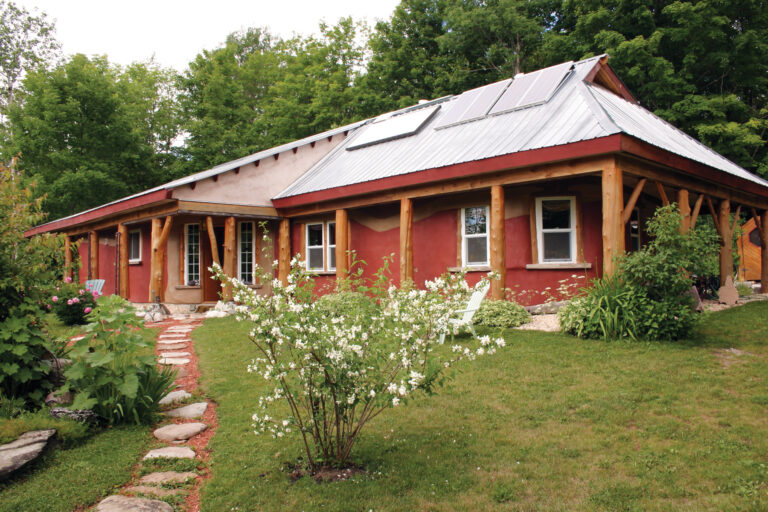
I began plastering straw bale buildings in Ontario almost 20 years ago. Bale building has its roots in the Sandhills of Nebraska in the early 1900s, and it had a global renaissance starting in the 1980s. The only reference in popular culture to straw bale building at the time I started was the story of the three little pigs, so we used to hear some variation of a big bad wolf joke on almost every job site. Our standard reply was, “The first little pig forgot to plaster his house.”
There’s a lot of truth to this, because most of the strength, weatherproofing, and air-sealing in a straw bale home comes from the plaster. When engineers are approving a load-bearing straw bale building, one of the most important numbers is the compressive strength of the plaster. And what about the famous insulation value of straw bales? Every now and then, an owner-builder tries to overwinter in an unplastered bale house. On a windy day in the dead of Ontario’s winter, you’ll find them huddled under a blanket, with the temperature in their house hovering above freezing. But the following winter, when their house is wearing its draft-proof coat of plaster, it’s the most comfortable and efficient home for miles around.
Traditional Techniques Meet Modern Methods
Plaster is typically made of sand, fiber, water, and a binder. The binder is what defines the plaster. The most common binders are clay, lime (either hydrated or hydraulic), and gypsum (plaster of Paris). Some plasterers use blends of any of these three binders in various combinations, but the ratio is important, because complex chemistry is hidden underneath the kitchen science. For example, clay and lime can make a nice plaster, but in the wrong ratio, they’ll just make a crumbly disaster, because the necessary chemical reactions only happen above a certain pH level.
bale
Natural plasters have many advantages over modern plasters that use cement or polymer as a binder. The two most important are that they’re more vapor-permeable, meaning water is less likely to become trapped and rot the underlying materials; and they have a much lower carbon footprint. (Cement is the source of about 8 percent of the world’s carbon dioxide emissions.) For me, the connection to a construction heritage that spans thousands of years is also meaningful. You can’t quantify it, but if you’ve spent time in historic buildings, you’ve likely felt it too.
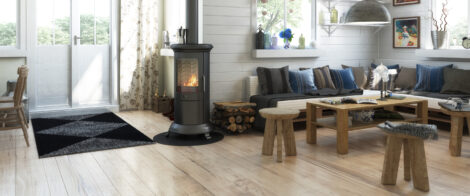
Natural plasters are an essential part of many natural building styles, but they also marry well with more standard construction. These days, we’re often asked to plaster over drywall, or, less often, over wood lath installed in place of drywall. Usually, the final coat is pigmented and replaces paint. The result is a nontoxic finish that adds beauty, form, and texture to a home.

Low toxicity is increasingly important as buildings become more energy-efficient and less leaky. While most natural plasters have little or no chemical off-gassing, it’s not a given that they’re entirely nontoxic. For example, if you’re going to use unsealed earth plaster in your home, you’ll need to make sure the clay has very little silica, which can cause lung cancer and silicosis. You must also clean up dust from plastering. While cleaning, you should wear a respirator and use a mop or a vacuum with a HEPA filter. Natural plasters are generally safe to live with, but you need to take precautions when working with them, as you would with any fine powder.
Many of my favorite jobs involved working directly with homeowners who wanted to do their own plastering. It’s not for everyone, but the kind of people who build their own home can usually learn to plaster it. And when they’re done, they’ll know how to maintain and repair their plaster. That’s a big plus, because earth plaster is easily repaired, but also soft enough to be easily damaged. Lime is a little tougher, but unpainted lime plasters are even harder to repair without leaving obvious marks.

If you’re building a natural building, you might want to plaster the base coats and use paint as a final finish, and there’s nothing wrong with that! There are many beautiful nontoxic paints available, and some are more durable, stain-resistant, and easier to touch up than unfinished plasters. Silicate paints are extremely tough and weather-resistant, and they bond well to plaster. For many people, unpainted accent walls may be more desirable than an entire house finished with unpainted, unsealed plaster.
Regardless of what type of plaster you’re planning to spread on your walls, you’ll probably need a recipe. While some excellent natural plasters are sold in pre-mixed bags (American Clay comes to mind), the options are still limited, and the natural plaster world is largely DIY. This has led to a beautifully collaborative community of natural plasterers who carefully craft recipes, share them with each other, modify them, and share them again. It’s truly an open-source community. If you want to see it in action, check out the Facebook group “I Love Natural Plaster.”

When Tina Therrien and I began writing our book Essential Natural Plasters, we decided to tap into this spirit and collect recipes from our colleagues. We weren’t sure how it would go, but everyone we asked happily accepted. Several contributors had books of their own, and one of them described our project as a book “by the community, for the community.” The result is a book that I use as a reference myself, and I have a working copy that’s already filled with notes. (I’ll admit, my memory is bad enough that I consult it even for details of my own recipes!)
When Mother Earth News asked me to write a DIY plastering article, I wondered which recipe to pick, knowing I wanted to share one that could be widely used by readers. The recipe I chose will work as a final finish coat over natural walls or drywall. You could use almost the same recipe to make a lime plaster; just change the clay to Type S hydrated lime, pre-mix the dry sand and lime in a separate container, and leave out the wheat paste.
Pigmented Finish Clay Plaster with Fine Fiber
This is a recipe for a pigmented plaster that can be used over most walls. It’s usually applied about 1⁄16 inch thick, but depending on the type and amount of fiber you add, it can be applied thicker without too much cracking. The idea is to show off the beauty of the earth, so it’s pigmented and doesn’t need a covering of paint. We use bagged kaolin pottery clay in this recipe because of its white color and its low silica content. Wheat paste binds the surface so the plaster will be more resistant to damage, and dusting will be minimal.

To use this recipe as a finish coat over uneven walls, increase the fiber and prepare the base coat well. To get a good bond, slightly roughen the base coat with a sponge, or scour it with a wood float while it’s drying. Mist the wall ahead of your work on absorbent walls, but not on drywall.
For painted drywall, you’ll need to apply an adhesion coat, which can be either wheat paste mixed with sand (roughly 5-to-1 by volume), or paint primer and sand (10-to-1). If you’re plastering over new drywall, tape and mud the drywall with a setting compound, and then seal it with a coat of paint primer and sand. If the drywall is left unsealed, the joints will show through because of the difference in suction between the drywall and the joint compound.
Ingredients

Sand. Use a fine sand, preferably 30 mesh or finer. White calcite (marble) sand is best, but can be hard to find. You can use white silica sand instead, which is available at most masonry supply stores. If you don’t need white sand, you can purchase jointing or “sweeping” sand dry, and then sieve it through a fine window screen; just don’t get the kind with polymer added. To get deeper colors (especially reds), use all or part dark sand. For brighter colors, such as yellows, use only white sand. If your sand has poor particle-size diversity, which is common with silica sand, you can use a finer mesh size and apply it thinner, or blend sands to get a better mix. If you want to polish the plaster, use fine sand and add about 10 percent whiting to the mix. Keep in mind that the finer the sand, the thinner you’ll need to apply the plaster to avoid cracking.
Clay. Use only kaolin clays; they have a nice white color and low silica content. (Check a clay’s material safety data sheet to determine its silica content.) If you don’t want to pigment your plaster, “Tile 6” gives a warm off-white.
Wheat paste. To make wheat paste, combine 7 cups of flour with 2 liters (2 quarts) of cold water, and mix with a drill and paint stirrer, or a hand blender. In a separate pot, boil 10 liters (101⁄2 quarts) of water. Slowly add the flour mixture to the boiling water, mixing the entire time. As soon as the flour mixture has been incorporated into the boiling water, remove the mixture from the heat to avoid burning. Cover the wheat paste with wax paper or a vapor barrier right away to keep a “skin” from forming. You may want to sieve it with a paint strainer before you use it.


Fiber. Cattail fluff works well and is easy to find. You can harvest the previous year’s stalks at almost any time of year, though winter is the season of choice. Store it on the stalks; it tends to get matted together if you store it loose in a bag. Fine hemp sliver, cut to1/2 inch, is a nice fiber but can be hard to find.
Pigment. Natural pigments are available online, or masonry pigments can be bought locally, which are usually nontoxic. Mix the pigment with enough water to make a thin paste, and stir it well. As a general rule, the amount of pigment shouldn’t be more than 5 to 10 percent of the binder.
To make Pigmented Finish Clay Plaster with Fine Fiber, mix the ingredients in the appropriate ratio by volume. One batch of mix will cover approximately 250 square feet.
Ingredient Ratios For 250 Square Feet
1.75 parts water 13 to 14 liters (14 to 15 quarts)
2 parts kaolin clay 16 liters (17 quarts)
5 parts fine sand 40 liters (42 quarts)
.02 part fine fiber 0.1 liter (1/3 to 1/2 cup)
.5 part wheat paste 3 to 4 liters (3 to 4 quarts)
Instructions

1. Put the water in a large tub or half-barrel. Hold back a little to dissolve the pigment, if using.
2. Add the clay to the water and let it sink in for a few minutes. Then, stir with a paddle mixer to make a slip (a thin mixture of clay and water, with approximately the consistency of heavy cream).
3. Add the sand. If using pigment, add half of the sand, stir, and then add the pigment slurry. Stir again, and then add the remaining sand.
4. Add the fiber, breaking it up as you go to avoid lumps in the plaster.
5. Add the wheat paste, and mix well. Add additional water slowly, if needed, until the plaster is wet and creamy but holds its form enough to be picked up on a trowel.
Application
All kinds of finishes are possible, and you can have fun experimenting with texture, but your wall will generally look bad if it’s bumpy and uneven in depth. The easiest way to get a consistent thin coat of plaster is to apply it in two passes. First, trowel a thin, even coat using a rectangular trowel with a fairly steep trowel angle. For the first coat, it’s OK if you can hear the trowel scraping the underlying sand a little. After plastering an entire wall, check the plaster where you started. Once the plaster is firm and not sticky, and you can’t easily leave a fingerprint, it’s ready for a second pass. You might need to take a coffee or lunch break while you’re waiting, but don’t let the plaster start to dry out completely. If there are small ridges, you can remove them with a damp sponge before the next pass.

The second coat goes on the same way as the first, but with a little less trowel angle to avoid scraping. Your troweling pattern will show up in the final product, so trowel in sweeping curves instead of straight lines. Try to leave the plaster smooth and level if you can, but it doesn’t need to be perfect yet. Once you’ve applied both coats, the mud at the start should’ve firmed up enough to finish. Before moving on to the next wall, pass over your work with a large, quality stainless steel trowel, preferably a pool trowel or a large Japanese trowel.

It’s a good idea to trowel the whole wall again after two or three hours, when it’s leather-hard. This will compress the wall, creating a harder surface, and smooth it a little more. This can be the final finish, or you have many other options. A pass over the wall with a slightly damp sponge can help even it out, and will bring out sparkle if you’ve used calcite sand. Burnishing the wall when it’s at or slightly past the leather-hard stage with a plastic Japanese trowel will leave a fine, smooth finish. Occasionally, after it dries, I sponge over a whole wall with a thin slurry of the plaster in tight swirls. It’s a bit messy and time-consuming, but eminently repairable. The resulting color variations resemble clouds.
Learn More About Natural Plasters
Read Essential Natural Plasters by Michael Henry and Tina Therrien, and visit their website.
Find this book in our MOTHER EARTH NEWS bookstore.
Read Clay and Lime Renders, Plasters and Paints by Adam Weissman and Katy Bryce.
Join the Facebook group “I Love Natural Plaster.”
Michael Henry is the co-author of Essential Natural Plasters. He’s been plastering for close to 20 years with Camel’s Back Construction and Straworks, and he leads plaster workshops at the Endeavour Centre in Peterborough, Ontario. He writes about plastering and green building at The Sustainable Home. He’s also the author of Ontario’s Old-Growth Forests, and he writes about forests here.