“If the United States took the money… for the Middle
East-aimed Rapid Deployment Force and used it for making
buildings heat-tight, the resulting energy savings would
eliminate the need for Middle Eastern oil
imports–making the Rapid Deployment Force
unnecessary.”
–The Rocky Mountain Institute
After reading the above quotation, I was reminded of the
1970s energy crisis when fuel prices skyrocketed for
cordwood as well as fuel oil. So I surveyed the heat efficiency of our New England home for the first time in
years. I discovered air leaks in the foundation, mouse-nest
cavities in the attic insulation, loose caulk around
windows, worn weather stripping on doors, and a cellar
window that I must have left partly open all last winter.
If, like me, you’ve been taking stable fuel prices for
granted, it’s time to overhaul your home insulation. We
must be prepared for the energy uncertainties of the ’90s.
There are new materials, new energy codes to satisfy; and
the environmental effects of insulation to consider.
You’ll recall from your school days that heat is a state of
matter–a function of the speed at which molecules
move. The more energy you impart to them, the faster they
move, the hotter they get, and the more heat they release
in any relatively cool direction. The fire in your
wood-burning stove distributes heat in three ways:
conduction, in which energy is transferred molecule to
molecule from the firebox to the cooler outside of the
stove; radiation, in which infrared rays excite molecules
in your cold feet or the living room walls; and convection,
in which air near the stove’s hot surface warms, expands,
and rises to circulate through the room.
Similarly, your house loses heat in winter and gains it
during the summer via conduction (through frame,
foundation, windows, and doors), radiation (from any warm
surface), and convection (through air circulating in
looping currents inside rooms and hollow walls,
transferring energy from warm to cool wall surfaces). But
the greatest heat robber of all is infiltration, which
occurs when air escapes through leaks.
To reduce infiltration, seal the house. To reduce radiant
and convection heat loss, impose energy barriers between
living spaces and the outside–i.e., insulate. To
complicate matters, you need to keep humidity in during
winter and out during summer. However, you must prevent it
from condensing inside cold wall surfaces, which rots wood
and soaks insulation, rendering it ineffective. Install a
vapor barrier between living space and insulation.
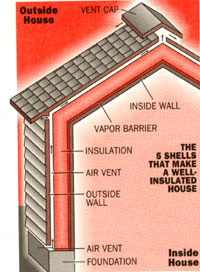
Imagine the house as a series of shells enclosing the
living space: warm inner wall, vapor barrier, house
framing, insulation, cold house siding–and between
vapor barrier and siding, a constant flow of air to
evacuate humidity.
Controlling Infiltration
Even the gentlest wind will create a vacuum on the house’s
lee side, sucking out house air through any opening. A
contractor or electric utility can photograph areas of heat
loss using infrared film or electronic sensors. They are
especially helpful in identifying hidden leaks in log house
chinking or joints in brick or stone buildings–both
curable by caulking. But you can
locate or preempt leaks in a frame house by using a little
common sense.
Our 200-year-old house sits on a dry-laid (mortarless)
stone foundation. Last summer, I went down to a darkened
cellar and was surprised to find sunlight glinting through
a dozen leaks. I plugged them with a silicone
rubber–a caulklike adhesive that will remain flexible
for decades. (I avoid liquid styrene plastic “super caulk”
that sticks to anything and will remain flexible
indefinitely. It contains toluene, a substance that has
scrambled the brains of more than one young
“paint-sniffer:’)
Then I ran a 48″-wide roll of four-millimeter-thick, black
plastic-mulch sheeting around the foundation. I stapled the
top to the clapboard siding three feet above ground level
and then secured it with inexpensive wood lath along top
and bottom, spacing it vertically every six feet. I laid
the bottom foot of sheeting flat along the ground and
placed old hay bales up against foundation and sill.
This combination diminishes the wind’s vacuum effect and
keeps out snow that may drift against the house, melt, and
seep in. Soaked insulation will rot the sill or freeze and
heave the foundation. Next spring I’ll remove and store the
plastic and use the hay for garden mulch.
Our clapboards and windows were so weathered that a gust
from a proper northeastern would suck little puffs of snow
into the north side of our living room. At first I covered
the whole wall with plastic, but that’s old-tech. I
recently wrapped the house bit by bit with Du Pont Tyvek, a
flexible plastic membrane that’s placed between sheathing
and siding in new homes. The Tyvek keeps wind from coming
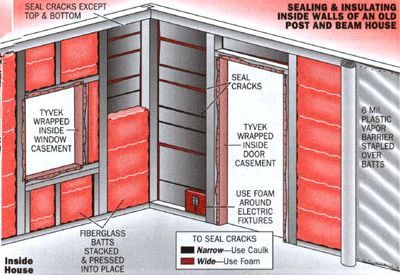
in but lets moisture out. After removing old clapboards, I
stapled Tyvek over the exposed sheathing boards, placing
tape over the staples and seams. As I tore out interior
walls, I pumped silicone/latex tube caulk into seams
between sheathing boards and into cracks and
knotholes–but not into top and bottom of
wall cavities. Air must be permitted to flow up and through
the outer wall to ventilate insulation.
Outside, I nailed siding over the Tyvek. Had walls been
thinner, I’d have applied rigid-foam insulation board
before the clapboards went on. Or, I’d have erected
super-insulated double walls inside–a partition of 2
x 4’s staggered between outer wall members. Leaving a 2″
airspace between double 2 x 4 walls filled with 3 1/2″ roll
insulation gives an R-value of 30 or more.
I chipped out loose beads of dried-out old caulking around
casements, plumbing and utility conduits, carefully
collecting and disposing of it. Old caulk may contain
poisonous white-led pigment. I replaced it with
silicone-latex, 30-year-life tube caulk. I use modern
aerosol foam.
Foam Insulation
Canned foam is great stuff; it acts as both a vapor barrier
and insulator rated at R-4 per inch. The nonexpanding kind
is good for filling narrow cracks. To fill larger cavities,
there are varieties that expand from 1 1/2 to four times
the bulk that burbles out of the can. A powerful adhesive,
it sticks to any clean surface, and a $7 can is equal to at
least $20 worth of tube caulk. You can pump foam around
electrical fixtures (but not inside the outlet box), and
into inaccessible crannies. If foam oozes out of bounds,
compress it with a wet putty knife or let it harden and
trim with a sharp knife. Foam needs moisture to expand, so
spray dry cavities with a little water. Have nail polish
remover on hand to clean the jet. Foam will harden in the
plastic applicator tube provided, but I find that soda
straws serve as well, and “bendy straws” can reach hidden
cavities.
Even if your house was professionally insulated, check
inside door and window casements by using a thin pry bar to
remove trim boards. I found heat-leaking cavities around
every casement in our place. Don’t pack window casements
full of expanding foam; it can swell and pinch sashes,
making them stick. Squirt in just enough to fill cavities
side to side. Once replaced, wood trim will need touching
up, but you’ll get years of energy savings for your
trouble.
One warning: many canned foams use ozone-layer-destroying
CFCs or HCFCs as a propellant or expander. Look for an
“ozone safe” banner on the can. The fluorocarbon freon is
also used to expand rigid foam panels made of urethane and
isocyanurate. Freon has been replaced by a more benign
expansion gas in expanded styrene, so I look for Styrofoam
board.
Infiltration Versus Air Exchange
Back when oil cost 19¢ a gallon, homes were built to
lose their air contents several times an hour. With fuel at
one dollar per gallon, you want to seal up–but don’t
overdo it. Air exchange between house and outdoors should
be at least a half-houseful an hour. If there’s less,
indoor air pollution, such as the cancer-suspect
formaldehyde (used as a preservative in carpets and
upholstering), may build up. If your house sits on
radon-bearing rock, the carcinogenic gas may seep in and
accumulate as well.
Plus, with furnace, fireplace, or exhaust fan drawing out
600 cubic feet of air a minute, a too-well-sealed house may
become a vacuum chamber that can suck exhaust gases into
living spaces.
A properly vented and tuned furnace or brisk wood fire
produces little hazardous carbon monoxide. But draft from
an open window on a downwind wall or a strong drawing flue
can overpower a weaker exhaust, and “backdraft” from
smoldering wood embers or a poorly oxygenated oil or gas
fire may actually kill you in your sleep.
If your wood-burning stove draws well with a window open,
but smokes even a little when the house is closed up, you
may have a problem. Crack open a cellar window and open a
hole in the floor behind the stove for combustion air.
Better, run metal ducting from the stove to the outdoors.
If cooking odors linger too long, you can unseal the attic
door or cut small closable vents through the wall or
ceiling.
Test air exchange by closing up the house and watching
smoke from incense or a smoldering cotton string placed on
the floor. If smoke rises straight up and pools at the
ceiling, you probably have too little air exchange. If you
have any doubt, find an insulating contractor with the
equipment to analyze air pressure, air exchange, and heat
loss.
Insulating Walls
Heat energy radiates through hollow walls and is conducted
through solid framing. The air between wall studs will
develop convection currents that transfer heat from inner
to outer wall. To stop all three processes, fill the wall
with a nonconductive air-movement
inhibitor–insulation–and face it with a
radiation reflector or absorbent.
In new homes or renovations you can apply high-R-value
rigid foam with an infacing foil backing over sheathing on
exterior walls. But foam board is expensive; the most
R-value for the buck comes from mineral-fiber insulation.
In conventional frame walls with studs placed 16″ in the
center, stock insulation goes up quickly.
Roll insulation backed with a kraft paper or reflective
foil-paper “vapor barrier” having staple flanges along the
edges was once universal. But foil dulls, and paper is both
an ineffective vapor barrier and flammable. Unbacked,
semi-stiff friction-fit batts pose less fire potential, and
you can see to fit them snugly. If using unbacked batts,
wear a respirator.
Insulating our old home was a challenge, even with the
interior walls torn off. It is framed with 6″-square studs
spaced anywhere from one to two feet apart. Using R-19
Owens-Corning pink panther fiberglass, I had to cut batts 5
1/2″-thick and 15″ wide to fit horizontally between studs.
I packed shreds of insulation loosely into odd spaces at
the ceiling and floor so that the cavities would not leak
heat. Expanding foam went into narrow spaces where I
couldn’t pack fiberglass easily without compressing, which
squeezes out air and reduces insulation value.
The Vapor Barrier
To keep house moisture out of the insulation, I stapled
six-millimeter, clear polyvinyl plastic sheet to the wall
framing. This must be done immediately–especially if
you don’t plan to install wall paneling or drywall right
away–because exposed fiberglass can shed tiny
filaments that can cause lung problems.
To be effective, the barrier must form a contiguous,
air-proof sheath around living space. I applied clear poly
tape over staples and joints in the sheet. At the ceiling
and floor, I caulked the seam between the floor and wall
framing. Then I caulk-glued, stapled, and poly-taped edges
of the sheet to beams.
You don’t want to tear out perfectly good walls when
insulating. Your best bet is to use blown-in insulation.
Loose fiber glass, mineral wool, or cellulose recycled from
newspaper and treated with fire retardants is blown through
holes drilled through hollow walls of frame buildings. If
applied uniformly, blown fiber adds R-3 or more per inch of
thickness, giving you up to R-12 in a conventional 2 x 4
wall, or R-19 in a house framed with 6″-wide studs. Don’t
be tempted to rent a blower to pump insulation into your
own walls. It takes an experienced pro to remove siding,
drill through sheathing, pack insulation uniformly into all
wall cavities, and then seal the outside so it won’t leak
air.
Don’t bother to insulate in any manner without applying a
vapor barrier inside. Poly sheeting doesn’t make very
attractive wallpaper, but interior paints such as Glidden
Insul-Aid will seal in moisture. Caulk thoroughly around
floor and ceiling moldings. Keep interior walls and
ceilings freshly painted. Today’s light-colored interior
paints reflect much radiant energy. Drapes, furniture, and
wall hangings absorb most of what’s left.
Roofs and Ceilings
In our latitude, the energy code mandates a minimum of R-30
in the roof or top-floor ceilings. That’s 8 1/2″ of
fiberglass, rock-wool, or cellulose. It can go in the roof,
in the attic floor, or both. Placing 5 1/2″ (R-19) of
insulation between 6″ framing in both roof and in attic
floor will give you R-40. With end walls insulated and
eaves filled loosely, snow on your roof won’t melt over
rafters.
Our rafters, in contrast, did melt snow, and I found that
we had only three inches of aged insulation–much of
it mouse-holed or compacted–between ceiling joists in
the attic floor. I vacuumed and fluffed it, filled the
mouse holes, put a layer of 6″ batts on top. In the part of
the attic used for storage, I covered rafters with two
layers of 1″ rigid-foam R-6 panels (R-6 x 2 = R-12), and
then covered that with 1/2″ plywood (R-5).
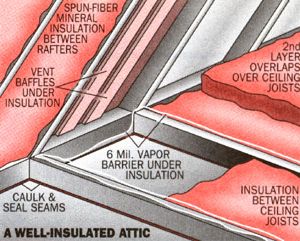
Next I insulated the attic floor by installing short
lengths of rigid-plastic vent-space baffle along eaves at
the perimeter of the insulation. If you plan to install
fiber-glass in a sloping roof, staple vent-space baffles
along the underside of sheathing to maintain
eaves-to-roof-peak ventilation.
You also need a contiguous poly-vapor barrier between
living space and the bottom of roof insulation. If
insulating be tween roof rafters only, staple poly to
rafters under insulation, double-fold and tape seams. When
insulating the attic floor, lay overlapping sheets of poly
between joists and snugged down into the spaces between
before placing insulation.
Handling insulation in hot attics is no fun. Glass fibers
stick to your sweaty skin, and can itch. To avoid handling,
rent a blower to put rock wool or fiberglass insulation
into the attic floor–but be doubly sure to use a
respirator. Loose cellulose can be blown in as well.
However, because it lays out more easily than mineral
fiber, it can be easily distributed with a rake.
Working on an unfloored attic, please don’t try to hop
around on the floor joists. After slipping and pushing a
boot through the kids’ bedroom ceiling, I hauled a pair of
4 x 4 plywood panels into the attic and leapfrogged them
around to provide a solid kneeling floor.
Cellar and Foundation
It seems that what’s out of sight in the cellar is out of
mind as well. Many centrally-heated homes lose more energy
through a heated basement than through the roof.
Solid, heat-conducting rock, brick, and poured concrete
have only fractional R-values, and even with their open
cells covered, 8″-wide concrete blocks rate only R-1 1/4.
Newly built foundations are insulated with 1″ of rigid foam
below grade, plus a collar of another inch over the
portions above ground level. In older homes, you’ll need to
attach foam panels inside with metal lath or wood furring
strips. Fasten them to brick or concrete cellar walls with
concrete nails, or to stone walls with screw anchors
cemented between rocks.
It may be easier to insulate your cellar walls with rolled
fiberglass set into a floor-to-ceiling, 2 x 4 partition. As
suggested above for a sloping attic roof, place air vent
baffles behind fiberglass and a vapor barrier in front. A
raised, insulated cellar floor can prevent up to 15% of
energy loss. Allow for water drainage if walls or floor
leak even a little. (For details, see any of the books or
articles on building a rec room in the basement.)
Most unintentional cellar heat loss is due to radiation
from a poorly insulated water heater and pipes, furnace and
hot air ducts, or a long run of flue pipe. You can cure
most of the problem yourself. A blanket over the hot-water
heater can save plenty (your electric utility company may
install it free). Strips of duct tape–the real thing
from a heating supply outlet, not cheap “Duck”
tape–will seal seams in hot air ducting. You can tape
foam sleeves to insulate water pipes and install an
insulated flue between the furnace and chimney.
But fire and building codes are strict when it comes to
insulating furnaces. Consult a licensed heating contractor,
and have him install an automatic flue damper that closes
when the flame has been out long enough to exhaust
combustion gasses but keeps clean warm air from being lost
up your flue.
We only use the oil furnace to supplement wood stoves
during the depth of winter, and the unheated cellar can get
cold. To keep plumbing from freezing up, I wrapped electric
heat tape around the pipes (soil pipe leading to the septic
tank as well as the water supply) and enclosed the water
pump in an insulated box with a light bulb inside. Between
the joists under the living room floor, I installed 6″,
foil backed, rolled fiberglass, with foil facing up to
reflect radiant heat back into the room. With a
fiber-pad-backed carpet carrying an R-value of over 2, our
feet stay warm during the wood-heat season.
Doors and Windows
More energy can be lost through a few doors and windows
than through walls and roof combined. Small wonder; rated
at only T-0.9, a glass pane conducts and radiates energy
both ways, which is great during sunny winter days but
inefficient at night (and the reverse in summer). During
the `70s, when petroleum threatened to rise to $50/bbl (it
now sells for about $18), a number of
door/window-insulating ideas were developed–not all
of them practical. I remember one dual-pane window that
could be blown full of insulating styrofoam beads. Problem
was, getting them all out was nearly impossible, and little
white bits flecked the inner panes.
In modern energy-saving, dual-pane sashes; interpane spaces
are filled with argon or another inert gas, which, with its
heavy molecules, is less conductive than still air. A low-E
coating–a super-fine spray of reflective
metal–is applied to inner surfaces of panes. Much as
the metal grid in your microwave oven door lets light out
but keeps microwaves in, the low-E coating lets visible
light through but reflects infrared. Reflecting heat inward
in the north, and outward in the south, the low-E,
gas-filled sash has an R-4 rating.
The newest development is a window with low-E coatings on a
thin plastic film suspended in argon gas between dual
glazing and rated at R-8. New “hard” low-E coatings can
also be applied to storm windows. So, low-E main and storm
windows can combine to be almost as energy efficient as
your walls.
Energy codes require insulated doors and windows with air
and heat gaskets around casements in new construction and
major renovations. You can replace doors and windows in
your older home, but for a price that may not be repaid by
energy savings. The best multiple-glazed windows offer a
rating of R-8 and cost $150 to $350 apiece. Installation
labor can up the cost to $500 per window.
A metal-and-foam–sandwich entry door carries an R-15
rating. If used with a good, airtight dual-glazed wood or
metal-and-foam storm/screen door, the entry’s R-rating will
approximate the wall’s. But, such an entry can cost $1,500
or more to install. Also, when replacing any window, check
your building code. It may require that old nonwood
casements come out, increasing the whole expense.
Using costly high-tech methods isn’t the only answer.
Jalousies, sunshades, lattice blinds, and awnings also help
insulate doors and windows. They are just as effective
today as sun and heat radiation barriers as they were in
Scarlet O’Hara’s day.
In our cold Yankee climate, we heat only the most used
parts of the house. Each fall I cover doors and windows in
seldom used rooms with foil-backed 3 1/2″ – fiberglass, and
then cover that with sheets of poly film stapled and
duct-taped to edges of wood trim. Poly goes on the outside
as well. To eliminate wind flap, I tape wood lath in a
cross pattern on the outside. With the fiberglass offering
R-13, the glass R-1, the 2″-thick layer of dead airspace
behind the poly adding R-2, and the two sheets of plastic
another R-2, I have almost R-19. Cost per window is less
than $5 and the materials are usable for years if removed
and reinstalled carefully. It’s ugly but cheap and
effective.
Over windows in frequently used rooms, I screw fixed-pane,
wood-sash, storm windows snugly to the outer window-trim
boards. I’ve replaced the droopy felt weatherstrip with
3/8″-wide x 3/16″-thick EPDM rubber weather-gasketing
around the inside of each storm window frame. Sold by W. J.
Dennis & Co., of Elgin, Illinois, for over
25¢/foot, EPDM isn’t cheap. However, it is 10 times
more effective than felt or easily torn-open cell foam
stripping. Its self-stick backing adheres to any dry
surface. With a tough, closed-cell skin, it will last for
10 years or more. Not as sturdy as EPDM is the 1 1/4″ wide,
self-sticking, closed-cell, vinyl weather strip used to
seal between truck beds and camper tops (Its width also
makes it useful on uneven surfaces such as the bottoms of
old window sashes.)
On the inside and outside of windows we want to see
through, I fasten window-clear plastic sheeting, which is
double the cost of semiclear poly but worth it.
Anti-wind-flap lath crosses are held on the outside with
clear poly tape. If the putty keeping glass panes in place
is maintained, the old windows are airtight and offer
R-values of 3 to 4. Thick, tight-closing drapes bring the
R-value up to 5 or 6.
More effective than drapes are window quilts: roller shades
of two layers of fiber- fill with a reflective mylar sheet
between them. Boxed at top and held by airtight guides at
each side, quilts offer an insulating value of about R-4.
You can also buy or make insulating drapes with a boxed
cornice at top, edges fastened to walls, and bottom
weighted down or on tracks to seal with the floor. They
will more than double the R-value of an old-style picture
window, sliding door, or window wall.
I’d suggest that you avoid those heat-shrink, plastic film,
indoor-window insulating kits that sell for about $3. The
film tightens up fine if you heat it evenly, but the
two-faced tape that comes with it won’t come off its paper
backing unless it is fresh from the factory. Indeed, I have
yet to find a tape that won’t remove paint from the walls
when I peel it off in the spring. You’re better off
fastening plastic film by folding the edges of the plastic
two or three times, and then compressing it with thin wood
strips tacked around the outer edges of the window’s wood
trim.
We have thick, old, wooden doors and well-insulated wooden
doors (combination storm/screen) at the entries. I taped
clear poly over both sides of the glass in both doors to
give the same R-value as an expensive triple-glazed sash.
To make an effective weather seal, I fastened EPDM to
3/4″-square wood strips and tacked it with small nails to
the insides of both door frames. Along the inside of the
door bottoms, I installed adjustable, rubber edged aluminum
floor sweeps. At night we roll “draft dogs” (fabric tubes
filled with sawdust) against the door. The fabric comes
from cutoff legs of old jeans; the sawdust comes straight
from the woodpile. When a blizzard howls, we pack them
along the door sill between the main and storm doors as
well.
Pets Don’t Help
Of course, the draft dogs don’t last long if our pair of
pets gets a hold of them. Some of the poly does need annual
replacing thanks to the house beasts scratching to get in
on a cold evening. I screwed scratch panels of 1/4″ plywood
over the bottom half of the storm doors, but the great
fools jump up and claw the poly on top if we don’t answer
on their very first howl. The tom cat hurls himself at the
plastic with all claws extended if not admitted on first
meow. By winter’s end, there’s as much tape as poly sheet
covering the front door and the cat’s favorite living room
window. But, we all stay warm and fuel efficient at a
reasonable insulating cost.
An Analysis of Cost, Heat, and Money
Savings
We all want to conserve energy, but we also need to get the
most fuel efficiency for the dollar. Tightening siding and
caulking foundation, doors, and windows will eliminate 30%
to 50% of the heat a typical house loses to infiltration,
and do so at a negligible cost. An insulation contractor
can calculate savings from added protection, but you can do
a rough estimate yourself. Assuming you’ve already caulked
the house thoroughly and have some roof insulation and
storm windows and doors, multiply annual heating costs by
20% each for maximum potential cellar and roof heat loss,
and by 30% each for wall and window or door loss.
Now price needed fiberglass, foam panels, and replacement
windows and doors and calculate the costs of bringing
R-values up to snuff. Then divide costs by annual savings
to find time needed for payback. In our house, R-R windows
would add only R-2 over the R-6 of the old storms I use,
and would cost at least $2,500 (and that’s if I did the
installing). I calculate that they would provide a 2/8 or
25% reduction in the window’s 30% contribution to a loss of
a $1,000 cost per year. If we heated entirely with oil
)–$75 per year at best–it would take 33 years
to make up the cost. However, if we heated with a
combination of wood and oil at a cost of about $500 per
year, our great-grandchildren would still be waiting for a
full payback.