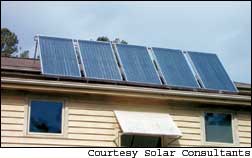
In the 1970s and ’80s, those of us involved with the solar movement focused on promoting renewable alternatives to fossil fuels and nuclear power. The research and experience coming out of that era was tremendous, and it will continue to serve us well over the next decade.
But our focus back then was too narrow — we could create houses with 100-percent solar heating and passive cooling, but we failed to adequately consider the rest of the picture. Would these buildings keep their occupants healthy? Were the buildings durable? How much “embodied” energy was consumed elsewhere to produce the materials used in these buildings? And what about other environmental impacts that result from where we build and the materials we use?
The green building movement, which took off in the late 1980’s and early 90’s, is built on the solar movement but takes a decidedly broader view. Yes, we want to create low-energy buildings heated and powered by sunlight, but we also want to satisfy these other concerns to address much broader environmental priorities. Green building materials are an important part of this discussion.
Understanding Materials
Products can be considered “green” for many reasons. The raw materials used in making them may come from sources considered environmentally friendly: wood from certified, well-managed forests; recycled materials; and rapidly renewable agricultural fibers, for example. Some products are considered green because they are manufactured in a way that releases minimal pollutants or avoids toxic byproducts. Other products are green because they minimize the negative effects of construction (such as avoiding the need to excavate a foundation), or because they help a building minimize its use of energy or water. Products also can be green because they do not introduce pollutants into the built environment, or because they help remove pollutants.
The process of examining the environmental and health impacts of materials is referred to as life-cycle assessment (LCA). This emerging science considers a product’s environmental burdens throughout its life cycle — from resource extraction and manufacturing, through the use of the product, and ultimately to disposal or recycling it into a new product. Because most building materials are in use for a long period of time, the usage phase of a material’s LCA is particularly important. LCA is a highly complex science that we are only beginning to seriously investigate; European and Canadian researchers are well ahead of their U.S. counterparts in this regard.
The problem is that with so many different types of environmental and health impacts, when we compare products, we often are comparing apples to oranges. Even worse, we may be comparing the color of apples to the taste of oranges. The challenge in evaluating green building materials is in balancing the many environmental and health considerations to determine whether those materials should be considered green.
The Holy Grail of LCA for building products would be a database in which the life-cycle environmental impacts of different materials were fully quantified and the impacts weighed so that a builder or designer could easily see which material was better from an environmental standpoint. Though efforts have been started along these lines — one example is the Building for Environmental and Economic Sustainability (BEES) software developed by the National Institute of Standards and Technology (available for free download at here) — we are not close to realizing that goal. We are a long way from a comprehensive, truly objective way to compare the greenness of building materials, but we still can make informed decisions regarding their selection.
Finding These Products
Until we have a comprehensive LCA database that we can use to quantify the environmental characteristics of building materials, one way to identify green products is to rely on green labels or certifications for those products. Most such labels are specific to a particular type of product. Examples include certified wood from the Forest Stewardship Council (FSC), Energy Star appliances and office equipment, and GreenSeal labels on paint.
There also are a number of directories of green building products, including the online Oikos Green Product Directory from Iris Communications. My firm, BuildingGreen, offers the GreenSpec Directory, the newsletter Environmental Building News and a new residential directory, Green Building Products.
Are Green Products More Expensive?
Some green building products are more expensive than their nongreen counterparts. VOC-free (volatile organic compound) paints produce no significant pollutants, but require different chemical formulations that may cost more to manufacture or that may be produced in smaller volumes, such that manufacturers can’t benefit from economies of scale. Other green products are made from natural ingredients that are significantly more expensive, or from wood that is grown and harvested in environmentally sensitive ways that can cost more. With mechanical equipment and appliances, greener products have greater energy efficiency, which can require more expensive components or more elaborate configurations.
Not all green building products are more expensive, though. Plenty of them cost no more than their conventional counterparts — or even cost less. And as green products gain market share, economies of scale should bring down overall costs.
Alex Wilson is the president of BuildingGreen in Brattleboro, Vt., and executive editor of Environmental Building News. BuildingGreen publishes authoritative information on environmentally responsible building design and construction. This article is reprinted courtesy of Solar Today.