

“How are you going to heat it?” This is the question most often asked at the first stages of owner-builder planning. Pertinently so, as the type of heating has a major effect on room location and window placement, as well as general house design and orientation layout. To answer this question, most people have no more information than the half-truths offered by heating appliance salesmen, heating contractors and fuel distributors.
The heating problem is not simple. Consider operation with just one type of fuel-consuming appliance, the oil burner. When a “high pressure” oil burning unit is used (such as that produced by the Carlin Company), about one gallon of oil per hour is consumed. But the Williams’ Oil-O-Matic model, a “low pressure” type, requires just half this amount per hour. And now the Iron Fireman Company comes up with a “Vertical Rotary” burner which requires even less, or about one-third gallon per hour.
Electric power companies advertise the advantages of the “all-electric house” — the freedom from handling fuel and ashes, and the extreme simplicity and flexibility of operation. But with electrical rates at 3 cents per kilowatt-hour, heating costs will be about six times as much as with fuel oil at 16 cents a gallon. Where natural gas is available the cost differential is even greater. I do not mean to rule out the use of electricity for domestic heating. In regions where electrical rates are low, or where there are very mild winters, or in cases where an intermittent, quick-return type of heat is desired, electricity may offer inducements in cost and performance.
Comparative Cost in Dollars of Domestic Fuels
The following information is from Consumers Bulletin. Listed by fuel type, average price, and average cost per million BTU:
Anthracite coal; $28.50 per ton; $1.40
Bituminous coal; $16.25 per ton; $0.80
No. 2 fuel oil; $0.16 per gallon; $1.40
Manufactured gas; $1.40 per gallon; $3.35
Natural gas; $0.75 per gallon; $0.90
Bottled gas (propane); $0.14 per gallon; $1.90
Electricity; $0.03 per KWH; $8.80
As there is a wide price variation from city to city, actual local prices should be substituted for reliable comparison.
Climate Considerations
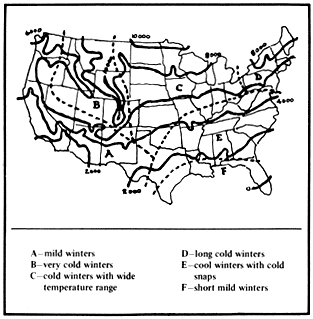
The factor of climate, of course, is of importance in heating. But air temperature is only one of several important climatic measurements. Relative humidity, solar radiation, and air movement should be taken into account. For instance, it has been found that a wind of only 15 miles per hour may increase the heat loss from a window surface by 47 percent and from a concrete wall by 34 percent. So heating plans have a close relation to windbreaks and wind baffles.
2000 degree-days* — intermittent types of heat; stoves, portable heaters using gas or electricity; central heat likely to be troublesome.
4000 degree-days — space heaters popular; baseboard radiation very satisfactory; electricity and bottled gas often used; heating limited to living room.
6000 degree-days — central heating desirable, though often replaced by space stoves; hot-water heating systems popular; electric heat impractical.
8000 degree-days — heat required in every room preferably central system; periphery usually sufficient to permit use of steel baseboard radiation.
10000 degree-days — central heat required in every room; periphery of house likely not long enough to permit adequate heating by baseboard radiation; electrical heating prohibitive in cost.
*The heating engineers’ “degree day” is based on difference between outside temperature and 65 degrees Fahrenheit, counting by hours.
Ways Heat Is Transferred
Heat is transferred in three ways; by conductors (e.g., the warm floor), by warm air, and by radiant panels. Rather than attempt to solve the heating problem through one type of heater alone, you might combine the best features of each, including the radiative and conductive effects of the heat-circulating fireplace, as well as the radiative effects of solar heat. Hot-air convection heating, which is quick-acting, can compensate for the time-lag typical of hot-water panel heating.
The ancient Romans, and later Count Rumford and Ben Franklin, and now heating engineers and physiologists have speculated on the heating process in relation to health and fuel economy. From all available evidence, I am reasonably directed toward using radiative means of heating rather than convected, warm-air types. It is important to realize that the purpose of heating a building is not to put heat into the occupant, but to keep him from losing heat. We are comfortable when we give off heat effortlessly at the same rate that we produce it. The only purpose of a heat-system is to aid the body’s mechanism in maintaining balance between its rate of heat loss and its rate of heat generation.
In the case of convected heat, the air-temperature in a room must reach 68 to 70 degrees for basic comfort; yet this temperature unfortunately is too high for us to emit heat rapidly enough. Our pores tend to “open” (through certain nervous and endocrine reactions) and more blood flows to the surface of the body, so that it can radiate more heat to the outside air. The result is a feeling akin to exhaustion as on a hot, humid day.
Comfort at lower air temperatures can be achieved by using radiative heating methods — thereby promoting the generation of heat within the body, and the exhilaration that goes with brisk activity. In a conventionally heated room, hot air rises from the convector (usually located beneath a window) and then sweeps across the ceiling and falls down the opposite wall. Temperatures at the ceiling level are highest where they actually do the least good, comfort-wise. A temperature of 100 degrees at the ceiling may produce only a 70 degree temperature at the living zone! A smaller range of air temperature from floor to ceiling is possible by using radiant panel heating methods. Where a 70 degree air temperature is required in convected heating, less than 65 degrees is required using radiative means, resulting in a 30 percent saving in fuel consumption.
The sun or an open fire emits radiant heat rays. The Romans, by circulating hot gases from charcoal fires through ducts to warm walls and floors, created radiant heat 2,000 years ago in England. The traditional Korean “ondol” heating adapts the radiant principle; combustion gases from the kitchen stove flow through a labyrinth of chambers under the floor-slab to a chimney at the far end of the room. Radiant heat then comes from the floor. Frank Lloyd Wright revived radiant heating in the Western world in developing the “gravity heat” system. He used it (1937) in the Johnson Wax Building.
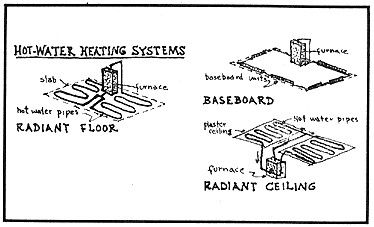
About 90 percent of currently installed radiant panels use hot water as a circulating medium, but a hot air radiant system is definitely less expensive to install and operate. Most water systems use steel or copper pipes buried an inch or two beneath the top surface of the concrete floor slab. This is no doubt less costly than ceiling or wall installations, but the hot-water radiant ceiling has many points in its favor. In order to achieve maximum efficiency, the water temperature in a radiant floor slab must be maintained at from 80 to 90 degrees. Yet a floor temperature of over 70 degrees will cause a rise in foot temperature and consequently an undesirable disturbance of normal heat emission from various areas of the body, since the temperature of the lower extremities is normally several degrees lower than that of the trunk and upper areas.
The fact that the floor is warm in a ceiling-heated room may at first seem contradictory. But if the entire surface of the ceiling is heated, there is no chance for convected air circulation. This makes for a uniform temperature, with radiant energy transmitted downward and intercepted by the floor surface. Water temperature in ceiling-heated surfaces must be kept at from 125 to 135 degrees.
There is a long time-lag in radiant floor heating; slow morning heating and slow evening cooling. A sudden change in weather cannot be compensated for soon enough. This is the usual objection to a hot water radiant system. However, a thinner floor slab will hasten the response to temperature change. Dividing water circuits into separate sections—one circuit for the living area, one for the sleeping area, etc.—will also cut down on heating lag. Likewise, a grid system of pipe layout is more efficient than a sinuous pattern.
The hot water radiant ceiling will of course cut down considerably on heat lag. The latest ceiling panel development—that of attaching the heat coils to the top of perforated metal snap-on panels (with acoustic “thermal blanket” insulation)—has proven to be far more efficient in heat response than the conventional plaster-lath installation. Metal is an excellent heat conductor, and becomes heated almost to the same temperature as the water in the pipes. The exposed metal should be of a matte or “flat” surface (aluminum is best); if polished it has no radiating qualities.
Another recent development in “hydronics” (that is, water heating) has come out of experimental work at the University of Illinois. Considerable time and installation expense can be saved by using 1/4 inch to 3/8 inch flexible copper tubing in place of the usual 3/4 inch steel or copper pipe, since the number of fittings can be reduced one-half. The small appliance-sized, automatically-fed boiler has recently appeared on the market. High temperature water heating combined with water heating for domestic use can be supplied at relatively low cost. Levitt has used both the 3/8 inch copper tubing and the combination water heating appliance (York-Shipley, 94,000 BTU/hr).
A hydronic system known as “baseboard radiation” is another current development. Heat is provided by baseboard radiation units located usually on cold walls. Some convection effects probably occur, but the units are mainly radiant in their action. Forced hot-water baseboard radiation is low in first cost and simple to install.
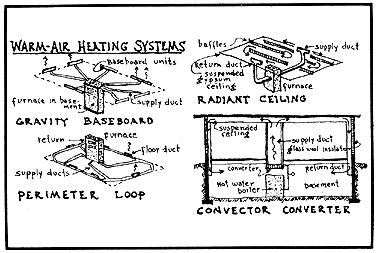
About 50 years ago the cast iron stove was moved into the basement and became a furnace. As a “gravity” convection heater it sent up hot air (and other gases!) through a grill in the floor. Basically this gravity warm-air heating system has not been improved upon. It is still the cheapest heating system for the small, compact home, and is perhaps found in existing homes more often than any other type. Air enters the system through one or more “cold air” or “return air” registers, and is heated as it passes through the large return duct.
About 25 years ago someone had the bright idea of installing a fan in the bottom of the heater. The resulting “forced-air” system allowed for smaller ducts and more freedom in design. Moreover, it was possible to keep the house and furnace on the same level. The majority of new homes are equipped with warm-air perimeter-duct or baseboard heaters—this in spite of the fact that extensive research proves convected-air heating is generally unhealthful—for heating appliance manufacturers and installation contractors are about 10 years behind research developments in their field.
Since the best method of domestic heating may be a wise combina tion of radiative and convective systems, I mention two more promising “combination” systems. From a centrally located furnace, hot air is blown down into radiating feeder ducts imbedded in the concrete slab. Hot air circulating through these feeder ducts heats the floor surface to a temperature of about 73 degrees. as it passes through to a larger perimeter duct and then into the room. Thereupon a blanket of warm air passes up the exterior wall where it is most needed. Since the floor surface is heated, no cold air floor register is necessary. The absence of cold air at the floor level also contributes to the “living zone” comfort.
Crawl space perimeter heating is another recently developed “combination” system. It is said to produce the most uniform temperature with the quickest response at the lowest cost. In this system the total crawl space serves as the plenum. The central down-flow furnace supplies warm air to a short, stubbed-out duct system, pointing to the far corners of the house. Registers are located around the outside perimeter of the rooms. Return air is collected in an interior wall and returned to the furnace through a short duct. When a layer of heated air exists below the floor joists, not only is the floor surface temperature increased, but also the “living zone” temperatures are made more uniform from floor to breath level.
No matter what type of heating system one chooses, if the house is not adequately insulated and weatherstripped, heating costs will be excessive. In cold climates it will cost only half as much to heat a well insulated building as a poorly insulated one. The Housing and Home Finance Agency (Release No. 126, Oct., 1949) reports that the annual fuel saving from moderate insulation of a typical dwelling in Washington, D.C. will amortize the additional cost-expense in two years! In one carefully planned experiment it was shown that coating the walls and ceiling of an experimental room with aluminum paper reduced the heating load by 21 percent.
It has also been found that 80 percent of the hourly heat loss from a concrete slab or crawl space house is through the perimeter and floor, with only 20 percent through the ceiling. And of this total heat loss, most occurs along the perimeter rather than downward through the floor. In two houses in Champaign, III., the one not weather-proofed required 3,000 gallons of oil in one year, whereas the same-sized house with storm sash and doors, weatherstripping of outside doors, and insulation of ceiling and sidewalk took only 800 gallons.
An efficient heating system in a well-insulated dwelling is comforting to body and mind.





