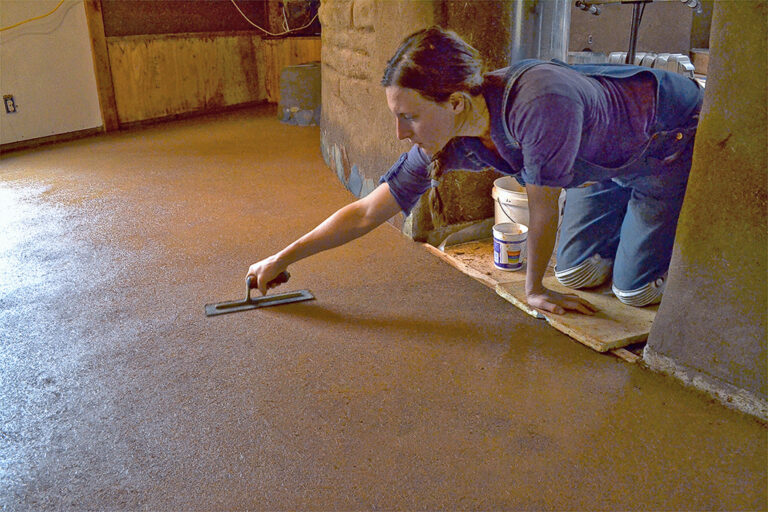
An earthen floor is a great option for those who want to bring earth into their homes. The technique is relatively easy to learn, and the floors can be installed in a variety of situations and conditions, including both new and existing buildings. They could sell themselves on aesthetic appeal alone, let alone their unique feel, low toxicity, thermal benefits, and minimal environmental impact.
The concept of an earthen floor is not new. Homes have been built directly on the earth for millennia. In many parts of the world, people still live on floors made of earth. Most traditional earthen floors are just the raw earth, tamped down with human feet and moistened frequently with water to keep the dust down. Sometimes sealers are used to stabilize the earth more permanently.
Over the last few decades, earth builders in North America have been improving earthen floor installation techniques to the point where now even people living in conventional houses are willing, even enthusiastic, to live on a floor made out of earth. Today’s earthen floor practitioners carefully select, process, and mix their raw materials and install them with the assistance of laser levels, steel trowels, and insulation to make floors that are flat, smooth, and warm. Oil and wax sealants provide durability, water-resistance and shine. Some earthen floors are installed in conjunction with radiant heat systems, a wonderful heating option for modern homes.
Earthen floors are remarkably versatile, but may not be suitable for every application. It’s useful to understand a few of their key characteristics to determine where they should and should not be installed.

Weight: Earthen floors are heavy; they require a stable and strong subfloor. Most typically they are built “on grade” (i.e., directly on the ground), over a strong base pad made of concrete or compacted gravel (road base). They can also be built on raised wooden subfloors, even on second or third levels if the structure is strong enough to support the additional weight; consult with an engineer if in doubt. An advantage of heavy floors is that they are a good source of thermal mass, which helps moderate indoor temperature fluctuations.
Hardness: The surface of an earthen floor can look and even feel like concrete, but it does not have the same compressive strength. Earthen floors can be dented by point loads or scratched by heavy objects. Their hardness can be compared to that of a wood floor. Experience has shown that because they are softer, earthen floors are more comfortable to stand and walk on than concrete floors.
Water resistance: Sealing with the right kind of oil gives earthen floors a durable, waterproof finish. You can spill water on them and even mop them without any problem. But below the sealed surface, the floor is still unstabilized earth. Prolonged exposure to lots of water could have negative consequences, as the water seeps through cracks and pores into the layers beneath. Earthen floors have been successfully installed in bathrooms, but shouldn’t be used in showers or in basements that flood.
Thickness: Earthen floors are usually 3/4-2 inches (2-5 cm) thick. It’s important to consider this added thickness when planning for transitions to adjacent rooms or entryways, or in rooms with already-low headroom.
Installation time: Earthen floors are not a quick flooring solution. Drying and curing are the most time-consuming stages. Sometimes installers employ fans, heaters, and dehumidifiers to speed up the drying process. Under the proper conditions, a floor could be completed and ready for use in two weeks, but three to four weeks is not uncommon.
Toxicity and flammability: More people are becoming concerned about toxic materials in building products, such as glues, polymers, preservatives, and flame retardants. Earthen floors are a natural, non-toxic flooring option; the main ingredients come from the earth beneath our feet. The oils used for sealing, while extracted from natural ingredients, do contain some volatile organic compounds (VOCs). Once the VOCs have evaporated (this takes one to three days), they no longer pose any risk to the inhabitants, but any adjacent occupied rooms should be sealed off during the oiling and drying process. Earthen floors are naturally non-flammable, and are good options for areas around stoves and fireplaces.
Testing an Earthen Floor Mix
Many earthen floors are made from locally sourced and processed ingredients. The basic ingredients are sand, clay soil, and a short natural plant fiber (chopped straw is a common choice). Sand is the main building block, giving the floor its strength. The fiber provides tensile strength to minimize cracking, and an aesthetic touch. The clay is the binder that sticks it all together. There is a lot of flexibility in the recipe for a floor mix, but good testing is critical to ensure a successful installation.
Start the testing process by making several batches of sand and clay soil mixed together in different ratios. Earthen floors are mostly sand. The final recipe will depend a lot on the amount of clay in the soil; if it is very clay-rich, you will need to add a lot of sand to compensate. Try starting with three test batches with different clay-to-sand ratios, say 2:1 (sand to clay), 3:1 and 4:1. For each test, carefully measure the ingredients into a bucket, mix them dry and then add water slowly until the mix reaches a thick but spreadable consistency like cake batter. Use a wooden float to spread the mixture on a stable surface. Each test patch should be about ¾ inch (2 cm) thick and at least 18 inches (45 cm) in diameter. Smooth it with a steel trowel and allow it to dry. Repeat this process for each of the other tests, carefully labeling the ratios of each.

When the test patches are dry, check them for cracks, dusting, and durability. Cracks are caused by the shrinkage that naturally occurs when clay dries. If a test patch has a lot of cracking, the clay content is too high. If sand grains easily come loose when the surface is rubbed, this is an indicator of too little clay. Finally, the test patch should be resistant to scratching with a fingernail. You will be able to mark it, but it should not crumble away as it is scratched. A surface that is too fragile indicates low clay content.
Once you have determined a good sand-to-clay ratio, make new test mixes with fiber added. Try several tests with fiber content ranging from 10-20 percent of the volume of the clay/ sand mix. The “right” fiber concentration is mostly personal preference. Fiber in the floor will affect workability and aesthetics. More fiber makes the mix harder to spread and smooth out; too little could mean a weaker floor. Chopped straw is light in color and contrasts against the darker background of an earthen floor. The more fiber, the more this effect will be visible. Once a suitable recipe is determined, do a final round of testing that includes burnishing, oiling, and waxing, to see what the finished floor will look like.
Mixing and Pouring the Earthen Floor
An earthen floor needs a stable, strong, and level subfloor. Subfloors that settle or flex will eventually cause cracks in the finished floor. If it is a wood-framed subfloor, cover the wood with a vapor retarder to prevent damage from moisture during the installation process. Insulating under the subfloor is highly recommended to improve energy efficiency and occupant comfort. The insulation material must be strong enough to support the weight of the floor above without shifting or compacting over time. Typically, a high-compressive-strength rigid foam insulation is used. Unfortunately, there are few good natural options. Pumice rock has been used with some success. Straw or straw-clay combinations are not recommended.
Before beginning the pour, protect any surfaces in the room that could become damaged or dirty during installation. Set up fans and dehumidifiers for drying in advance. Determine how thick the floor will be and mark the walls with a line to indicate the finished height. There are various methods for ensuring a flat and level floor. A laser level is great tool if it is available and the installers are familiar with its use. Other options include screed rails and boards (a technique commonly used for concrete pads), or using a depth gauge (a simple stick with a mark on it) to measure the floor thickness as it is installed. Mixing the floor material is a messy process that is best performed outside. Organize all the materials in a central location and make sure they are processed and ready for use. Determine an appropriate measuring container (usually a five-gallon bucket) and translate the predetermined recipe for that measuring volume.

Mixing can be done by hand in a wheelbarrow or with a machine like a mortar mixer. For small floors, hand mixing works fine. Have two people with hoes stand at opposite ends of the wheelbarrow. Mix the sand and clay first, dry, then slowly add water to achieve a cake batter consistency. Then add the chopped straw, and more water if necessary. If using a mortar mixer, put water and clay in first, and then power up the mixer. Add the sand next, followed by the straw and more water if needed, then dump into a wheelbarrow for transport. For either method, add water slowly until you are confident about how much is needed to make an acceptable mix. It’s easy to make a dry mix wetter; drying out a too-wet mix requires adding more dry ingredients in the correct proportions, which can be complicated.
Dump some wet mix onto the work area. Keep the piles of material to a manageable size, about enough to cover a 2 × 2 foot (60 × 60 cm) area. Flatten the mix with a wooden float. Check frequently for uniform thickness and level. Use a back-and-forth sawing motion to remove small amounts of mix from high areas without making holes in the floor, or add more mix to low spots and blend it in with the flat part of the float. Once a section is flat and level, swipe a steel trowel lightly over the surface to make it smooth and glossy. It should only take a couple of passes. Do not overwork the material! Any irregularities up to 1/16-inch (1.5 mm) deep can be taken out in the burnishing step.
Burnishing, Oiling, and Finishing and Earthen Floor
Burnishing is the process of polishing the still-damp floor with a steel trowel to further smooth and compress it. This step is not necessary, but it will improve the final appearance of the floor. Burnish within 24 to 48 hours after pouring. The floor should still be damp but not too soft; if it’s possible to make a trowel mark deeper than about an 1/8 in. (3 mm), the floor is still too wet and needs more time to dry. Once it reaches the necessary stiffness, carefully walk out to the far end of the floor, using foam pads or steel floor pans to spread your weight. Mist down a section with a spray bottle and smooth it out by applying pressure with a steel trowel. The surface should be shiny and smooth when done. If you find areas that are particularly low, you can add a little more wet mix to fill them out. This is your opportunity to make the floor perfect!
After the floor is completely dry, it can be sealed with a drying oil like linseed oil. Linseed oil is made from flax seeds, and there are many types and grades available. The recommended oils do not contain heavy-metal drying agents and come premixed with solvent to allow increased absorption. See under “Resources” for suppliers. If a premixed oil is not available, mix four parts linseed oil with one part solvent (mineral spirits, citrus oil, or turpentine) to make your own oil blend.

Proper sealing with an appropriate oil is what gives an earthen floor its hardness and resistance to moisture. The oil is absorbed by the dry earth mix and polymerizes as it dries, binding the earth together and making a hard and water-resistant layer on top. Keep in mind that the unoiled floor is fragile — walk and work on it carefully! The oil can be applied with a brush, a paint roller, or rags. Apply four to six coats of oil in the same day, one right after the other. Do not leave any puddled oil on the floor; clean it up with a clean rag. Make sure the room is well ventilated while applying the oil, and also while it cures, which can take a week or more.
Once the oil has cured, the floor is ready for use. At this point, there are some additional optional finishing steps that can make the floor even smoother and shinier. Many choose to apply a floor wax for added durability and shine. The recommended waxes are fairly liquid and can be applied with a brush or rag. After drying, the floor should be buffed with an electric buffer to remove excess wax. Another optional step is to lightly sand the floor after the oil has cured and before waxing. This leaves a smoother finish.
The earthen floors of today are a synthesis of ancient and traditional practices melded with modern materials and building science. Until recently, the only way to have an earthen floor was to make it yourself. Now, in some parts of the country, there are contractors who offer the technique, and a ready-mix floor product is available to take out some of the guess work for the novice builder. More people are finding that earthen finishes are not merely appropriate for our modern lifestyles, but are in fact a highly desirable choice. They offer all of us the opportunity to experience the joy of living with earth in our homes.
Sukita Reay Crimmelhas installed over 20,000 square feet of earthen flooring, and is one of the preeminent experts in the emerging field of earthen floors. She has created a ready-mix flooring product and a line of finishing oils, manufactured under the name Claylin.
James Thomson has spent a decade introducing students to the joys of building with earth with House Alive, one of the leading natural building training organizations in North America. He is an accomplished public speaker and event planner, having facilitated several professional conferences for natural builders.
A Tamped Road-Base Floor
By Frank Meyer
I made my first earthen floor over 20 years ago. I started the process by collecting samples of all the soil types available in our area. After weeks of playing in the dirt, mixing in stabilizers, and trying to strengthen and harden the earth to make it suitable for a floor, I came to an interesting conclusion. One particular road base made the hardest, prettiest, and quickest floor without any stabilizers at all. Its rich red color and excellent blend of silt, clay, sand, and gravel made test bricks that were more impressive than anything else I came up with.
Not all road bases are created equal. The one I chose is what is known here as “city base,” and is approved for building roads and streets in Austin, Texas. It originates in a quarry where the material is taken from the earth and the silt, clay, sand, and gravel are separated, then re-blended to specified proportions. By using this material and applying basic road building techniques, we have a big advantage over traditional poured-earth floors. The process uses relatively little water, thereby requiring a much shorter drying time. It can typically be walked on a day or two after installation.
To begin the process of building a tamped road-base floor, make sure the ground is fairly level, smooth, and compacted to at least 6 inches (15 cm) below the planned finished floor height. If a vapor barrier is used, spread a layer of sand 1-2 inches (2.5-5 cm) thick both below and above the barrier to prevent gravel from puncturing it. Apply the first layer of road base to a thickness of about 2 inches and wet it with a hose or watering can, just enough so that the silt and clay stick to the aggregate.
Compact the first layer. A plate compactor, available at tool rental outlets, works well. (Be sure to vent the building with fans if using a gas-powered compactor.) Hand tamping is slower but much quieter and doesn’t produce fumes. Hand tampers are easily made from wood or concrete or by welding a steel plate to a piece of pipe. Hand tamping the edges works best, even if a powered compactor is used.
Repeat layers as necessary until they reach about 1 inch (2.5 cm) from the finish height. At this point, you need to level the floor. Sift the road base through a piece of 3/8 inch (1 cm) hardware cloth to produce a mixture of silt, clay, sand, and small gravel. Layer it on and level it out, using screed boards (much like concrete workers use).
After leveling, moisten and tamp the mix again, making sure that it bonds with the layer below. For the top coat, we screen the material again, this time using 1/8 inch (3 mm) hardware cloth. The top coat is not compacted but hand troweled and burnished, using just enough water to make it bond and be workable. The most important thing is to make sure it bonds with the layer below. Trial and error will give you a feel for it. Although many of the floors I have done have no straw in them, adding chopped straw lessens the likelihood of cracking. Getting a smooth, slick finish is more difficult with straw in the top coat, so I recommend chopping the straw very finely if a glassy finished is desired.
Traditionally, earthen floors were sealed with fresh blood from a cow or ox, but most builders today use boiled linseed oil or tung oil to seal the floor so it will not dust up, and it can even be cleaned with a damp mop. The floor must be thoroughly dry before sealing or the finish may turn cloudy, or even moldy in a moist location. I like to put no less than six coats of oil on, making sure each coat is totally dry before adding another coat. There are now many commercial products available for sealing that may even dry harder than linseed oil, but they are more expensive. Consider using them only for the final coat. With time, patience, lots of hard work, and an affinity for getting dirty, anyone can do this. Enjoy!
Frank Meyer of Thangmaker Construction has over 45 years of construction experience. His focus is sustainable and green building. He specializes in straw bale construction and earthen floors and is available for consultation and workshop facilitation.

The Art of Natural Building (New Society Publishers, 2015), edited by Joseph F. Kennedy, Michael G. Smith, and Catherine Wanek, is a collection from over 50 leading voices in the field of natural building that describes dozens of eco-friendly building techniques, from straw bale and cob, to hemp and salvaged materials. The following excerpt is from Chapter 47, “Earthen Floors.”
Reprinted with permission from The Art of Natural Building, edited by Joseph F. Kennedy, Michael G. Smith, and Catherine Wanek, and published by New Society Publishers, 2015.