

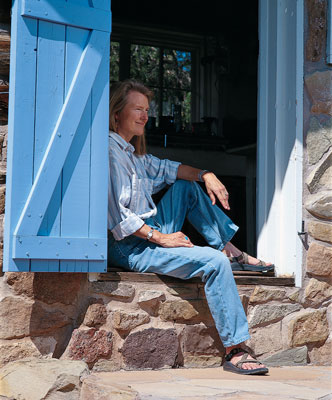
Dyanna Taylor is thrice blessed. Her adventurous career as a cinematographer takes her to remote corners of the world; she is the granddaughter of environmentalist Paul S. Taylor and Dorothea Lange, whose black-and-white still photographs documented the angst of the Great Depression; and she possesses a deep, almost spiritual connection with the earth.
In her thirty-year career shooting films for PBS, HBO, National Geographic, and all the major television networks, Dyanna has earned a reputation as one of the great documentarians of our time. She credits her grandmother with a triple legacy: her natural gift for portraying human joy and earthly dignity, her first camera (Dorothea’s two-and-a-quarter Rolleiflex, given to Dyanna when she was fourteen), and her critical eye. “Dorothea taught me to look and then look again and to see,” Dyanna says.
Dorothea doted on her eleven grandchildren, giving them the gift of a Thoreau-like family cabin overlooking the rugged Pacific Coast north of San Francisco. In this mythic place Dyanna and her young cousins reveled in a free, simple life attuned to the tides and the moon, the hot springs and the sulfur, the animals and the plants. Dorothea dedicated her last years to her grandchildren, her work, and her simple shelter, called Steep Ravine. “To watch the natural growth of the children there, and to see them so happy and free there, is the joy of Grandma Dorrie,” she wrote in a 1961 Christmas letter later published in her book To a Cabin (Viking Press, 1973).
This childhood freedom gave Dyanna her deep joy in simplicity, her sense of place in the universe, and an awareness of her body’s limitations. “It was an incredible gift, this freedom to find my body, to be in the grass, to be in the sea, to climb on rocks. To tumble, to run, to make as much noise as I wanted. To build, to create, to hide. To play. To watch the natural world. My grandparents didn’t coddle or inhibit us. So what if we skinned a knee, cut a chin, or even broke an arm? Everything was a lesson in nature and how we fit into it,” Dyanna says.
After Dorothea’s death, Dyanna went back to Steep Ravine to live for a year and a half, an anguished hermit in search of a path. The blessing of being Dorothea Lange’s granddaughter had become a curse, a great internal pressure. Using her grandmother’s Rolleiflex and a single-lens reflex camera her grandfather bought for her, Dyanna ran through reams of film, always unhappy with the mediocrity of her work, always comparing it to Dorothea’s more profound images. Then she stumbled across filmmaking. “Working with moving images was liberating somehow,” she says. “I wasn’t forced to work in that frozen image. I could be in photography and not have the rules Dorothea was bound by.”
Dyanna made her first film when she was nineteen and has been making films ever since. Her 2001 film Winter Dreams, chronicling the life of novelist F. Scott Fitzgerald, won a Peabody Award for its lyrical, inventive images. In 1998 New York Women in Film honored her with a lifetime achievement award.
An organic refuge
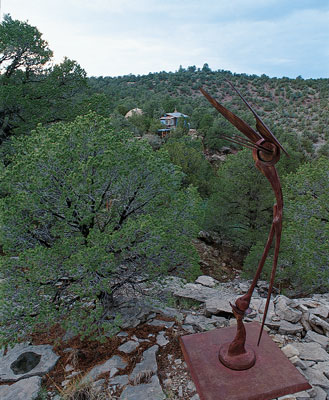
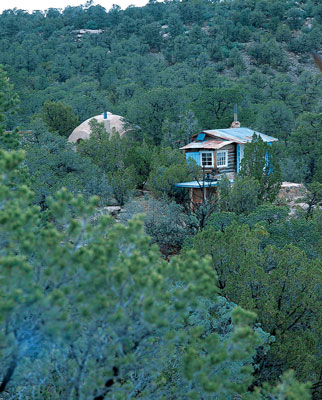
In 1992 Dyanna gave up her New York City loft and moved to the Southwest to lead a quieter life. She purchased a lovely hand-built house in Santa Fe (her “launching pad to the world”), then, in 1995, she purchased twenty acres of rugged river canyon. She found adjacent to it twenty-four acres and an ideal refuge: a tiny cabin perched on the edge of a granite cliff overlooking the Pecos River. She met the owners and caretook the place until she was able to buy it at the end of 1998.
“This is where I hide,” she says, “where I come for clarity. I love this little river canyon. It feels like an embrace.” For Dyanna this remote canyon offers refuge from the overstimulation of work. Here she lives submerged in nature’s time, hiking in moonlight, marveling at the nighttime sky; attending to meteor showers, northern lights, and full moons; and celebrating the solstices.
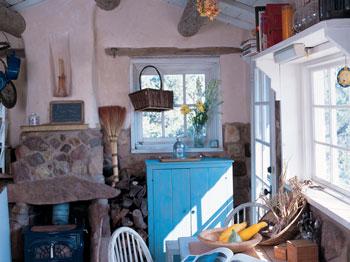
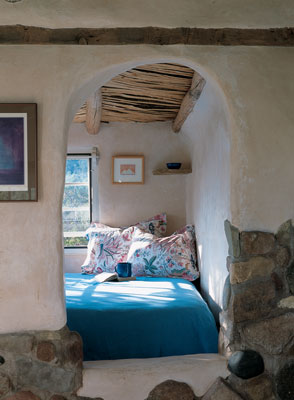
Andrew Geer built Dyanna’s cozy 205-square-foot cabin in the late 1980s for a woman who wanted a weekend retreat. She didn’t have much money, and Geer (now in demand as a custom builder of traditional New Mexico houses) didn’t have much experience. The woman quickly accepted his offer to build a cabin for under $4,000. He drew up a sketch (a ten-by-seventeen-foot room with angled roof and a five-by-seven-foot bed nook) and dove in, working completely alone for most of a summer. “It was really fun,” he remembers.
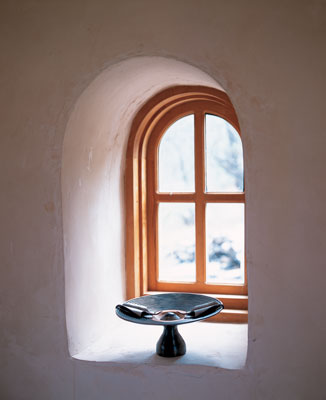
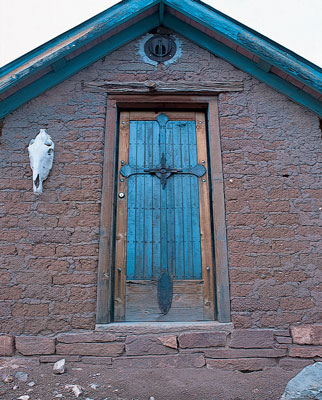
The original owner wanted the cabin to look lived in, so Geer fashioned simple shelter out of basic earthy materials–logs, adobe, rock–materials he still favors. “Mud is incredible,” he says. “It’s a local material, and you’ve got thermal mass with one-foot-thick walls. If they stay dry, wood and adobe last forever.”
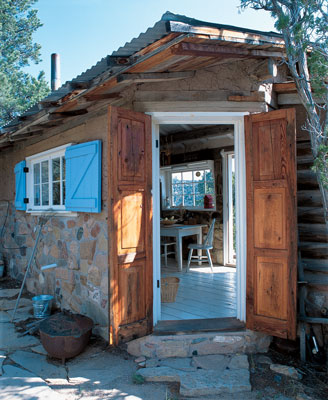
The price Geer quoted for construction was mostly for labor, as he used recycled materials: pine doors and window frames, ripply glass, plank flooring, exterior decking. He bought the adobe block for $20 from a demolished 100-year-old house, agreeing to haul it himself. Rock came from the nearby road, sand from the arroyos, and mud plaster from the river. Even the corrugated steel roof is recycled. “I bought some plaster, some nails, and some cement, but that was it,” he says. “Materials cost around $400.”
Like America’s first settlers, Geer worked without electricity, employing old-fashioned construction techniques. Mortise and tenon joinery instead of nails, hand-carved pegs for hanging baskets, hand-adzed beams and hand-planed flooring (both with visible plane marks) give the place the look of a pioneer cabin.
Adding on
Building on the granite cliff wasn’t easy, especially for a novice, but Geer embraced the challenge. He scraped off a foot of top dirt, exposing the giant boulder. Then, using a star chisel, he notched two-inch-deep holes into the rock, hammered rebar into the holes, and pinned a two-foot-high stone foundation directly into the cliff face so the cabin walls wouldn’t shift. Even when New Mexico’s spring winds wail, the cabin remains tight and solid.
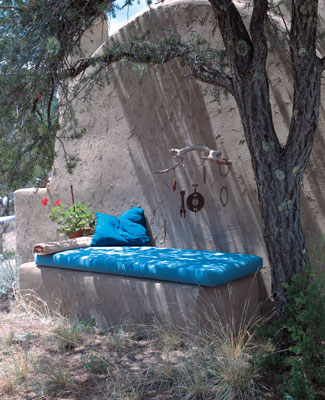
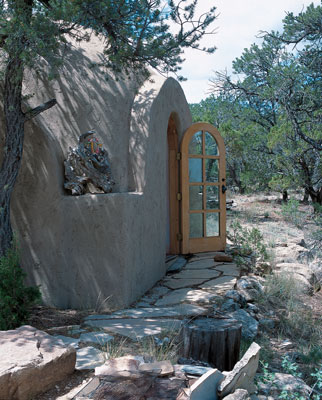
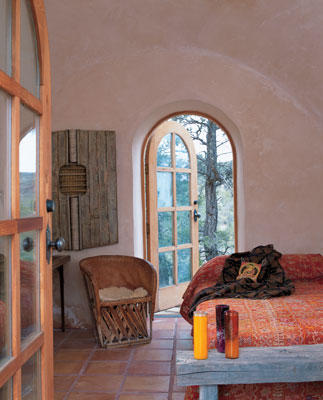
During the three months it took Geer to build the cabin, he took care to minimize his impact on the land’s fragile ecology–even cutting out indentations in the cabin roof to allow space for existing juniper, piñon, and scrub oak to grow. He dug a pit for an outhouse and cantilevered decking over the cliff, expanding the tiny perch into several outdoor areas with benches and a wood-fired hot tub. A year later he hung a five-foot-round shower room over the rocks a few steps away, framed in fir with a river rock floor. In 1990 he added a third structure: a twelve-foot-diameter sleeping dome with two-foot-thick adobe walls–“straight mud, no wood,” he says proudly. The dome’s curved shape eliminates a flat surface for the sun to hit, thus keeping the space cool during hot summer days.
“I just loved the dome when it was first built, and I wanted everyone to know it was a dome. But it looks too outer space-like to me now,” he confides. “It needs to be squared off, like traditional Islamic domes,” a project he and Dyanna began this past January.
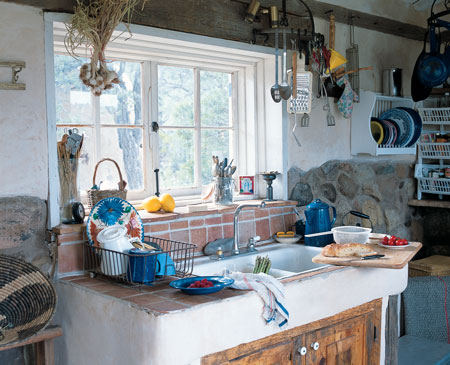
Like the cabin of Dyanna’s youth, this one had only cold running water when it was built. In 1998, shortly after Dyanna moved in, her now- neighbor and partner, Gary Dryzmala, a sculptor, built a fourth structure: a two-story, eight-by-fifteen-foot adobe bathhouse, complete with a tower housing a SunMar composting toilet. A storeroom provides space for an odd assembly of utilities: circuit breakers and solar batteries providing juice for electric lights (supplemented by kerosene lamps) and a gas propane heater providing hot water on demand–a luxury. Gary also built a nearby well/generator house that they call the “pumphouse.” It feeds water to the gravity tank housed in the bathhouse tower. From there, a small solar pump supplies water for the composting toilet and kitchen sink.
Touring the cabin for the first time in years, Geer is impressed with how well the structure has endured. “This is a fine little place,” he says delightedly, rubbing his hand along the rough stone foundation wall. Hand- plastered pale walls are lined and aged. Adobe mud has a timeworn textured look. Cement grout in the foundation still has an orangy tint resulting from bits of pebbles and dirt taken from the arroyos. But it’s the river rock that fascinates Dyanna, who confesses to spending hours staring at the foundation wall, finding “incredible things” in the stone work: fossils, beguiling colors, serpentine shapes, marvelous textures.
“It’s a great perch up here,” Geer says. “This sweet little cabin feels like being in a cave with windows, surrounded with solid earth and organic materials. Nothing else feels quite like it.” –NH
Does the soul need wilderness?






