


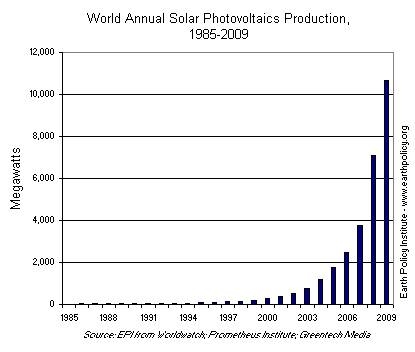
Solar photovoltaic (PV) cell manufacturers worldwide produced a record 10,700 megawatts of capacity in 2009 — an impressive 51 percent increase from the year before. By the end of 2009, nearly 23,000 megawatts had been installed worldwide, enough to power 4.6 million U.S. homes.
China manufactured 3,800 megawatts of solar photovoltaics in 2009, leading all countries for the second straight year. Rounding out the top five producers were Japan in second place, Taiwan in third, Germany in fourth and the United States in fifth.
While China now manufactures more than a third of the world’s photovoltaic cells, most Chinese consumers cannot yet afford the technology. Ninety-five percent of China’s production is exported, mainly to Germany, which installed a record 3,800 megawatts of PV in 2009, more than half the total amount installed worldwide. Italy was first runner-up in newly installed photovoltaics, followed by Japan, then the United States.
Over the past decade, installed PV capacity has grown 16-fold worldwide, in large part due to government incentives encouraging the use of solar power. Although PV production and installation costs have fallen substantially over time, solar incentives will continue to be necessary until solar reaches grid parity (price competitiveness) with heavily subsidized fossil fuels.
The most important incentive to date for the solar industry is the feed-in tariff, which guarantees generators of renewable electricity — including homeowners, private firms and utilities — a long-term purchase price for each kilowatt-hour they produce. This powerful incentive to invest in renewables has now been adopted by approximately 50 countries.
Nowhere has the feed-in tariff been more effective than in Germany. This premium payment for solar electricity has not only spurred Germany to preeminence in installed photovoltaic capacity, it has also helped grow their domestic solar industry. Deutsche Bank estimates that feed-in tariffs had driven 75 percent of world photovoltaic installations as of 2008.
The United States has no national feed-in policy. Instead, federal tax credits, along with state and local programs, have been the main drivers of U.S. photovoltaic growth. One example is renewable portfolio standards, which require utilities to get a certain percentage of their electricity from renewables.
While global interest in small-scale solar installations keeps growing, the photovoltaic landscape is evolving to include utility-scale, multiple-megawatt solar parks. In September 2010, a newly expanded, 80-megawatt park in Ontario, Canada, overtook a plant in central Spain to become the largest operational PV power plant in the world. The United States has 23 projects ranging from 100 to 5,000 megawatts under development in the arid Southwest. But these projects simply scratch the surface of that region’s potential: If we harnessed a mere 2.5 percent of the annual solar radiation striking southwestern land suitable for solar power plants, we could produce as much energy as the whole country currently uses.
With costs dropping, economies of scale growing, and governments realizing the benefits of this limitless, climate-friendly resource, the future for solar power looks brighter than ever.





