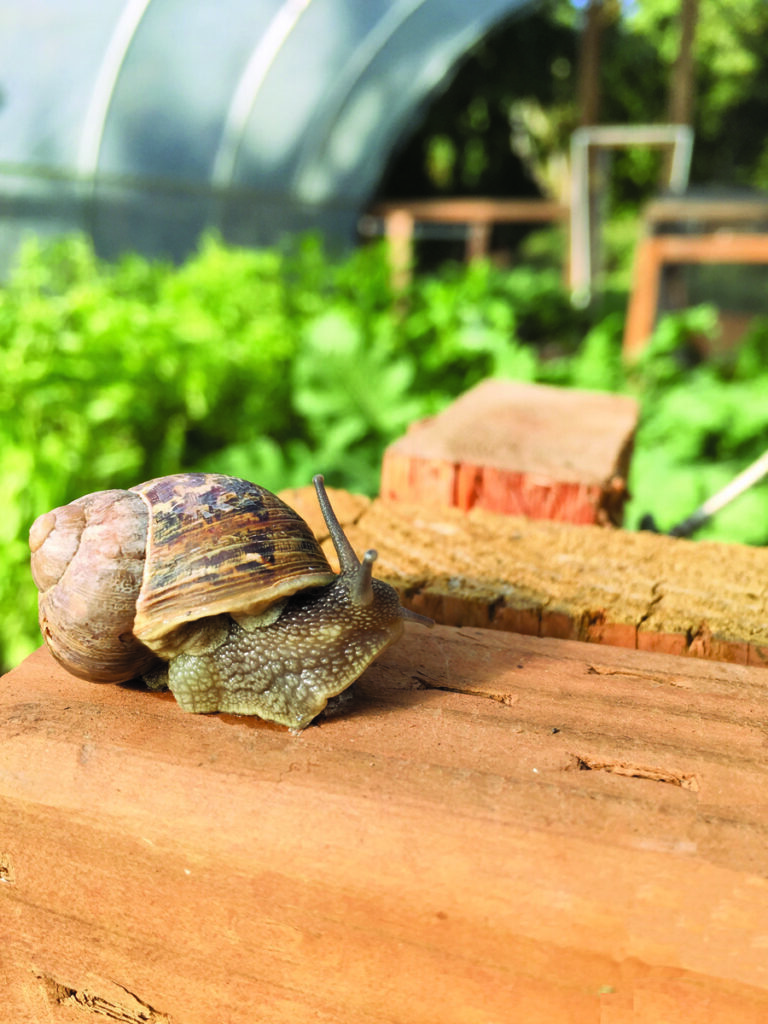
What’s slow and slimy, carries its home wherever it goes, and is one of the most unwelcome visitors for gardeners and orchardists across nearly all Zones?
If your mind conjured up the whorled, golden-brown shell pattern of the common garden snail, you’re correct, and likely among the many growers who annually ponder how to rid their plots of this damaging pest. The common garden snail (Cornu aspersum) makes a home outside its shell among a wide range of host plants, including numerous fruit trees, vegetable crops, garden flowers, rosebushes, and rotting scraps.
Rather than spend his time expelling snails from his property, one Washington farmer has spent the past decade perfecting the conditions under which C. aspersum thrive so he can cultivate them for culinary use. Ric Brewer is the owner-operator of Little Gray Farms, one of the only escargotières, or “snaileries,” approved by the U.S. Department of Agriculture (USDA). On his property near the Olympic Mountains, Brewer works in the vanguard of this country’s snail cultivation, supplying a growing market for domestic escargot that, until recently, relied solely on European imports.
All Hail Snails

Little Gray Farms is named for the petit gris, or “little gray,” garden snail, which is one of four snail species that dominate the culinary world. Besides finding homes in fields across much of the United States and Canada, the little gray snail appears on European menus alongside its cousin Helix pomatia, more commonly referred to as “escargot.” Another cousin, the gros gris, is the larger domesticated snail most often canned in Europe for export to gourmet food shops around the world.
Big or small, neither gray snail is indigenous to North America. Unfortunately, their passage to the New World isn’t well documented; one popular narrative suggests that French or Belgian immigrants brought snails with them as an intentional food source when they came to the United States more than 200 years ago.
Though France is the nation most associated with gastropod gastronomy, many European countries regularly enjoy escargot. In North America, the culinary tradition has never reached this same continent-wide appeal, but that may be changing. The market for escargot consumed in the U.S. — valued at $300 million per year — is growing quickly, with the vast majority of snails imported from faraway places, including Morocco and Italy. Brewer wondered: Would chefs and home cooks support a local source?
Farming Beginnings
In 2014, Brewer began foraging for snails in farmers’ fields to supply a single restaurant. He found Washington to be particularly conducive to foraging, not only because snails thrive in the state’s cool spring temperatures, but also because he had access to the locavore-centric Seattle restaurant scene. He priced his haul at $50 to $60 per pound (about 100 snails), and over time, demand grew, largely by word-of-mouth. “The chef community is small. They all check out each other’s menus,” Brewer says.
Foraging snails on evenings and weekends helped Brewer develop a market for local escargot, but to grow his customer base, he needed to supply snails in a greater, more consistent quantity. That would require growing gastropods himself.
Brewer’s experience cultivating snails dates back more than a decade to when he worked at a Seattle zoo. He befriended the staff entomologist, who was then caring for a rare species of tree snail. She asked him to help raise a colony at the zoo, a role Brewer accepted. This set him on the path to becoming the North American survival coordinator for the species, working with five other zoos around the U.S. as part of a captive breeding program.

While his professional life was devoted to saving rare snails, Brewer’s personal interest remained focused on eating their common cousins. He dabbled with snail husbandry, discovering that the little gray suited his tastes best because it delivered a softer texture and smoother flavor than gros gris. However, to scale his operation and expand the harvest season, he’d need to secure a permit from the USDA — which classifies common garden snail species as harmful and nonnative — and build an approved facility.
From Dirt to Dinner
Basic heliciculture, or snail cultivation, can be achieved with little more than a plastic bin. Shallow bins are best, because snails can crawl up tall sides and fall and crack their shells. Filling a bin with soil is optional, though it’s not advised for indoor cultivation because soil tends to attract fruit flies.
“Before you think you’re going to be the King of Snails, go out and find 10 snails,” Brewer advises. “Spend the full four seasons raising them. Watch what they eat, see how they behave, and then ask yourself: Given the work it took to raise these 10, can I comfortably magnify it by 1,000?”
Little Gray Farms started its snail cultivation with an open-air technique known as the Italian (or Australian) method. This approach involves planting an entirely enclosed garden in which snails (no more than 25 per square foot) are released to feast. Snails enjoy a wide variety of edible plants, from cruciferous vegetables to sunflowers. “If you like to eat it, they probably do too,” Brewer says. Using a system like Brewer’s, you can anticipate each snail to produce one or two clutches of 20 to 30 eggs per season, beginning in early spring. To achieve a successful snail population, construct an outdoor setup that’s snail-habitable by early spring, after risk of freezing has passed, and hold the enclosure at 40 degrees Fahrenheit. Also include snail shelters, such as leaning boards or toad houses.
Construct the walls from tightly woven (but not mesh) landscape fabric; wood or metal can work well too. To avoid the need for a fully enclosed roof, Brewer uses zinc metal roofing material for walls, topped by electric fencing powered by a 9-volt battery. “They’ll be zapped, but fatality is low,” he says.
To avoid losses from rodent and snake predation, Brewer advises burying wall material at least 6 inches into the soil, laying metal hardware cloth over the ground, and topping it with soil before you plant. The cost to build an escargotière will be the price of building materials, soil, seeds, and other accessories to fill the space.
Only serious snail farmers will opt for the high-tech, relatively expensive indoor (or closed-loop) method that Little Gray Farms recently built to seek USDA approval and expand operations. These systems feature light-, temperature-, and humidity-controlled tables 8 to 10 feet long that hold small pots of sterilized soil where snails lay their eggs. An irrigation system brings in water twice daily to mist the snails, which are fed a proprietary chow of vegetable material, carbohydrates, and protein. Brewer justifies the systems’ $20,000-plus price tag by his ability to supply restaurants year-round with a predictable and maximized yield.

Many people just enjoy foraging edible snails for personal use as a seasonal treat. Check with local organic farms or vineyards in your area, which may welcome your free pest removal. However, be prepared for rejection too, especially from growers who advertise their farms as snail-free. Little grays have been reported in 30 states, but are most common in the West and Pacific Northwest, while gros gris are found in the Midwest and eastern U.S. For most regions, foragers will find success during May and June. Brewer likens the activity to mushroom hunting.
“You need to know what you’re looking for, so go online and look at pictures,” he says. Then, grab a flashlight and search during dawn and dusk in disturbed areas, such as in gardens and among nonnative plants. You’re likely to find last year’s hatchlings first — now grown into their juvenile stage — followed by adults. (Very tiny snails are those that’ve just hatched.) Be careful where you forage, because snails that’ve been exposed to slug bait can retain heavy metals and become too toxic to eat.
Gastropod Gastronomy

Always cook snails before consuming them, because they can carry parasites. Similar to preparing clams, snails need to be purged by providing them a diet of only water for about one week to eliminate all stomach contents and excrement.
“There are so many ways to enjoy a snail beyond serving it in a pool of butter,” Brewer says. He suggests trying snails with pasta, mixed into vegetables, served alongside bone marrow, and as a baked potato or pizza topping. “I’ve seen snail burgers, snail poppers, and at one restaurant, snail paella. The limit is your imagination.”
For now, Brewer maintains full-time off-farm employment, and operates Little Gray Farms during nights and weekends, but he looks forward to the day when his snails provide primary income. In the meantime, he supplements local sales by overnight-shipping shucked and vacuum-sealed snails to a few out-of-state restaurants and home cooks.
Brewer also provides consultation to enthusiasts who want to start their own heliciculture business. He advises to start small, work slowly, make relationships in your community with fellow farmers and chefs, and scale from there. “If anyone gets into any kind of farming, they need to be in it for the passion as well as the profit.”
Escargots with Mushrooms and Tarragon Recipe
Kale Roberts is a former editor for MOTHER EARTH NEWS and a current senior program officer with ICLEI-Local Governments for Sustainability, where he supports cities across the United States to develop resilience and climate action plans.