When I went to work on a coffee farm in the Kona Coffee Belt of Hawaii’s Big Island, I already knew how great freshly ground coffee could be. What I didn’t know until I learned how to roast coffee on the farm was how much more interesting freshly roasted coffee could be.
Coffee tastes best 12 to 24 hours after the beans are roasted — numerous flavor compounds begin to dissipate just a few days after roasting. Your entry to roasting your own can be as low-tech (a cast-iron pot) or as sophisticated (roasting machines start at $100) as you like.
Judging the Java
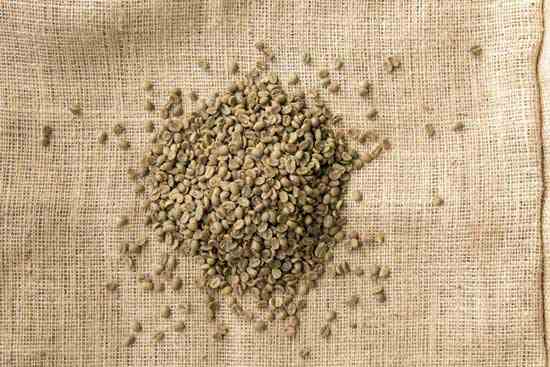
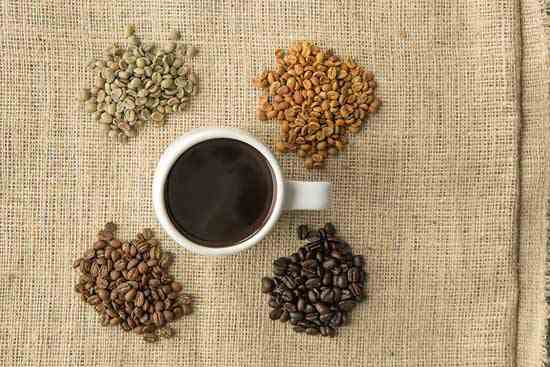
Determining coffee doneness strictly by timing is difficult, because many factors, such as humidity, affect how long these stages take. As the beans roast, they transform from pale green to light brown to dark brown to almost black. The green coffee beans make the telltale popping sounds of the “first crack” that comes just before a light roast, as well as the “second crack” that comes near the dark-roast stage.
Some roasters have thermostats to set for each roast. Each stage of the roast has its own name: Cinnamon Roast (385 degrees Fahrenheit), New England Roast (401 degrees), American Roast (410 degrees, at the beginning of first crack), City Roast (426 degrees), Full City Roast (437 degrees, at the beginning of second crack), Vienna Roast (446 degrees), French Roast (464 degrees), Italian Roast (473 degrees) and Spanish Roast (482 degrees). Many coffee connoisseurs agree that varietal character is lost in roasts darker than City Roast.
As you become proficient in home coffee roasting, you’ll trust your senses and learn when the roast you prefer is reached, smell the right aroma, hear the first crack and, depending on how dark you want the roast, the second crack. Best of all, roasting your own joe gives you a deliciously sippable end product.
Roasting Requirements
Heat: To caramelize sugars and release flavorful oils, roast coffee beans at high temperatures. Beans can be roasted through convection (circulating hot air), conduction (touching a hot surface), radiation (being bathed in heat from a radiating source) or a combination of the three. To get an even roast, keep either the beans or the air around the beans moving.
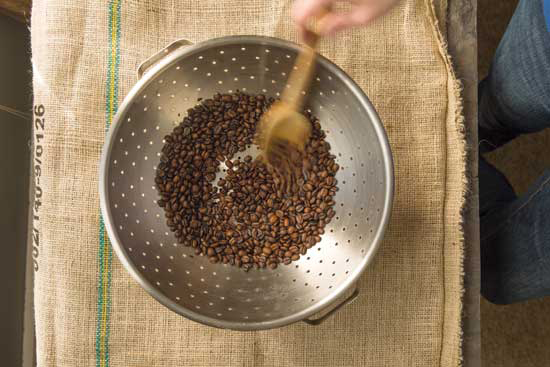
Cool: When the roast reaches your intended point on the spectrum from light to dark, cool the beans quickly to stop the roast where you want it. Specialty roasting machines have a cooling setting. For a low-tech method, cool beans by stirring them continuously in a large colander.
Vent: You’ll need to be able to vent the oily smoke produced by roasting coffee beans. The traditional and least complicated method is to roast outside. If confined to a kitchen, roast by a window, use a kitchen exhaust fan or buy a dedicated roaster. To cut down on smoke, roast smaller batches and, because coffee beans become oilier (and thus smokier) as they roast, keep roasts lighter.
Find Green Coffee Beans
Contact small coffee estates or companies near you that advertise fresh-roasted brews to see whether they’ll sell you some green coffee beans. Or, the websites Coffee Bean Corral, Coffee Project, Home Roasters and Sweet Marias, and sell quality coffee beans from all over the world. Store green beans in a cool, dry spot. The more you buy at a time, the more money you’ll save compared with roasted beans.
Popular Coffee-Roasting Methods
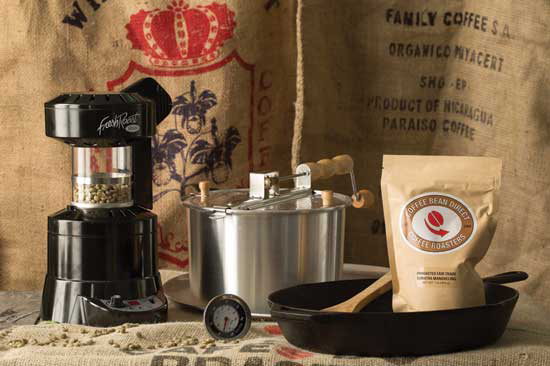
You can improvise a means of roasting coffee with simple equipment or buy a home coffee roaster. Slower roasts result in coffees that are low in acid and sweetness but are full-bodied. Faster roasts retain acidity, sweetness and flavor nuances but are lighter in body.
Rapid roast. Cooking beans in a cast-iron pan on your stovetop is the simplest form of conduction roasting (see How to Roast Coffee in a Cast-Iron Pan). You must stir the roasting beans constantly and cool them quickly, but judging the sound, color and aroma of the roast is straightforward with this method.
Medium roast. Both fluid-bed roasters (sometimes called air roasters) and popcorn poppers circulate hot air efficiently. Fluid-bed roasters have a required capacity (defined in the user manual or on the machine). Air popcorn poppers need to have a thermometer installed (or be retrofitted with one), and you should use the kind in which hot air enters the chamber from the side wall rather than from the bottom. (Don’t expect popcorn poppers to have a very long life span, because they’re not designed for this task.) Prices range from a $30 modified Whirley Pop stovetop popper to the $150 Nesco fluid-bed roaster.
Slow roast. The low-tech option here is to roast beans in a gas oven on a perforated baking sheet, such as those designed to turn out crisp pizzas ($10 to $30). Most ovens vent smoke effectively, but beware of hot spots. With some practice, you can get a nice roast from the oven. Nesco also makes a slow-convection roaster (about $200) with a superior smoke-capturing ability.
Perforated drum roasters rotate and cook beans through convection, conduction and radiation. Drum roasters can handle more beans than other roasters — up to a pound at a time in some cases — and are considered more durable than fluid-bed roasters because they don’t need high fan speeds to cool the machine. Ranging in price from $300 to $1,000, these are for the serious coffee connoisseur or a cooperative of interested home roasters.
Do you love fresh-roasted coffee? ReadHow to Roast Coffee in a Cast-Iron Pan.