

The price of freedom is always responsibility. And if
you’ve taken up the raising of your own chickens to free
yourself from weak, watery agribiz eggs and additive-laden,
preservative-packed, and water-injected supermarket meat
… sooner or later you’re going to have to assume the
responsibility of picking, plucking, and preparing your own
poultry.
When that day comes (EDITOR’S NOTE: Experienced
homestead poultry raisers know that smaller birds, such as
Leghorns, make delectable fried chicken when they’re no
bigger than a pound and three quarters to two pounds in
size and that larger breeds, such as White Rocks, can be
eaten as fryers as soon as they reach a weight of three
pounds. They can also be eaten fried when they’re larger
too, of course … but there’s something so
mouthwateringly special about that first meal of homegrown
fried chicken every summer that the old hands among us
always seem to rush it to the table a little faster, maybe,
than we should), your first step will be to examine
your flock and pick out the first bird you want to butcher.
(EDITOR’S NOTE: Your chickens will stay a lot calmer
and you’ll work a lot less while catching the birds if
you’ll get yourself a long (eight to ten feet) length of
3/16 inch or 1/4 inch metal rod from the hardware store or a
junkyard and bend one end into a handle and the other into
a crook just b ig enough to slip over a chicken’s
leg but not big enough to slip over its foot. It’s then a
simple matter to slowly movearound through a pen
or house full of the poultry and “hook” the birds one at a
time at your leisure.)
Carefully inspect the chickens you catch. Pinfeathers are
more difficult to remove than larger ones so, if you’re
rushing the season a little, make sure the young birds you
butcher are well feathered out … otherwise, they may be
hard to pick. You should also feel around the two bones
that protrude just below the vent of mature hens. If you
can fit three fingers between these bones, the chicken is
probably laying which means (if you want the eggs) that you
should pass that particular lady by in favor of another hen
on which the bones are closer together.
As you select each bird — or group of birds — for
the table, you can either cage them for later slaughter or
kill them then and there. There are several ways to do
this, but I prefer the simple and straightforward “axe and
chopping block” method. The block can be any chunk of
firewood, as long as it’s solid and squared off on both
ends so that it won’t move around or tip over and cause you
to hurt yourself or maim a chicken as you wield your axe or
hatchet.
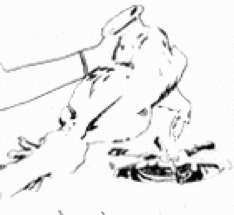
Hold the tips of each bird’s wings (to give you more
control) right along with its feet in one hand as you
position the chicken’s head (with its neck well stretched
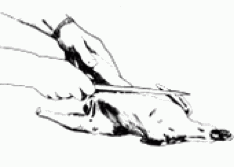
out) on the block. One quick, firm, well-placed blow (as shown in Figure 1 in the Image Gallery) with a sharp axe or hatchet, then, is all you should
need to sever the bird’s head.
Continue to hold the chicken with its neck down so that
it’ll bleed well. The blood can be allowed to fall around
the bases of your fruit trees, if you have any,
where it will both serve as a good fertilizer and
discourage rabbits from kill ing the trees by nibbling away
their bark. If you need to, hold both the bird’s wings and
feet during this bleeding process to keep it from flopping
around and spraying blood on you.
As soon as the chicken is bled — but before it has a
chance to stiffen — you should carry it directly to a
waiting pile of old newspapers, a sharp paring knife, a
bucket of boiling water, and a pan of cold water … for
scalding, picking, and washing.
Although authorities on the subject recommend that young
birds be scalded for only a few seconds in 150 to
160 degrees Fahrenheit water and that older birds be dipped slightly
longer in water heated to 180 degrees or 190 degrees, experience
will soon teach you that temperature and dipping times are
not as critical as these experts would have you believe.
Just remember that if your water is too cold and/or you do
not immerse a chicken in it long enough … the bird will
be hard to pick. And if the water is too hot and/or you
leave your poultry in it too long … the feathers will
practically fall out by themselves, but the skin of each
plucked bird will be discolored and may even break in
several places.
Relax! No matter how poorly you scald and pick your first
few chickens, they should still be edible. Practice makes
perfect. Keep trying. You’ll soon get the hang of it. I
don’t even use a thermometer. I just remove my boiling
water from the fire, dip a chicken in quickly if it’s young
and a little more slowly if it’s older, re-dip the really
tough birds as necessary, and then place each scalded bird
on the pile of newspapers and let it steam for a few
minutes. Then, as soon as the wing feathers will pull out
easily, I know it’s time to go to work.
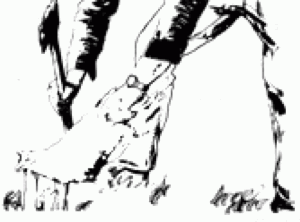
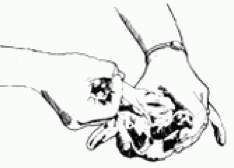
Grasp the body of a scalded and steamed bird in one hand
and one of its legs at the top of the thigh in the other.
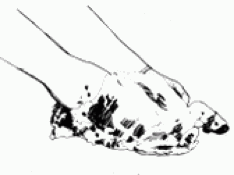
Then (Figure 3 in the Image Gallery) pull the second hand down toward the leg’s
foot. Most of the feathers will slip right off the leg in
one operation. Repeat this process on the other leg, both
wings, and the neck. If the chicken was scalded properly
and didn’t have too many pinfeathers, most of the body
feathers can then be pulled out by the handful. In the
beginning, of course, you’ll probably select chickens that
are “all” pinfeathers, scald them poorly, and pick so
slowly that the birds’ feathers tighten up on you again
before you have them cleaned. Don’t despair! Work faster
and you’ll soon have the knack of stripping the feathers
from a chicken so quickly and easily that others will think
the fowl picked itself. In the meantime, though, reconcile
yourself to slowly and laboriously plucking seemingly
endless pinfeathers from your first few birds … one … by … tedious … one.
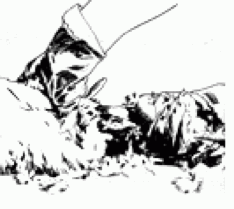
OK. Feathers and pinfeathers all out? You’re ready to singe
away the fine hairs that are still on the chicken. This can
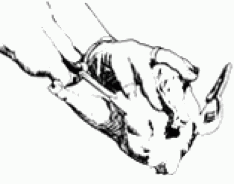
be done over an open gas flame (Figure 4 in the Image Gallery) or, if you have a
wood-burning cookstove, you can remove one of the range’s
lids, shove a wadded section of newspaper down the “eye”,
light the paper, and singe the chicken over the blaze. Or
just twist some newspaper together, strike a match, and
singe your birds outside if the wind isn’t blowing too
hard.
Remove the picked and singed chicken’s feet by bending each
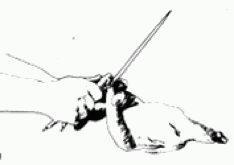
foot back (Figure 5 in the Image Gallery) and cutting through the joint. Some
people like to skin the feet and cook them for soup or to
add flavor to broth. Others just throw the unskinned feet
to the dogs.
If your bird is to be cooked whole, you can now advance
directly to Figure 7 (shown in the Image Gallery) and its accompanying copy. If the
chicken is to be cut up, however, you may find it easier at
this point to cut off the legs (Figure. 6). Pull each one away
from the body and cut between the body and the
leg — right down to the joint — with a sharp knife.
As you then bend the drumstick and thigh further out from
the body the joint should separate, and you should be able
to cut the leg completely away. Wings may be removed in the
same manner, either now or after the bird has been gutted.
Rinse off each severed piece of meat and drop it into your
pan of cold water.
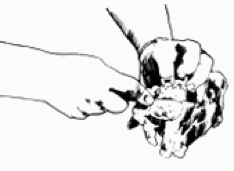
To remove the chicken’s entrails, slit the skin from the
end of the breastbone (Figure 7) all the way to the vent. You
can insert your fingers into the opening behind the knife
blade as you make this cut if you like, to help prevent the
accidental puncturing of the bird’s intestines. To simplify
the removal of the entrails, you may also want to make a
second incision across the chicken’s belly, just
below the breastbone (this cut can be made right down to
the backbone) … and you .should also make sure that
your first cut is continued around the vent.
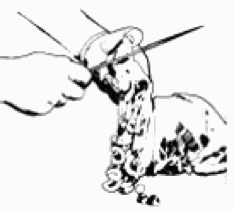
Now (Figure 8) insert a hand into the opening you’ve just
made and work your fingers around the intestines to loosen
them from the cavity. This is also the time to locate the
tube leading up to the neck and cut if off as close as
possible to its upper end. (Yes, this is the messiest part
of the whole job, but it’ll soon be over.)
Success! As soon as the “neck tube” is cut, all the bird’s
innards will slide right out of the body cavity. Locate the
greenish gall sac in the liver and cut around it without
spilling its bitter contents on any of the meat you want to
save. Then (Figure. 9 in the Image Gallery) cut off the gizzard, liver, and heart.
Cut into the gizzard until you reach its lining and remove
the organ’s contents with the lining. (This will be a
little difficult to do and, usually, some of its contents
will get on the gizzard. Don’t worry. It’ll rinse off
easily.) Put the clean gizzard, liver, and heart in your
pan of cold water.
Now (Figure 10 in the Image Gallery) make an incision in the neck just above the
breastbone and locate the two tubes leading to the crop
(sometimes called the craw) and the lungs. Work your
fingers around the craw and carefully remove the crop (Figure 11 in the Image Gallery) without rupturing it. The lungs can be taken out as the
body of the bird is cut up. Or, if the body will be left
whole, you can reach into the lower opening that you’ve
made in the body and run your fingers under the lungs to
remove them.
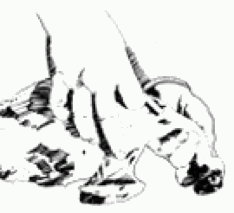
Finally (Figure 12 in the Image Gallery), remove the oil sac above the tail by
cutting under and around it. Wash all the meat you’ve
saved. If the chicken is to be baked or roasted, you can
put it into the oven whole. If it’s to be fried or prepared
in some other way that calls for individual pieces, cut up
what’s left … and you’re finished.
The disagreeable part of preparing a chicken is soon
forgotten when the bird is brought to the table in the form
of a delicious dish. Here’s one of my favorites:
Dip individual pieces of chicken in milk, then in a mixture
of flour, salt, and pepper. Brown the chunks of meat in oil
or other shortening, and then put them in a deep baking
dish. Add one-half cup of water and bake at 350 degrees Fahrenheit. When
tender, mix one can of mushroom soup with 3/4 cup of water
and pour over the chicken. Bake 15 to 20 minutes longer and
serve.





