
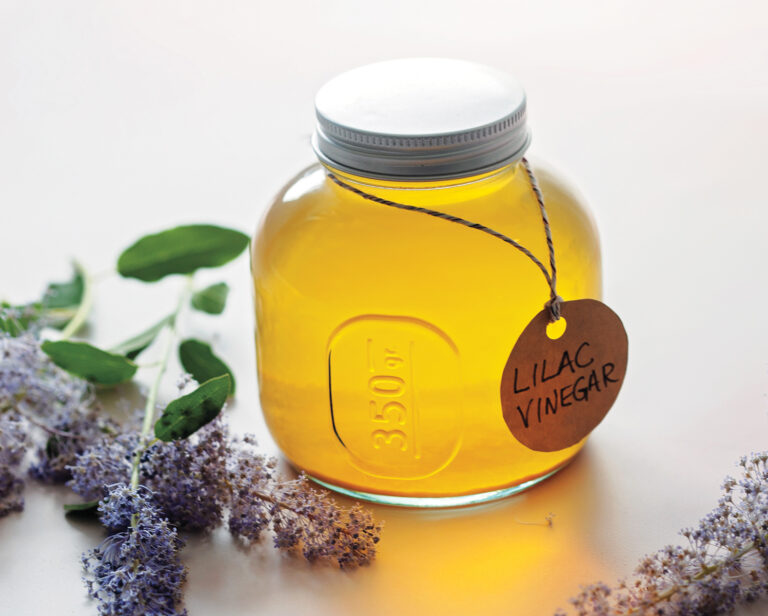
By capturing wild yeasts from blossoms and plants, you can harness the power of microbes to create lilac vinegar, including a vinegar starter, in your home kitchen.
To make vinegar, you can simply pour fresh juice into a wide-mouthed vessel, top it with a cloth, and let time and microbes happen. In my experience, though, this works perfectly about as often as it doesn’t work at all, most often because of harmless but undesirable surface yeasts or other unwelcome microbes. The microbes compete for the sugar and nutrients and cause the process to stall or not begin.
That’s why I add a vinegar starter to my recipes. Starter helps give the vinegar a good send-off — first by acidifying the liquid, which helps control surface yeasts, and then by seeding it with a good population that goes to work quickly.
The world’s best vinegars start out with good ingredients, fermented into respectable wine, sake, cider, or other alcohol. You can start with ready-made alcohol; however, to create the tastiest vinegars possible, you’ll need to become a maker of alcohol — and alcohol starts with yeast.
Yeast is the single-celled fungus that’s found readily on the blossoms and fruit of plants. To capture wild yeasts instead of commercial strains for your homemade vinegar, simply leave fresh, unpasteurized juice in an open vessel and let the yeasts that populate it, along with any that drop in, do the work.
If you’d like to work with wild yeasts but have no access to raw juice, you can begin your vinegar project by making a wild yeast starter. A starter is a mini-fermentation that will give you a preview of how well your wild yeasts will work on your batch of vinegar. Make sure it’s a good starter; if it’s quite active, you’ll know the yeasts are viable. You’ll also have a chance to taste it. If it’s boozy, that’s a good sign. If it’s sour and lactic, that means you caught lactic acid bacteria, which turns those sugars into lactic acid (not vinegar acid) rather than alcohol, and you won’t want to use it. Making a starter will also give you a chance to “test” the yeasts you’ve captured; they may be active and delicious, or they may be faulty.

The beautiful thing about yeast harvesting is that you need very little plant material to get things going. One small cluster of milkweed flowers, for example, will give you enough yeast and essence for a couple of quarts of vinegar. But don’t harvest blossoms from areas that have been sprayed with pesticides or herbicides. And remember, not every flower or plant is edible. Be sure to identify the plant and flower, and use only the edible parts. Use flowers sparingly, especially at first, as some may cause digestive upset in some people.
Wild Yeast Starter Recipe
In The Big Book of Cidermaking, my husband, Christopher, and I give in-depth information on foraging for wild yeast. I use a lot of botanical and blossom yeasts to ferment regular grocery store apple juice into cider and then vinegar. This is taking DIY herbal vinegars to another level. Two floral vinegars we enjoy are made with lilacs and dandelion blossoms.
You’ll need a pint jar with a lid, and pasteurized fruit juice — I usually use apple or grape. The juice ensures the yeast will have enough nutrients to get off to a good start. (If using your own homemade juices, you’ll need to pasteurize them first.)
- Sterilize a clean 1-pint jar and its lid by submerging it in boiling water for 10 minutes. You can also use a different container with a tight-fitting lid, or one that’s capable of holding an air lock. With tongs, transfer the sterilized jar to a clean towel, placing it right-side up. Allow the jar to cool before filling.
- Using pasteurized fruit juice from a bottle that’s just been opened, fill the sterilized jar 3/4 full. If you’re using a pint jar, this will amount to 1-1/2 cups juice.
- Add fresh botanicals, berries, or flower petals to juice in jar. Plan on about 1/3 cup fruit per 1-1/2 cups juice, or about 1 cup flower petals per 1/4 cup juice. Use larger quantities if you want a stronger flavor.
- Cover jar with a lid and tighten. The carbon dioxide produced by the fermentation process will need to escape, so be sure to burp the jar once or twice a day.
- Let jar sit at room temperature or cooler; wild yeast does better in cool, slow fermentations. Stir or shake the mixture three times a day. You may begin to notice bubbling in 2 to 3 days, although it could take 2 weeks or more in low temperatures. As yeast populations grow, the bubbling will become more active. At this point, you should smell and taste the solution to check what kinds of flavors are developing. If they’re pleasing, you can pour this into the base liquid for the lilac blossom vinegar you’ll be making with in the recipe.
If you don’t see any activity after the second week, the wild yeast may not be strong. You can continue to wait, but you’ll need to toss the starter, sterilize the jar, and begin again if you see mold growth or a layer of surface yeast growing on top. - When the liquid has finished fermenting, store the jar in the refrigerator, making sure the lid is tightened, and with as little airspace as possible between the liquid and the top.
When you’re ready to make vinegar, be sure to bring the starter and your base liquid to room temperature to prevent yeast shock. Shake the starter, then filter by pouring it through a strainer. If you don’t intend to use it for anything else, go ahead and use the whole amount. Under anaerobic conditions, your starter will last at least a year.
Lilac Vinegar Recipe
Because of their evocative scent, lilacs might be the first flower I fell in love with as a girl. As an adult, I’ve planted one near a window wherever we’ve lived. This flower and its scent bring me comfort, and so does the lemony floral vinegar it makes.

Consider this a base recipe and technique, and see “Flower Power” to experiment with more ideas. Yield: about 1 gallon.
Ingredients
- 1 gallon pasteurized apple juice
- 1 to 2 cups lightly packed lilac blossom florets, picked from stem clusters
- 1 cup raw, unpasteurized, and unfiltered wild yeast starter, or a vinegar mother
- Pour most of the apple juice into a sanitized wide-mouthed gallon jar, add lilac blossoms florets, and pour in as much of the remaining juice as will fit. Stir well with a wooden spoon.
- Cover the jar with a basket-style coffee filter, or a piece of unbleached cotton muslin or tightly woven cheesecloth. Secure with a string, a rubber band, or a threaded metal canning band to keep out fruit flies.
- Place covered jar in an environment where the temperature is between 50 and 65 degrees Fahrenheit. Wild yeasts like a cool temperature, so the closer you stay to this range, the better. Wild yeasts are typically slow to start, so don’t expect to see bubbles in your jar for a couple of days or more.
- Once a day, remove the jar cover and stir the contents to get some oxygen in the mix. Make sure the flower petals themselves stay submerged; otherwise, they can become a host for undesirable opportunistic bacteria. Replace the jar cover after each stirring.
- After 5 or 6 days, add starter, stir well, and replace covering. Place on your counter or in another spot that’s 75 to 86 degrees.
- Check vinegar after 1 month. It should have nice acidity. If your environment is cool, don’t be surprised if the vinegar takes another month or two to fully mature.
- Bottle finished vinegar, saving the mother for another batch or sharing with a friend. You can use it immediately, or age it to allow the liquid to mellow and flavors to develop.
Flower Power: Wild-Fermented Floral Vinegar
You can harness wild yeasts from domesticated plants in your garden, or from foraged blossoms. Each blossom vinegar has its own spirit and quality. Because I make a lot of these, I have the luxury of comparing them side by side, and I’ve found that they’re true individuals. Dandelion blossoms yield a delicious, mellow, and refreshing vinegar. Sage blossoms produce a savory herbal vinegar with a floral hint of sage that doesn’t remind you of roasted poultry with stuffing. Manzanita blossoms deliver rich cinnamon and honey notes.

Here are possible substitutions for the blossoms in the Lilac Vinegar Recipe.
- Rose petals: make sure they’re from a fragrant variety.
- Sunflower petals: the seeds’ nutty flavor carries through.
- Dandelion blossoms: one of our favorites.
- Dianthus: delivers scents of carnation with clove and nutmeg notes.
- Calendula: in large quantities, adds golden color and peppery flavor.
- Red and white clover: can add licorice or anise notes in large quantities.
- Begonia: citrusy.
- Lavender: fun choice, but it can quickly become overpowering.
- Wild violet: like lilac, with floral notes.
- Plum blossoms: nice amaretto notes.
- Sage blossoms: light sage flavor with a floral quality.
Kirsten K. Shockey is a bestselling author and educator on fermentation. This is an excerpt from her newest book, Homebrewed Vinegar, used with permission from Storey Publishing, and available below.

Ferment 60 Different Vinegars
Did you know that vinegar can be made from anything with fermentable sugar? Within Homebrewed Vinegar, author Kirsten K. Shockey provides in-depth coverage of the science of vinegar and the basics of equipment, brewing, bottling, and aging, thereby giving readers the foundational skills and knowledge to ferment their own vinegars. This title is available at the MOTHER EARTH NEWS store or by calling 800-234-3368. Item #10595.






