When working with commercial feed lot beef (which is typically what’s sold in large supermarket chains as well as many smaller markets) there’s a process that meat goes through as it’s being cut down from large “primal cuts” into the retail cuts people buy.
This process is called “bloom”, and it takes about 5 minutes. When commercial feed lot beef blooms, it turns a very bright, almost artificially red color. This is not the natural color of beef.
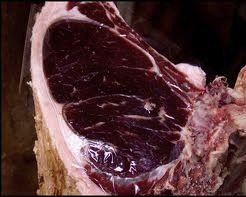
When a piece of meat is what is called a “dark cutter,” it does not bloom. It will be a very dark purplish-blackish color, and will also have a sticky texture – so much so that at times it will leave a buildup of residue on the butcher’s knife. The meat will be dryer and tougher.
What’s going on here?
A stressed animal. A dark cutter is an animal which is stressed at the time of slaughter. The stress can be caused by a variety of reasons: transport of the animal to the slaughterhouse, putting the animal into a pen with too many other animals, or just a naturally high-strung animal. The animal may be sick, or may have been inhumanely treated.
Based on my personal experience working in a slaughterhouse, as well as news reports that have surfaced in recent years, I tend to believe that the latter is the most common cause. Inhumane treatment. I’m underlining this because there are ethical issues that ought to be considered here.
Recently, as a favor for a friend who owns a grocery store, I put up a meat order of NY strip steaks. The order required eight whole NY strips. Six of the eight were dark cutters. Six – representing three whole animals.
This means that three of the animals it took to produce the eight whole strips were stressed at slaughter. In the ten years I’ve been involved in the local food movement, with all of the local beef I have cut and sold and have processed for local farmers, I have never seen any dark cutters.
Just one of many good argument for buying locally raised antibiotic-and-hormone-free or grass-fed beef.