

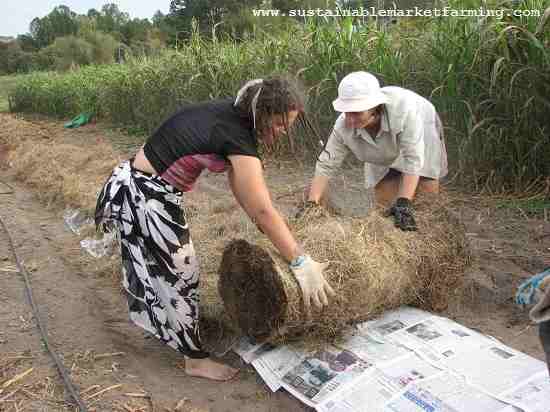
Organic mulches improve the soil organic matter. Photo by Luke Stovall
Gardeners and farmers do not control the weather, and it’s only going to get more chaotic as climate change bites. Heavy rain events can leave soil impossible to work, because the water can’t drain away fast enough. What can we do when it’s too wet? Here are some ideas drawing on the chapter Preparing for and Coping with Disasters in my book The Year-Round Hoophouse.
We need to plan ahead and deal with the possibilities of too much (and also too little) water. We need to pay greater attention to the climate as a critical factor in our decision-making. We need to adapt, our responses when the rainfall doesn’t meet our hopes. Here I’ll be talking about too much rain.
Prepare Your Soil and Crops
Figure out which crops are already marginal in your climate, and decide whether they are worth keeping, and whether they are important enough to provide more protection for. See Weatherspark.com for easy-to-understand graphics showing the average weather in your locality. The International Cooperators’ Guide Grafting Tomatoes for Production in the Hot-Wet Seasonrecommends using eggplant rootstocks for tomatoes when flooding is expected.
1. Use raised beds or ridge-planting to help excess water drain sooner.
2. Increase the organic matter content of the soil so it can absorb more water in a manageable way, without compacting and going anaerobic. Incorporate compost, cover crops, organic mulches, crop debris and weeds — all improve the soil structure, organic matter and humus. The effect of compost lasts longest. If you’re no-till, lay all these materials on the surface and expect incorporation and the benefits to be slower to arrive.
3. Consider no-till cover crops which become mulch. Their roots will support microbial growth, form active organic matter, and rapidly release N to the plants.
4. Minimize tillage because tilling accelerates nutrient burn-up and hence the loss of organic matter.Avoid tilling or disking right before a forecast of heavy rain.
5. Maximize the volume of living roots (food crops and cover crops) in the soil (use both deep-rooted and shallow-rooted crops). Root channels improve the soil structure and drainage.
6. Keep roots (alive or dead) in the soil all the time, or as much of the time as possible, to also tie the soil together and prevent erosion.
7. Avoid “bare fallow” at times of year when you could get a lot of rain. That might mean not just hurricane season, but year-round. Low-growing non-invasive cover crops can be planted in pathways.

Covering some soil, either with a hoophouse or plastic on the soil, keeps some areas dry. Photo by Wren Vile
Cover the Soil in Key Locations
1. Hoophouses and caterpillar tunnels can help keep crops from deluges. Large structures do have the issue of runoff, but you can plan ahead for that and make a drainage system. When we built our hoophouse, we made a ditch around three sides of it, to channel runoff downhill. Some people who have roll-up or drop-down sidewalls install plastic guttering on the “hipwall” lumber that these structures need, and collect the rainwater for irrigation. See the NRCS Code 558 Roof Runoff Structure.
2. Before the storm moves in, cover the soil where you plan to plant: temporary caterpillar tunnels (field houses), low tunnels, plastic mulches and tarping (occultation) can keep some of the soil dry, at the expense of causing runoff that makes other areas wetter. This can help get crucial plantings done in a timely way, leaving the wider problem to resolve later.
Take Serious Action for Serious Problems
1. If water drainage is a big issue where you are, you may need to consider a “grassed waterway” See the NRCS publication Grassed Waterway and Vegetated Filter System, Conservation Practice Job Sheet 412. This is really a very large gradual swale with a grassed surface, which you can graze or mow (think home-grown mulch!).
2. Another option is a “drywell” or French drain, a big hole full of rock. This will probably need to be large and require a lot of rock (and money), and maintenance to keep it free of sediment and leaves.
3. Field tile drainage
4. Keyline plowing (along contours).
5. Swales (also called “infiltration trenches”) allow water to gradually seep into the soil, while sending sudden large volumes downhill to an area which can absorb more water.A swale 18″ (45 cm) wide by 8″ (20 cm) deep in averagely draining soil can infiltrate approximately 1.6″ (4 cm) rain per hour per 20 ft2 (1.86 m2) of contributing area.
First Aid if you can’t plant when you want to
1. Consider transplanting instead of direct seeding. We did this one year with our winter squash, when the plot was hopelessly too wet. We were able to transplant the squash fairly young, and did not have a big harvest delay.
2. Consider a different, faster, variety that you can sow later and catch up. Some leaf lettuces only need 46 days (Salad Bowl, Bronze Arrowhead, Tom Thumb), while Romaines can take a lot longer (Crisp Mint, Winter Wonderland 70 days, Webb’s Wonderful 72 days). Baby lettuce mix can be ready in as little as 21 days from mid-spring to mid-fall.
3. Consider a different, faster, crop that you can sow or transplant later. Keep your crop rotation in mind, as well as the next crop you intended to plant in that spot. Here are some fast-growing crops:
4. Ready in 30–35 days are some Brassicas such as kale, arugula, radishes (both the fast small ones and the larger winter ones); many Asian greens (Chinese Napa cabbage, Komatsuna, Maruba Santoh, mizuna, pak choy, Senposai (40 days) tatsoi, Tokyo Bekana and Yukina Savoy), spinach, chard, peashoots, many salad crops(lettuce, endives, chicories). One summer we sowed Tokyo Bekana as a lettuce substitute. 20 days to baby size, 45 days to a (large) full size.
5. Ready in 35–45 days are corn salad, land cress, sorrel, parsley and chervil.
6. Ready in 60 days are beets, collards, kohlrabi, turnips and small fast cabbages (Farao or Early Jersey Wakefield).
First Aid if you can’t till
1. Could you mow? This will prevent weeds seeding, and prevent the cover crop or previous food crop from getting any bigger. It will be easier to till once that does become possible.
2. If you can’t get a mower across the beds, can you use a weed whip (string trimmer) or a manual weed whacker or a scythe?
3. Could you use a broadfork? This will open up the soil, allowing it to dry faster.
4. Could you lay tarpsover the whole mess, and wait for the cover crop or weeds to die?
5. Could you use a flame weeder to kill the existing vegetation? Flamers are intended to kill small weeds, not big ones, but we successfully used our wand-type flamer to kill weeds in the potato patch one spring when it was too wet to hill the potatoes.

Raised beds can help channel rain away. Photo by Wren Vile
Dealing with Floods
1. Drain flooded soil promptly, or you may end up with drowned plants (insufficient air) and with a high salt level caused by evaporation. Dig shallow trenches to let the flood water flow away.
2. See How to Rehab Your Soil after a Floodon the Hobby Farms website for five steps to repairing the damage: Clean Up, Remove Water, Beware of Contamination, Level the Land, Rebuild the Soil with Cover Crops. See also the Carolina Farm Stewardship Association’s Expert Tip: How to Handle Flooded Fields for information about food safety.
3. Consult your local Extension service before selling any produce that has been in standing water, as the water may have become contaminated. See the US Food and Drug Administration Guidance for Industry: Evaluating the Safety of Flood-Affected Food Crops for Human Consumption
4. If you have a suitable source of nitrogen, apply some, after the flood recedes. You could lose yield from loss of soluble nutrients. The soil may have become anaerobic, reducing available nitrogen. You may also get a flush of weeds, competing with your slow-to-recover crop.
Pam Dawling works in the vegetable gardens at Twin Oaks Community in central Virginia. She often presents workshops at MEN Fairs, as well as sustainable agriculture conferences. Pam also writes for Growing for Market and other magazines. Her books, Sustainable Market Farming, and The Year-Round Hoophouse are available at www.sustainablemarketfarming.com.Her blog is on her website and also onfacebook.com/SustainableMarketFarming.
All MOTHER EARTH NEWS community bloggers have agreed to follow our Blogging Guidelines, and they are responsible for the accuracy of their posts. To learn more about the author of this post, click on their byline link at the top of the page.






