I wrote “In praise of West Indian Gherkins” on my blog on September 23, 2014.
After a few years of growing many varieties of pickling cucumbers and getting too many pests and diseases, we went outside the box in 2013 and tried some West Indian Gherkin seed from Monticello, where they used to be grown by Thomas Jefferson (and some of the enslaved people, no doubt). These are not closely related to actual cucumbers, but are used similarly. (They are not the same as Mexican Sour Gherkins, either.) I saw them growing in the Monticello garden when I was there for the Heritage Harvest Festival in September 2012, and they are certainly robust and productive in hot humid weather. This seems like a great crop for disease-prone gardens – no trouble with cucumber leaves turning yellow!
West Indian Gherkins are prolific and drought-tolerant, and show no sign of any of the many cucumber plant diseases or pests. Because the healthy vines cover the ground, there is no room for weeds, making it an easy crop to grow. Our pickles turned out well and are becoming quite popular! We grew even more this year. Next year, I want this to be the only pickling cucumber we grow! It is a rambler (long vines) so maybe a trellis would be wise if space is tight.
Because West Indian Gherkins are open-pollinated and don’t cross with actual cucumbers (or watermelons, despite the look of the leaves), we 
save our own gherkin seeds, and a little money in the process. In late September this year, I harvested four 5-gallon buckets of gherkins (one for seed, 3 for pickling) from a 50-foot row we abandoned over five weeks previously. These plants survived that period just on rainfall, as we pulled out the drip tape back when we thought we were done. And there was only about 3-inches of rain, almost all of it in one week, with nothing in the other four weeks.
Before I saw these gherkins growing at Monticello, I had no idea of their existence. Now I’m starting to hear about them in more places.
William Woys Weaver, author of Heirloom Vegetable Gardening wrote about them for MOTHER EARTH NEWS in 2008. He discovered that they originated in West Africa, rather than West Indies, and that they can be pickled, eaten raw or cooked like zucchini. Read more. 
Seed is available from Monticello, Seed Savers Exchange, Trade Winds Fruitand Reimer Seeds. These round cucumbers with soft spines are an unusual and attractive crop. When first forming, they look like miniature watermelons, and might lead to that old question “Is a cucumber a fruit or a vegetable?” Botanically a fruit, in the kitchen, a vegetable.
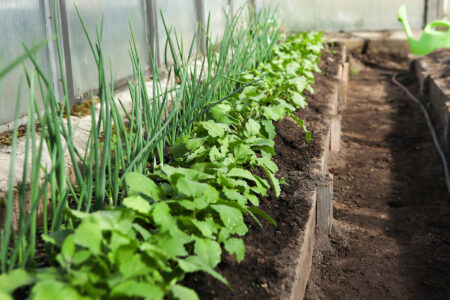
I’ve learned that West Indian Gherkin is resistant to some species of Root Knot Nematodes, so we plan to grow it in our hoophouse as part of our rotation of nematode-resistant crops for a bed there which produced some gnarly-rooted tomatoes this year. We’ll get soooo many pickles! It’s a very productive crop for us. I wrote about our struggle with RKN in the November/December 2014 issue of Growing for Market magazine. We have been growing a series of nematode-resistant cover crops in the winter and spring, and solarizing the bed in the summer. Now we’re ready to grow some of the more resistant food crops and seed crops. After that, some resistant varieties of susceptible crops.

See my blog to read more about our nematodes.
Here is our first (baggy) attempt at solarization in the hoophouse.
Early this September the pickleworm arrived in our part of Virginia. This tropical insect, Diaphania nitidalis overwinters in south Florida (and maybe south Texas) and spreads up the east coast each year. It regularly reaches South and North Carolina in August or September. This is the first time I’ve seen this pest on our farm. I’ve read that it can reach as far north as Michigan and Connecticut some years. We’re reassured that it can’t overwinter here, and that we could get at most 3 generations. Sort of reassured.
The adult is a night-flying moth, which lays tiny eggs on buds and flowers. Despite the name, this pest likes yellow squash more than pickling cucumbers. (And winter squash, gherkin and cantaloupe can be colonized if necessary, as poor third choice crops.) We first found ours on Zephyr yellow squash and initially the neighboring Noche zucchini was untouched. But yesterday some of the zucchini also had holes.
Read more about the pickleworm on my blog. It looks like growing gherkins rather than pickling cucumbers will help us avoid damage from that pest, too.
The extension website publication Biology and Management of

Pickleworm and Melonworm in Organic Curcurbit Production Systems by Geoff Zehnder of Clemson U provides useful information.
For pictures of pickleworm damage, see Sunninglow Farms blog. They are in Florida and posted in April. I shouldn’t complain too loudly. It was September here before we saw them.
Photo Credits: Large pickleworm larva, Photo University of Florida; Hoophouse, Credit Kathryn Simmons; Root Knot Nemode, University of Alabama; West Indian Gherkins, Suzie’s Farm
All MOTHER EARTH NEWS community bloggers have agreed to follow our Blogging Guidelines, and they are responsible for the accuracy of their posts. To learn more about the author of this post, click on their byline link at the top of the page.