Build a DIY worm farm and learn vermicomposting basics by adding worms to your composting process to create a nutrient-rich fertilizer for your garden.
Vermiculture, or worm farming, is the use of worms to break down organic material. It’s a simple way of turning table scraps into compost. The end product is a nutrient-rich natural fertilizer called “worm castings.” A vermicompost bin can maintain the conditions necessary for hosting an environment for worm reproduction.
Backyard Vermiculture Benefits
Vermiculture can benefit your backyard garden in the following ways:
- It will enhance your existing composting operation.
- It will use worms to create a high-yield nutrient-rich fertilizer.
- Worms, such as red wigglers and earthworms, will help break down organic material more rapidly.
- The end product will have a higher amount of humus than compost, and humus can improve aeration and water retention tremendously.
Vermicompost is rich in nitrogen, phosphorus, and potassium, and contains both macronutrients and micronutrients that benefit plant health and stimulate plant growth. The compost contains worm castings; partially decomposed organic materials; and organic waste with fragments of plants, food, and other detritus. Most vermicompost contains plant-growth hormones, which can increase plant vitality and yields. In vermicompost, micronutrients that may ordinarily be washed away in heavy rains, such as magnesium and sulfur, are instead bound and released slowly.
The product that vermicomposting yields is more than worth the small investment it takes to get started. You can begin free of charge if you have a friend who keeps worms already. Just set up your system first, and then ask your friend for about a dozen worms. Within a month or two, your worm population will start to increase. In the retail market, natural fertilizers can be expensive. Finished vermicompost sells for up to $35 for a 20-pound bag. You can make your own 20-pound bag of castings in your basement or backyard for just pennies after you pay your initial costs.
If you’re using reclaimed materials to build an outdoor bin, you’ll only have to buy the worms and straw bales (to be used as occasional bedding and for insulation during winter months). You can really keep costs down as long as you’re creative with your building resources.

Set Up a Standard Worm Bin
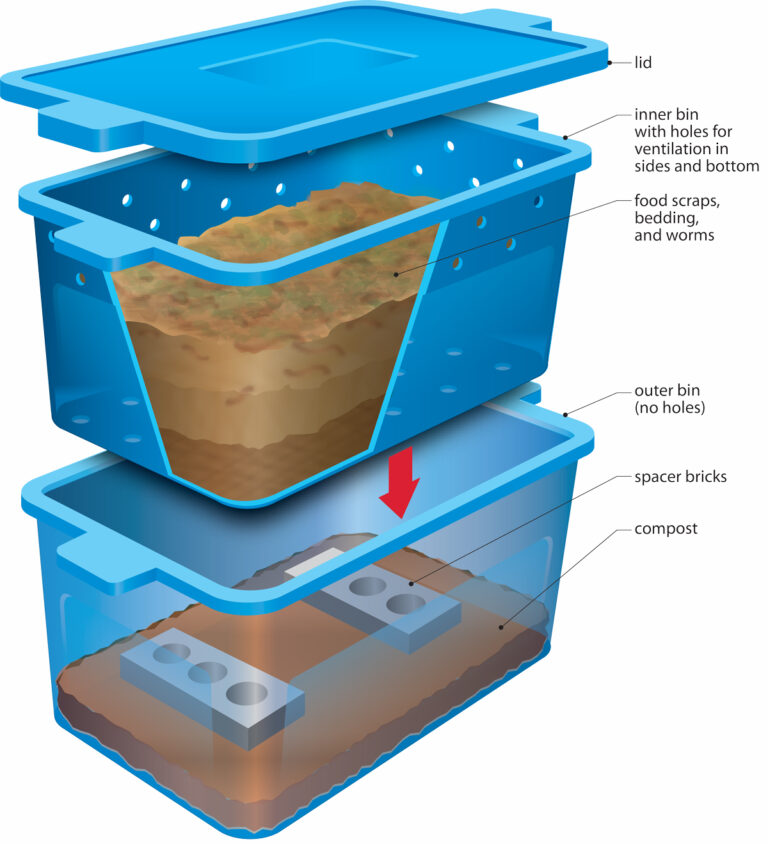
A typical worm bin is made with two plastic containers — an inner bin and an outer bin. The inner bin needs several holes drilled on all four sides and three dozen holes drilled through the bottom. A layer of small pebbles, river rocks, or sand on the bottom will prevent water buildup in the bedding and promote drainage. The outer bin, which acts as a catchment for any liquid, will need several dozen holes drilled through all four sides, but none on the bottom.
Add the worm bedding — a mixture of shredded paper or torn newspaper, leaf litter, grass clippings, and small pieces of cardboard, such as toilet paper rolls — and spray with water until the mixture is wet.
The bedding should sit until it reaches the correct temperature, between 55 and 80 degrees Fahrenheit. It should stay below 90 degrees F for at least two days. After the optimum temperature has been reached, push aside the bedding, add the worms, and cover with the bedding. You can then add food scraps slowly. A rule of thumb among vermiculturists is that worms can eat their weight in one day. For example, 1 pound of worms will go through 1 pound of food scraps daily.
After 1 to 2 months, harvest the bottom layer of vermicompost. Add a few handfuls of new worm bedding. Continue adding kitchen scraps, and the cycle will continue.


What to Add to Your Bin
Some items that can go into a compost bin shouldn’t go into a vermicompost bin. The following items can be composted in a worm bin:
- All food scraps, except meat, dairy, and spicy peppers
- Eggshells
- Coffee grounds
- Newspaper (black and white only; no colorful, glossy pages)
- Cardboard, such as toilet paper and paper towel rolls
- Leaves
- Grass clippings
- Small twigs
- Plants removed from the garden after their life cycle is complete (don’t add if they’re infested with nonbeneficial insects or diseased)
- Noninvasive weeds before they go to seed
Don’t compost waste that should go to the landfill or be recycled, or materials that won’t decompose. Don’t add invasive weeds or diseased plants; instead, burn them away from your garden and compost bin.


- Recycled paper and newspaper both make excellent bedding for worms. Borrow or buy a simple paper shredder to shred newspaper, thin cardboard, and black and white paper waste, and keep it in a bin with a tight-fitting lid. Ask friends and family to save newspapers for you. You might also check with your local newspaper office to see about getting their leftovers after distribution.
- Fall leaves are a great addition to a vermicompost bin. Leaf blowers sometimes come with an attachment that sucks and grinds up leaves and deposits them into a collection bag. This works well, because the shredded leaves take less time for the worms to process, and they won’t compact as much as whole leaves.
- Grass clippings from untreated lawns are a wonderful addition. Lawn mowers may have an attachment for collecting clippings, which can then be added with leaf litter to your bins. This should only be done if the lawn isn’t treated with chemical pesticides.
- Sawdust from untreated lumber can be added to a vermicompost bin. Lumber mills are often a great resource for untreated sawdust. You might want to avoid sawdust from species such as black walnut (Juglans nigra) and relatives that produce allelopathic chemicals, or any of the aromatic cedars that might contain oils toxic to worms.
- Wood chips make an excellent filler material for long-term composting, and they’re especially helpful for adding a carbon component to your large pile, for aging manure, and for adding a base layer to a long windrow system. (See notes on tree species selection, above.)
- Spent grains are often readily available and can be a good source of food for microorganisms in a vermicompost bin during winter, when large volumes of vegetable scraps aren’t as available. Use caution when employing spent grains for vermicomposting because of the amount of heat they generate when decomposing, as well as how they change the pH of the pile. To cool them down a bit, you can add spent brewing grains to a compost pile first to get them started decomposing. Another method for aging them is to use a 5-gallon bucket with several holes drilled into the bottom for drainage and airflow. Place about four handfuls of chip mulch at the bottom, add spent grains, and top with several more handfuls of chip mulch. This will allow the spent grains to cool off a bit and start decomposing after 1 to 2 weeks. Be sure to add only a few handfuls at a time in one corner of the bin. Don’t cover the bin with spent grains, because you’ll want the worms to be able to retreat if an area of the bin gets too warm for them.
- Coffee grounds are readily available from most coffee shops. If the shops don’t separate their grounds from the garbage, you could offer to provide a few clean buckets for them to dump grounds into. You can schedule a weekly pickup, and drop off clean buckets each time. This is a great resource, especially if you’re doing a large vermicompost system or windrow, discussed below.
- Animal manure is a great addition to a vermicompost pile. Pre-composted or aged manure is best for a vermicompost bin. Some animal manures are better than others. Most offer good nutrition for worms, such as cattle, poultry, sheep, goat, hog, rabbit, and horse manure. Weed seeds in uncomposted animal manure are often a disadvantage, because the seeds need to reach a certain temperature to become nonviable, but pre-composted manure can still be used.
Pile Division
On a larger scale, compost can be placed into piles or long windrows instead of bins. We like to divide ours into one-year, two-year, and five-year piles. The one-year pile has plenty of worms and microorganisms that are working hard to transform the organic matter into a usable growing medium. It contains only materials that will decompose within a year, such as food scraps, leaf litter, newspaper, and grass clippings. It has a 1-to-1 carbon-to-nitrogen ratio.
The two-year pile contains everything the one-year pile has, but we add cardboard and manures from goats, rabbits, cows, and horses. We also include lots of fallen leaves, straw, and paper goods to this pile, and we turn it weekly.
The five-year pile contains everything the two-year pile has, plus chicken manure. Because chicken manure is high in nitrogen, we try to balance it by adding more straw.
Purchasing Worms
Because there are roughly 1,000 worms per pound, worms are sold by weight rather than by count. For an indoor worm bin, starting with 50 to 100 worms is fine. For an outdoor vermicompost bin, we started with 1,000 worms, and they multiplied quickly.
You can mail-order red wriggler worms from the following reputable companies:
- Uncle Jim’s Worm Farm: 800-373-0555
- Planet Natural: 888-349-0605
- Red Worm Composting
- Gardener’s Supply Company: 800-876-5520
- Local Harvest: 831-515-5602
- FednHappy: 833-469-6767
Crystal Stevens lives along the bluffs of the mighty Mississippi River in Godfrey, Illinois, with her husband and two children. She’s an author, artist and art teacher, folk herbalist, regenerative farmer, and permaculturist.
Worms at Work is a practical guide to fertilizing and enriching your garden naturally. It discusses the vital role worms play in boosting soil health, and the reasons why every gardener should use vermicompost in order to decrease reliance on toxic synthetic fertilizers. Covering simple designs for building your own vermicompost bin, this book will help you put your worms to work, and grow happy, healthy plants in happy, healthy soil.