

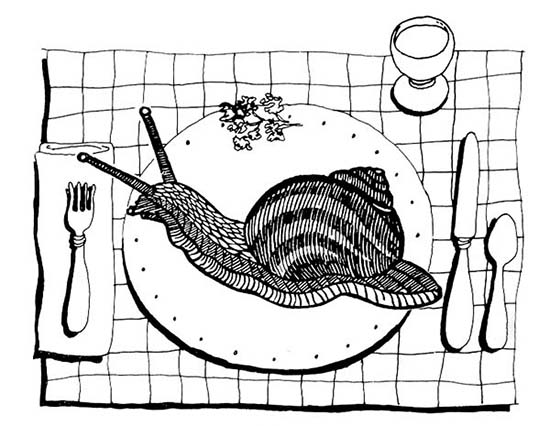
European brown snails were imported into California in the 1850s for use as food. But the tasty mollusks didn’t catch on, and many of them quietly “slipped out back.” They went wild and started eating farm and garden crops rather than being eaten.
Today, eating snails is becoming increasingly popular in the United States. There are several California escargot canneries and even a Snail Club of America (with its own newsletter). Unfortunately, interest in marketing live snails means that more escapees may invade gardens in other warm parts of the country (they don’t tolerate regular, heavy frosts).
To keep that from happening, many states now require inspection of California plants to make sure they are snail-free; some states require permits to ship live snails; and two states — Florida and Louisiana — prohibit live shipments. But it’s difficult to stop ignorant or defiant would-be snail farmers from ordering “starter kits.” Recently, there have been localized infestations in some southeastern states. Even though they have apparently been contained, just one overlooked snail could eventually lead to a regional snail infestation. So remember, as far as gardeners are concerned, the only good edible snail is a dead one!
Recent Agricultural Research
Agricultural scientists are always coming up with something new. Recent (but not yet available to the public) discoveries include a drought-tolerant lima bean that produced a respectable crop of pods full of tasty green seeds on only one inch of rainfall in three months; nitrogen-fixing tomatoes (the active bacteria were hiding inside the plant’s roots); and a nematode that can inject lethal bacteria into those destructive Japanese beetle grubs in your lawn and garden soil. And, oh yes, researchers are also developing a boon for spray-happy farmers: a tomato that doesn’t mind being dosed with the potent, widely used herbicide Roundup.
Research Briefs
Dried nematodes. USDA scientists have beneficial nematodes on the brain. With the help of the California biotechnology company, Biosys, they are drying lab-reared nematodes to make them easier to ship. The resulting paste of very flat worms is refrigerated and shipped, and the nematodes are then revived with water.
Sprouting onion sets. Trials in England have shown that onion sets sprout fastest at 60 degrees Fahrenheit and slowest at temperatures just above freezing. So to prevent premature sprouting of your spring onions, store sets in the refrigerator (but not the freezer).
(Gasp!) It’s tulipfinger! Compounds found naturally in several bulb species give some people allergic skin reactions (called tulipenvinger in Holland). If planting bulbs begins to give your hands rashes or blisters, protect yourself by wearing rubber gloves.
Goodbye, dogwoods? Dogwood anthracnose, first seen in the New York City area in the late 1970s, has begun spreading at a rapid rate. This devastating fungal disease has not yet marched west, but it has reached as far south as Georgia. It affects both eastern (Corpus florida) and western (Corpus Nuttallii) native dogwoods. Symptoms include water sprouts, cankers at the bases of dead branches, small purple-outlined spots, larger brown blotches on leaves and flower bracts. It is quite difficult to save infected trees. Fortunately, Japanese flowering dogwoods (Corpus Koysa) show excellent resistance.
Give a nematode bad breath. Soviet experimenters have found that a 1-to-1 or 1-to-2 mix of homogenized garlic in water can kill plant-pathogenic nematodes.
Cure those black walnut blues. Most gardeners know that black walnut trees produce juglone, a compound that can damage certain neighboring crops (such as tomatoes). Several researchers have now discovered that bacteria in well-drained soil break down juglone and thus eliminate its toxic effects. So if you’re having a problem with nearby black walnuts, you might try improving your soil drainage (or adding some soil from a spot in which both walnuts and juglone-sensitive plants grow) instead of chopping down the beautiful and valuable trees.
Wash away spider mites. Frank and Gertrude Hirsch have grown show-quality roses in Florida (spider mite heaven!) for 17 years and found that regularly spraying their plants with plain water provides better mite control than using a water-insecticide mix.






