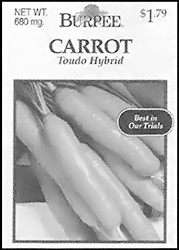
Like all technical specialties, seed growers/sellers have a
shorthand to convey the most information in the least
space. Aside from a paragraph or two describing the variety
and its growth habits, the printing on a seed packet or in a seed catalog comprises cryptic codes and terms that
may leave you in the dark. The following is a seed-packet
lingo legend:
Stock Numbers come out of the order-taker’s
computer and are crucial; get one wrong on a mail-order form
and you can end up with a packet of Heliocanthus when you
expected Head Lettuce.
Varietal Names, especially the older ones, can
vary among suppliers and their section of the country. The
low evergreen ground cover with small blue flowers called
periwinkle in one locale is Vinca Minor or “vinca” in
another, Ground-Myrtle or “myrtle” elsewhere.
With new varieties, it’s best to buy from the firm that
tells you on the packet or in catalog copy that they
developed or import the seeds. They will use the correct
name and reserve the best seed if there is a quality
choice.
Hybridplants (Hb) (F1) or (F2) are bred from
two or more different parent stocks, with traits that
improve on the best characteristics of both strains, but
they are unable to pass them on–like a mule can’t
heir its kick.
Don’t save hybrid seed and plant it; you’ll get an
atavistic throwback with the worst characteristics of some
half-wild great-grandparent. Open-pollinated (OP) seed will
grow true to type. Reserve seed Reselected variety
that does best in your soil and climate. Genetics of sweet
corn is often indicated by an (S), which means it is a
glucose-containing, eating variety rather than field corn.
(Se) is an extra-sweet hybrid; (Sh2) is a super-sweet
hybrid that must self-pollinate …which means they must be planted upwind
of and some distance from other corn varieties to develop
the sugary trait.
Maturity means days to harvest, not to fully ripe,
seed stage maturity–except for tomatoes and peppers that
you leave on the vine long enough to turn red. It indicates
time to harvest from average day of planting seed (or
transplanting indoor-started seedlings) into what the
seedsman sees to be a typical home garden. Some seed is
simply rated as early/midseason/late. But look hard at the
maturities; often “Early” varies only by a day or two from
“midseason” or “main-crop” The figures are approximations
at best, so use them for comparison only; an 82-day tomato
has already spent weeks in the indoor flat, and it may
never ripen at all if you live in a short season area and
plant it out late.
Disease & Pest Resistance shows what degree of
tolerance to common pests or diseases have been bred into
the seed. Verticillium and Fusariurn live
in most garden soil; so do nematodes of many kinds. Yellows
and nematodes are worst in southern soil. Bred-in
resistance is the best preventative.
AAS means a past All-America Selection.
VFN is commonly run together; it means a resistance to:
– Verticillium wilt of tomatoes and eggplant.
– Fusarium fungus of tomatoes and others.
– Nematodes, microscopic soil worms that bother especially tomatoes, peppers, and eggplant.
– T or TMV indicates resistance to tobacco mosaic virus that affects tomatoes and peppers.
– Y means a resistance to Yellows, a common fungus affecting members of the cabbage family.
– A indicates resistance to anthracnose in beans and cucumbers or altenaria stem fungus in tomatoes.
– BMV means resistance to bean mosaic virus.
– CMV means resistance to cucumber mosaic virus.
– MTO is seed free of lettuce mosaic virus.
ProprietaryCodes in a variety of
configurations indicate a variety’s special suitability for
new gardeners, for especially hot and dry or cool and wet
climates, or for other growing situations.