

The Seasons of the Garden column shares seasonal gardening information and tips with MOTHER EARTH NEWS readers.
Seasonal Gardening: Low-Water Lawn Care, Low-Nitrate Carrots and Protecting Crops
Summer heat and dry weather often add up to low water
supplies. You may have already done a lot to minimize
outdoor water use by mulching your flower and vegetable
beds and installing drip irrigation around your shrubs and
tree crops. But are you doing anything for your grassed
areas? Lawns are frequently the biggest water guzzlers in
home landscapes. Proper care can make a difference in how
much water you need to keep grass green and healthy. Here’re a few guidelines:
Frequent low mowing creates a dense grass canopy. Since
little air flows around such short-cropped leaves, little
water gets “wicked away” by wind. However, high-mowed grass
has more extensive roots than low-cut blades, so it
withstands drought better. Thus, a low-mowed lawn may use
less water over a season than a high-mowed one, but it
needs it more often. Lawn-care experts suggest a
compromise: Mow the grass frequently at a moderate
height.
Don’t overfertilize with nitrogen, or the leaves will grow
too quickly and use more water. Too much N also restricts
root development, further increasing watering needs. On the
other hand, adding extra potassium and iron may enhance
root growth and improve drought tolerance. In fact, adding
iron can make a low-N lawn look as green as a high-N one.
Last, if you’re starting a new lawn, check with your local
garden supply store or extension agent. Several new grass
cultivars have lower water needs than most common
varieties.
Seasonal Gardening Research Briefs
Low-nitrate carrots. Russian trials show
that carrots grown in high-nitrogen soil have high
concentrations of nitrates (which are potential
carcinogens)–unless the soil is also high in
phosphorus and potassium. So for your and your carrots’
best health, give them a balanced (fertilizer) diet.
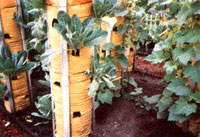
Grow up. MOTHER-reader Woodie Owen
recently saw the University of Mexico’s new idea for
helping people with little land grow crops: large
crop-growing tubes. Each six-foot-high and -round cylinder
is made from heavy plastic sheeting and filled with soil.
Then holes are cut out of the sides and transplants set in.
Seven of these wood-braced tubes fit under one hexagonal
plastic roof.
Preventing beetles . . . University of
Kentucky entomologists found that just the scent of a few
Japanese beetles feeding on a plant can attract more of the
pests. So handpick the advance guard (in the morning, when
the beetles are sluggish), shake those first comers off, or
shield your plants with a floating row cover such as
Reemay.
Dollar signs of the times. The new Boy
Scout Agribusiness merit badge replaces the Food Systems
and the Farm and Ranch Management badges. The patch’s logo?
A computer flanked by dollar signs! (A barn and gear appear
in the background.)
Birds away! Japanese farmers reportedly
use large balloons painted with several black-and-red bulls
eyes to protect millions of acres of
rice. North American trials show that six “Scare-Eye”-
balloons per acre help protect cherries, blueberries,
strawberries and corn from flocking birds like starlings,
grackles, crows and pigeons. Scare-Eyes are available from
Hartmann’s Plantation, Inc., Grand Junction, MI.
EDITOR’S NOTE: Greg and Pat Williams raise most of their own food on a small farm and publish HortIdeas, a fine newsletter on gardening research and products (available for $10 a year from G. & P. Williams, Gravel Switch, KY).






