The Seasons of the Garden column shares seasonal gardening information and tips with MOTHER EARTH NEWS readers.
Boost Your Foliar Feeds
Many gardeners spray the leaves of their crops with foliar fertilizers as a way of supplying the plants with micronutrients such as zinc and boron. There is also a more controversial practice that uses the leaf sprays to provide macronutrients such as nitrogen and phosphorus. Results of this type of foliar feeding have varied considerably. In fact, in some tests macronutrient-sprayed crops have produced worse yields than unsprayed ones. To improve such fertilizers’ effectiveness, growers sometimes add surfactants (which keep the liquid from beading up on the leaves) or humectants (which lengthen drying times).
Researchers at Texas A and M University recently tested more than 40 such aids, or adjuvants, to determine whether any of them actually enhanced the uptake of foliarapplied nitrogen and phosphorus by soybeans. The results? Glycerol, an inexpensive alcohol available at drugstores, was the only adjuvant that had a significant positive effect. When just 0.05% glycerol was added to the foliar solution, sprayed leaves contained 8.9% more nitrogen and 34.2% more phosphorus.
Furthermore, while some of the adjuvants that were tested damaged leaves, though concentrations were less than 1%, glycerol caused negligible harm even at 10% concentrations. More research is needed to confirm the Texas findings, but it certainly looks as if gylcerol is the adjuvant of choice for those who want to try macronutrient sprays on their plants.
Seasonal Gardening Research Briefs
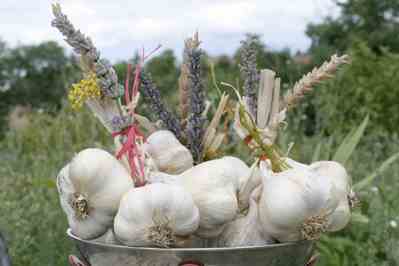
Garlic oil works. Garlic makes a good insecticide as well as a repellent. A senior-citizen horticulture class in Reedley, California, experimented with a garlic oil spray concocted as follows: Lots of finely minced garlic was soaked in mineral oil for at least 24 hours. About two teaspoons of the oil were added to a pint of water in which 1/4 ounce of Palmolive soap had been dissolved. This was thoroughly stirred, then strained into a glass container for storage. When used as a spray, one or two tablespoons of oil mix was blended into a pint of water.
The results reported by the Reedley class were astonishing! Cabbage moths, cabbage loopers, earwigs, leafhoppers, mosquitoes (including larvae), whiteflies and sonic aphids were killed on contact. Houseflies. June bugs and squash bugs died within a minute after being sprayed. Cockroaches, lygus bugs, slugs and hornworms were killed more slowly. Ladybugs, Colorado potato beetles, grasshoppers, grape leaf skeletonizers, red ants and sow bugs were not affected.
Down with cabbage maggots. Experiments in England over the past decade have shown that protective disks placed around brassica transplants provide excellent protection from cabbage maggots. The five-inch diameter disks–made from carpet-underlay foam rubber with a small hole in the middle of each one and a slit along the radius–prevent adult flies from laying eggs next to plant stems and encourage maggot-eating ground beetles.
Boost asparagus yields. Extensive New Zealand trials suggest that letting weeds compete with newly transplanted asparagus for more than six weeks will greatly reduce future yields. The tests also show that asparagus beds picked every day yield more spears than those picked less often.
Fewer tillers, more corn. It looks as if too many corn tillers–those extra stems that sometimes shoot up at the bottom of plants–may reduce yields. Experimenters at Alabama’s Tuskegee Institute found that more than two tillers per Seneca Chief sweet corn plant increased leaf production at the expense of ear production. This relationship probably won’t always hold for other varieties and growing conditions, but it wouldn’t hurt to pull off extra tillers in your corn patch–we’ve never seen any evidence that detillering hurts yields.
Traveling weed seeds. Researchers in Saskatchewan, Canada, set up seed traps it) a fallow field next to a weedy pasture and found that most weed seeds were dispersed only short distances from their parent plants–very few seeds traveled 20 feet or more. (Many weed seeds travel no farther than the height of their parents!) So maintaining a weed-free zone just a few feet wide around your garden should protect it from “migrating” weed seeds. Of course, it won’t do a thing for the seeds that are already there!
Flea beetles prefer white. Canadian entomologists report that flea beetles are most attracted to white sticky traps. (They like yellow traps almost as well, but don’t care much for red or green ones.)
EDITOR’S NOTE: Greg and Pat Williams raise most of their own food on a small farm and publish HortIdeas, a fine newsletter on gardening research and products (available for $10 a year from G. & P. Williams, Gravel Switch, KY).